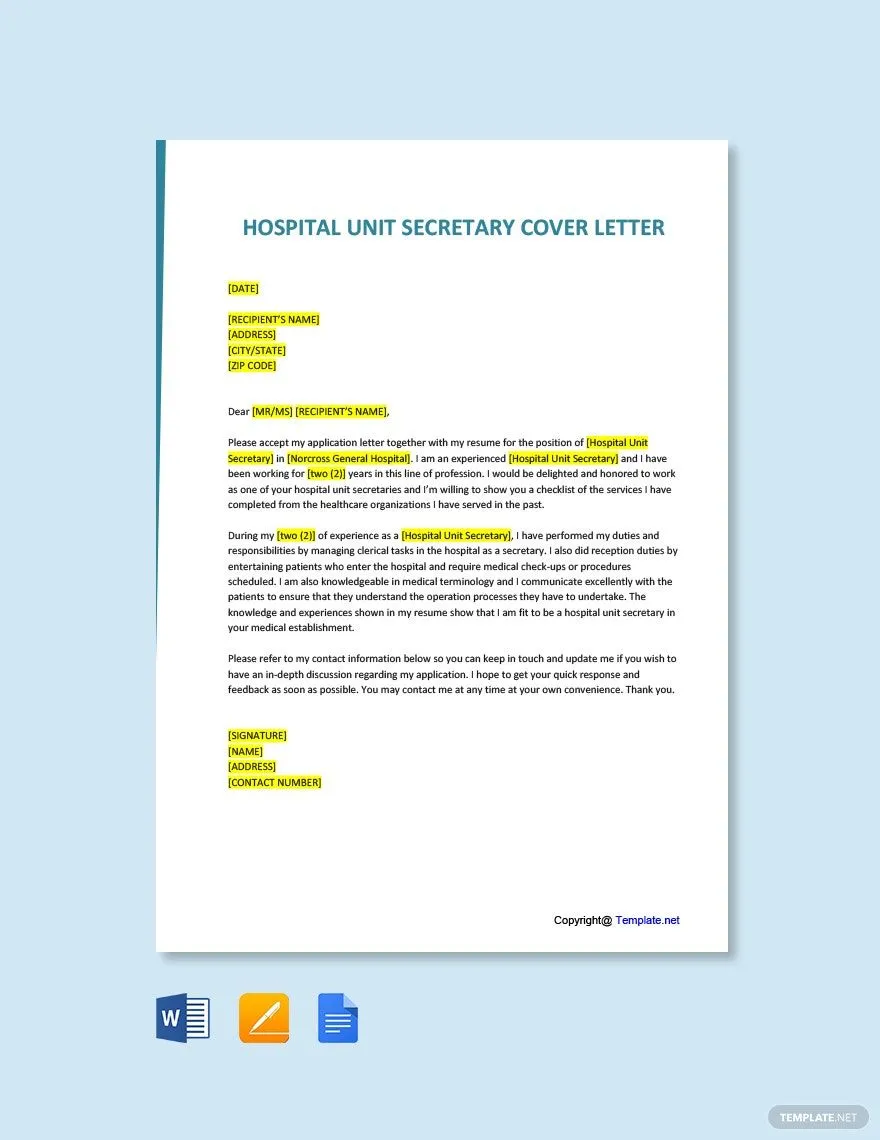
Understanding the Unit Clerk Role
A unit clerk, also known as a ward clerk or medical secretary, plays a vital administrative role within a healthcare setting, typically a hospital or clinic. They are the central hub for information, managing communications, and ensuring the smooth operational flow of a nursing unit or department. Their responsibilities are diverse and include answering phones, managing patient charts, scheduling appointments, ordering supplies, and interacting with patients, doctors, nurses, and other healthcare professionals. The unit clerk’s efficiency and organizational skills are crucial for supporting the medical team and contributing to positive patient care. A strong understanding of medical terminology, confidentiality protocols, and healthcare procedures is essential for this position, making a well-crafted cover letter a pivotal first step in securing a unit clerk position.
Key Skills for a Unit Clerk
The unit clerk role demands a specific set of skills to ensure success in the position. These skills are the foundation of your cover letter and should be highlighted to demonstrate your suitability. Excellent communication skills are paramount, encompassing both verbal and written communication. You should be adept at conveying information clearly and concisely, and capable of interacting with people from diverse backgrounds. Strong organizational skills are another critical requirement. Unit clerks juggle multiple tasks and must be able to prioritize effectively, manage time wisely, and maintain accurate records. Proficiency in computer skills, including electronic health record (EHR) systems, is also essential in the modern healthcare environment. Furthermore, a unit clerk needs to be detail-oriented, possess strong problem-solving abilities, and maintain a professional demeanor, especially when dealing with stressful situations or sensitive patient information. Being able to demonstrate these skills in your cover letter shows you possess the key abilities needed for the job.
Essential Components of a Unit Clerk Cover Letter

The foundation of a compelling unit clerk cover letter should include specific elements. First, you must start with a professional header that contains your contact information, including your name, address, phone number, and email. Below the header, include the date and the hiring manager’s name (if you know it), and the name and address of the healthcare facility. Next, a well-crafted opening statement is crucial for grabbing the reader’s attention. This statement should immediately convey your interest in the position and highlight your most relevant skills or experiences. The body of your letter should then expand on your qualifications, providing specific examples that demonstrate your ability to perform the job duties. Be sure to emphasize the skills and experiences listed in the job posting. Finally, your closing statement should reiterate your interest in the role, express your gratitude for their consideration, and include a call to action, such as an invitation to contact you for an interview. A cover letter must be tailored to each specific job application. Don’t use the same cover letter for every application; instead, customize it to match the requirements and expectations of the specific position.
Formatting Your Unit Clerk Cover Letter
The formatting of your unit clerk cover letter contributes to the first impression you make on the hiring manager, so attention to detail is critical. Your letter should be easy to read and visually appealing. Use a professional font, such as Times New Roman, Arial, or Calibri, in a font size between 10 and 12 points. Maintain consistent margins (typically one inch on all sides) and use single-spacing within paragraphs with a blank line between each paragraph. Ensure that your letter is well-structured, with clear headings and subheadings to organize your thoughts and guide the reader. Use bullet points to highlight your key skills, accomplishments, or responsibilities. Always proofread your cover letter carefully for any grammatical errors or typos. The format makes a lasting impact and can contribute to whether the applicant can showcase their skills to be hired.
Writing a Compelling Opening
The opening paragraph of your cover letter sets the tone for your application and determines whether the hiring manager will continue reading. Your opening should immediately grab the reader’s attention and clearly state your interest in the unit clerk position. Avoid generic introductions, such as “I am writing to express my interest…” Instead, open with a strong statement that highlights your most relevant skill or experience. If you have a particular achievement that aligns well with the job requirements, mention it early on. Briefly explain how you learned about the position and why you are drawn to this specific healthcare facility. Consider mentioning a specific aspect of the job or the facility that attracts you to show genuine interest. This will make the reader want to read more about what makes you the best candidate.
Highlighting Your Relevant Skills and Experience

The body of your cover letter should showcase your qualifications and demonstrate your suitability for the unit clerk position. The key is to focus on your relevant skills and experience. Review the job description carefully and identify the key requirements. Then, provide specific examples from your past experiences that illustrate how you have successfully performed these duties. Quantify your accomplishments whenever possible. For example, instead of saying “Managed patient charts,” say “Managed over 50 patient charts daily with 100% accuracy.” Emphasize your skills in communication, organization, computer proficiency, and any other skills mentioned in the job posting. If you have experience in a related role or have received any relevant training or certifications, be sure to include them in your cover letter. Always tailor the content to the job description, highlighting how your qualifications and experience align with the employer’s needs.
Demonstrating Your Knowledge of Healthcare Procedures
As a unit clerk, you will be involved in various healthcare procedures, so demonstrating your knowledge of these is essential. In your cover letter, briefly mention your familiarity with medical terminology, electronic health records (EHR) systems, and standard office procedures. Highlight any experience you have with patient scheduling, insurance verification, or billing. If you have worked with any specific medical software or equipment, mention it in your cover letter. For example, you can describe your familiarity with processing patient admissions and discharges, scheduling appointments, or managing patient data in a database system. Express your understanding of the importance of patient confidentiality and your commitment to adhering to healthcare regulations. This is essential and shows you have a solid understanding of the core requirements of the job.
Showcasing Your Soft Skills
Beyond technical skills, unit clerks must possess strong soft skills. These skills are the personal attributes that enable you to interact effectively with others. In your cover letter, highlight your communication skills, emphasizing your ability to listen actively, speak clearly, and write concisely. Showcase your organizational abilities, demonstrating your capacity to manage multiple tasks, prioritize effectively, and maintain accuracy. Demonstrate your problem-solving skills by providing examples of how you have resolved issues in past roles. Highlight your ability to work well under pressure and maintain a professional demeanor, even when faced with stressful situations. Showcasing your soft skills enhances your appeal to the hiring manager and makes you a more well-rounded and competitive candidate. Remember to showcase these soft skills throughout your entire cover letter.
Closing Your Cover Letter Effectively

The closing of your cover letter provides you with the final opportunity to leave a positive impression. Reiterate your interest in the position and express your enthusiasm for the opportunity. Thank the hiring manager for their time and consideration. Include a call to action by inviting them to contact you for an interview. This could include your phone number, email address, or any other relevant contact information. Make sure to end with a professional closing, such as “Sincerely” or “Respectfully,” followed by your full name. Always ensure that your closing is tailored to the specific job and company you are applying to. An effective closing is essential for securing the job, as it leaves a lasting, positive impression.
Proofreading and Editing Your Cover Letter
Before submitting your cover letter, carefully proofread and edit it to eliminate any errors or typos. Ensure that your letter is free of grammatical errors, spelling mistakes, and punctuation errors. Review your writing for clarity, conciseness, and accuracy. Read your cover letter aloud to catch any awkward phrasing or repetitive sentences. Have a friend or colleague review your letter, as a fresh pair of eyes can often identify errors that you may have missed. Use a grammar and spell checker, but remember that these tools are not foolproof. Take the time to ensure that your cover letter is polished, professional, and ready for submission. A well-edited and proofread cover letter demonstrates your attention to detail and professionalism.