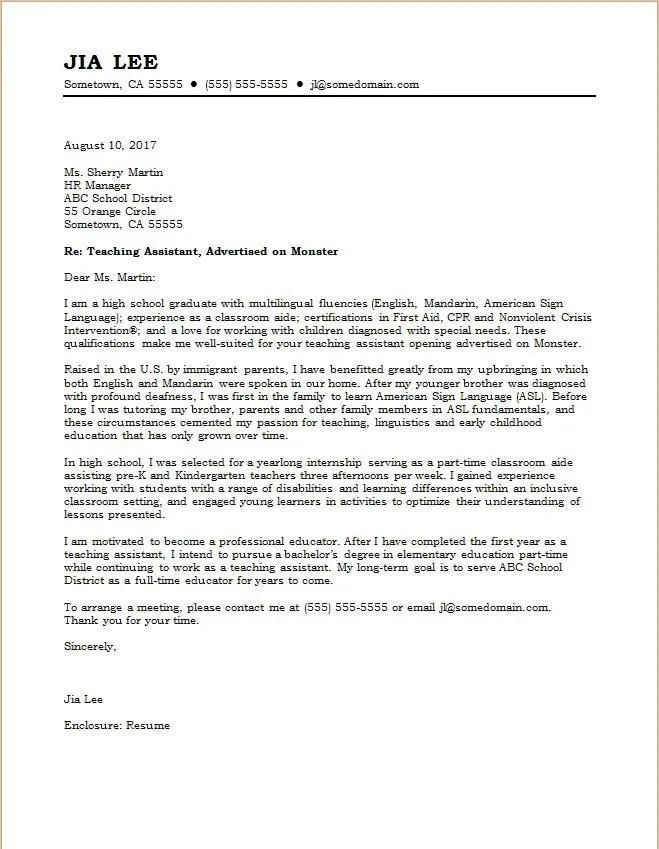
Understanding the Importance of a Teachers Assistant Cover Letter
A well-crafted teachers assistant cover letter is your initial handshake with a potential employer, serving as a crucial tool in the job application process. It provides an opportunity to go beyond the basic information presented in your resume, allowing you to showcase your personality, passion, and suitability for the role. This document is your chance to demonstrate why you are the ideal candidate, highlighting your relevant skills, experience, and enthusiasm for supporting students and teachers. A strong cover letter can significantly increase your chances of securing an interview, setting you apart from other applicants who may have similar qualifications. Failing to write a compelling cover letter is a missed opportunity to make a positive first impression and could lead to your application being overlooked. Invest the time to create a cover letter that truly reflects your dedication to education and your eagerness to contribute to a positive learning environment.
Key Elements of a Strong Cover Letter
Header Section

The header is the first thing the hiring manager sees, so it’s essential to make it professional and easy to read. It should include your full name, address, phone number, and email address. Ensure the contact information is up-to-date and readily accessible. Consider using a professional-looking font and layout to create a polished appearance. If applying via email, include your name and the position you’re applying for in the subject line. This ensures your application is easily identifiable and demonstrates attention to detail from the start. A well-formatted header shows that you are organized and attentive to detail, which are valuable qualities in a teachers assistant.
Contact Information
Clearly provide your full name, address, phone number, and professional email address. Ensure your email address is appropriate (e.g., using your name rather than a nickname). Double-check all details for accuracy to avoid any communication issues. The contact information should be placed at the top of the letter, either left-aligned or centered, to ensure it is easily found. Using a consistent font size and style throughout the header enhances readability. This information allows the hiring manager to quickly reach out to you if they are interested in your qualifications and experience. The goal is to make it simple for them to contact you.
The Salutation
Always start your cover letter with a formal salutation. If possible, address the hiring manager by name (e.g., “Dear Mr./Ms. [Last Name]”). Research the school or district to find out the name of the hiring manager. If you cannot find a specific name, a general greeting like “Dear Hiring Committee” or “Dear [School Name] Hiring Team” is acceptable, but a personalized greeting always makes a better impression. Avoid generic greetings such as “To Whom It May Concern.” The salutation sets the tone for the rest of the letter and shows that you have put in the effort to tailor your application. Proper salutations help you to make a stronger first impression.
Body Paragraph 1: Expressing Your Interest

In the first paragraph, clearly state the position you’re applying for and where you saw the job posting. Briefly express your strong interest in the teachers assistant role and the specific school or district. Show enthusiasm and mention what attracts you to the position or the school’s mission. Make it clear from the start that you are eager to contribute to their educational environment. This initial paragraph is your chance to grab the reader’s attention, so make it engaging and concise. Tailor your opening to each specific job; avoid generic statements that could apply to any position. A well-crafted opening sets a positive tone and encourages the reader to continue reading the rest of your letter.
Highlighting Relevant Skills and Experience
The body of your cover letter is where you detail your skills, experience, and qualifications. Focus on the aspects most relevant to the teachers assistant position. Provide specific examples from previous roles or experiences that demonstrate your ability to support students, assist teachers, and manage classroom activities. Emphasize your communication, organizational, and problem-solving skills. Mention any relevant certifications, such as those in first aid or CPR, if applicable. Use action verbs to describe your accomplishments and responsibilities (e.g., “Assisted,” “Managed,” “Collaborated”). Provide a concise overview of your qualifications to prove you’re a good fit for the job.
Mentioning Specific Qualifications
Carefully review the job description and align your qualifications with the required skills and experience. Highlight any specific qualifications mentioned in the job posting, such as experience with certain age groups, specific educational technologies, or experience working with students with special needs. If the job description emphasizes skills in organization, mention your ability to manage classroom materials and maintain a tidy learning environment. If the position requires knowledge of specific software or educational tools, be sure to mention your proficiency. Customize your letter to showcase how your specific qualifications match their needs. Reference any formal training or education, for instance, degrees or certifications.
Quantifying Achievements

Whenever possible, quantify your achievements to provide concrete evidence of your abilities. Instead of saying “Improved student engagement,” say “Increased student engagement by 15% through the implementation of interactive learning activities.” Use data, statistics, or specific examples to illustrate your impact in previous roles. Did you help reduce classroom disruptions? Did you assist in increasing test scores? Did you improve parent-teacher communication? Providing quantifiable results makes your accomplishments more compelling and demonstrates the value you can bring to the role. Quantifiable statements show the hiring manager what you can bring to their school.
Body Paragraph 2: Showcasing Your Passion
In this paragraph, demonstrate your genuine passion for education and your commitment to supporting students. Share your enthusiasm for helping children learn and grow, and discuss why you are drawn to the role of a teachers assistant. Express your understanding of the challenges and rewards of working in an educational setting and your willingness to go above and beyond to support the teachers and students. Show the hiring manager that this is not just a job for you, but a career and a mission. Give clear reasons why you want to work as a teachers assistant and your commitment to education.
Demonstrating Enthusiasm for Education
Share your enthusiasm by discussing your personal philosophy on education and your belief in the importance of providing a supportive and enriching learning environment. Mention any educational philosophies or approaches that resonate with you, such as a focus on student-centered learning, differentiated instruction, or creating a positive classroom culture. Express your commitment to fostering a love of learning in students and your understanding of the role a teachers assistant plays in supporting their educational journey. By showing enthusiasm, you can highlight the important qualities that make you a good fit for the role.
Aligning with the School’s Values

Research the school’s mission, values, and programs, and explicitly state how your values align with theirs. For example, if the school emphasizes community involvement, mention your experience volunteering in the community. If the school promotes a specific educational approach (e.g., project-based learning), discuss your experience or interest in that approach. Show the hiring manager that you have taken the time to understand their school’s culture and that you are a good fit for their team. Showing an understanding of the school’s values will help them see that you will be a good fit and are likely to stay.
Body Paragraph 3: Closing the Letter
In the final paragraph, summarize your key qualifications and reiterate your interest in the position. Reiterate your enthusiasm and make it clear why you are the ideal candidate. Restate your appreciation for their time and consideration. Express confidence in your abilities to contribute to the success of the school. Show the hiring manager that you would be a great fit for their school.
Expressing Gratitude and Offering Follow-up
Thank the hiring manager for considering your application. Express your appreciation for their time and let them know you are eager to hear from them. State your availability for an interview and provide your contact information again. This reiterates your interest and makes it easy for them to take the next step in the process. Offering a follow-up is a simple and effective way to show your interest. A closing that expresses your interest in the position provides one last, positive touch to finish the letter.
The Sign-off

End your cover letter with a professional sign-off. Common options include “Sincerely,” “Best regards,” or “Thank you.” Ensure the sign-off is followed by a blank line for your signature (if printing the letter) and then your typed name. Ensure the tone is appropriate for the school’s culture. A polite and professional sign-off will leave a positive lasting impression, and can set you apart. Avoid casual or informal sign-offs as it can be seen as unprofessional. Proper signing off allows the reader to end on a positive note.
Formatting Your Cover Letter
Font Selection and Readability
Choose a professional and easy-to-read font, such as Times New Roman, Arial, or Calibri. Use a font size between 10 and 12 points for the body of the letter. Ensure the font size is consistent throughout. Maintain consistent line spacing (typically 1.0 or 1.15) to enhance readability. Avoid using fancy or overly stylized fonts, as they can distract from the content. The goal is to create a clean and visually appealing document that is easy for the reader to process and review. A clear font and format will demonstrate your attention to detail.
Layout and Structure

Use a standard business letter format with left alignment. Include a one-inch margin on all sides of the page. Use single spacing within paragraphs and double spacing between paragraphs. Use clear headings and subheadings to organize your content and guide the reader. Keep paragraphs concise and focused, avoiding lengthy blocks of text. The overall layout should be balanced, with white space to make the letter visually appealing and easy to read. A well-formatted layout will show that you are organized and can present yourself professionally.
Proofreading and Editing
Carefully proofread your cover letter for any errors in grammar, spelling, punctuation, and formatting. Use a grammar checker and spell checker, but also manually review the document for accuracy. Pay attention to the tone of your letter, ensuring it is professional and appropriate for the role and the school. Have a friend or family member review your cover letter to catch any mistakes you may have missed. A polished and error-free cover letter demonstrates your attention to detail and commitment to excellence. The most important task is to make sure the cover letter is accurate.
Common Mistakes to Avoid
Overusing Clichés
Avoid using generic phrases and clichés that make your cover letter sound unoriginal. Phrases such as “team player,” “hard worker,” and “detail-oriented” are overused and don’t provide specific information about your skills and experience. Instead, provide specific examples and demonstrate your skills. Use strong action verbs and avoid jargon. Focus on providing unique insights that showcase your skills and personality. Make sure the letter presents original thoughts that showcase your experience and skills. Be authentic.
Ignoring the Job Description
Carefully read the job description and tailor your cover letter to match the specific requirements. Highlight the skills and experiences that the employer is seeking. Failure to address the requirements in the job description will make your application appear generic and less likely to be considered. Use keywords from the job description and demonstrate how your qualifications align with their needs. Show the hiring manager that you have taken the time to understand the role and are a good fit for the position. Customize your letter.
Providing Irrelevant Information
Focus on the information that is relevant to the teachers assistant position. Avoid including irrelevant details or experiences that do not demonstrate your qualifications for the role. Keep the focus on the skills, experiences, and achievements that align with the job requirements. Be concise and focused. Providing only relevant information demonstrates your understanding of the position and your ability to communicate effectively. Including only relevant skills and information will make sure the hiring manager will read through your letter.
Tailoring Your Cover Letter to Each Application
Avoid using a generic cover letter for every job application. Tailor your cover letter to each position, highlighting the skills, experiences, and qualifications that are most relevant to that specific role. Research the school or district and customize your letter to align with their mission, values, and programs. Take the time to personalize your letter. This will make your application stand out and demonstrate your genuine interest in the position. Tailoring the letter will give you a better chance of being noticed.