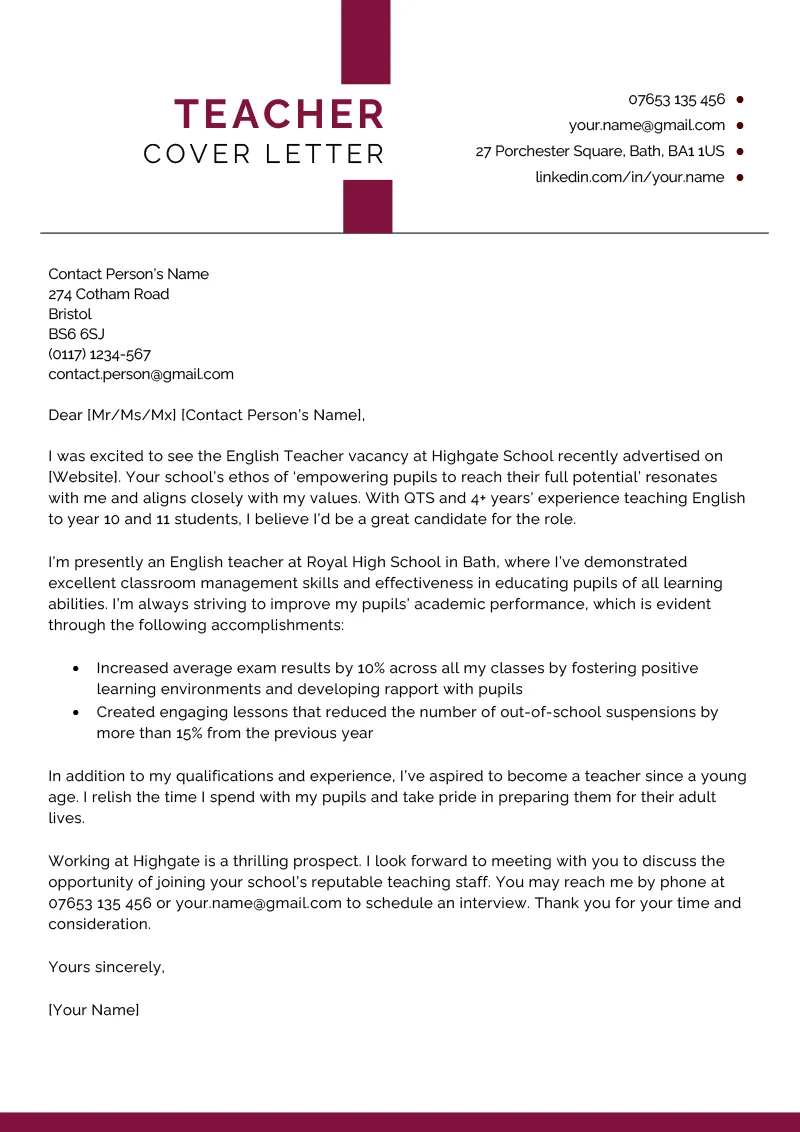
What is a Teacher Cover Letter
A teacher cover letter is a crucial document that accompanies your resume when applying for a teaching position. It serves as a personal introduction, allowing you to showcase your skills, experience, and passion for education in a more detailed and personalized manner than your resume alone. Think of it as your first impression, a chance to make a strong statement about why you’re the ideal candidate and to highlight the unique value you bring to the school community. A well-crafted cover letter can significantly increase your chances of securing an interview.
Why is a Teacher Cover Letter Important
In the competitive field of education, a cover letter offers a critical opportunity to distinguish yourself from other applicants. It allows you to connect with the hiring manager on a personal level, demonstrating your personality, enthusiasm, and commitment to the role. It provides a platform to elaborate on your qualifications, explain how your skills align with the specific requirements of the position and the school’s mission, and illustrate your understanding of the school’s values and needs. A compelling cover letter can be the deciding factor in getting your application noticed and landing you an interview, which is a critical step towards securing a teaching position.
Key Components of a Teacher Cover Letter

A well-structured teacher cover letter includes several key components that work together to present you in the best possible light. These components work in concert to tell your story. The goal is to make you stand out from the crowd. Each section should be carefully crafted to convey your qualifications and enthusiasm. From the heading to the closing, every element plays a role in creating a compelling application that will capture the attention of the hiring manager. This section will outline the key components, ensuring your cover letter is complete and effective.
Heading Section
Your Contact Information
Start with your full name, address, phone number, and professional email address at the top of the letter. Ensure that your contact information is accurate and up-to-date. Use a professional-sounding email address; avoid nicknames or informal addresses. This information is essential for the hiring manager to contact you quickly and easily.
Date

Include the current date below your contact information. This helps the recipient know when the letter was written.
Hiring Manager’s Information
If possible, address the letter to a specific person, such as the hiring manager or principal. Find their name and title by researching the school’s website or by calling the school. Use the correct title and be sure to spell the name correctly. If you cannot find a specific name, use a general greeting, such as ‘Dear Hiring Committee’.
Greeting Section
Start your letter with a professional greeting. Use ‘Dear Mr./Ms./Dr. [Last Name]’ if you know the hiring manager’s name. If you don’t know the name, opt for a general greeting like ‘Dear Hiring Committee’ or ‘Dear [School Name] Hiring Manager’. Avoid casual greetings such as ‘Hi’ or ‘Hello’.
Body Section

The body of your cover letter is where you present your qualifications and enthusiasm. It typically includes three paragraphs that highlight your skills, experience, and passion for teaching. Each paragraph should focus on a specific aspect of your qualifications, making sure you connect your experiences and skills with the requirements of the position and the values of the school.
First Paragraph
Express Your Interest
Begin by stating the position you are applying for and how you learned about it. Mention the specific school or district, and express your interest in the role. Show your enthusiasm for the opportunity.
Mention the Position

State the specific teaching position you are applying for. If you are responding to a job posting, mention the job title and reference number, if applicable. This ensures that the hiring manager knows exactly which position you are interested in.
Second Paragraph
Highlight Key Skills and Experience
Focus on your relevant skills and experience. Select a few key qualifications that align with the job description. Provide a brief overview of your accomplishments and how they match the school’s needs. This is your opportunity to convince the reader that you have the skills to succeed in the role.
Use Action Verbs

Use strong action verbs to describe your experience and accomplishments. Verbs like ‘developed’, ‘implemented’, ‘managed’, ’led’, ‘created’, ’taught’, and ‘assessed’ can make your statements more impactful. This makes your qualifications more active and engaging.
Provide Specific Examples
Support your claims with specific examples and quantifiable results. Instead of saying ‘I improved student performance,’ say ‘I improved student test scores by 15% in one semester by implementing a new reading program’. Provide context for your examples, and explain what actions you took to achieve these results.
Third Paragraph
Showcase Your Passion for Teaching

Showcase your passion for teaching and your commitment to student success. Discuss your teaching philosophy, what motivates you to work with students, and how you create a positive learning environment. Express your enthusiasm for education and highlight the positive impact you have on students.
Tailor to the School’s Values
Demonstrate that you understand the school’s mission and values. Research the school’s website, mission statement, and any other available information to align your qualifications with their specific goals. This shows you’ve done your research and are a good fit for the school culture.
Closing Section
The closing section should reiterate your interest in the position and provide contact information for follow-up. It’s your last opportunity to leave a positive impression.
Call to Action

Reiterate your interest in the position and express your eagerness to discuss your qualifications further. State your availability for an interview and thank the hiring manager for their time and consideration.
Express Gratitude
Thank the hiring manager for taking the time to consider your application. Expressing your gratitude shows professionalism and courtesy, making a good impression on the reader.
Closing and Signature
Close your letter with a professional closing, such as ‘Sincerely,’ ‘Best regards,’ or ‘Thank you’. Leave space for your handwritten signature, followed by your typed name. If submitting an electronic version, you may simply type your name.
Proofreading and Formatting
Before submitting your cover letter, it’s essential to carefully proofread and format it. A well-presented and error-free letter demonstrates professionalism and attention to detail, reflecting positively on your candidacy.
Review and Edit
Carefully review your cover letter for any errors in grammar, spelling, and punctuation. Read it aloud to catch any awkward phrasing or sentence structure. It helps to have another person proofread your letter for a fresh perspective.
Formatting Tips
Use a professional and easy-to-read font, such as Times New Roman, Arial, or Calibri, in a standard size (10-12 points). Keep the letter concise, ideally no more than one page. Use clear headings and subheadings to organize your thoughts and make the letter easy to read. Ensure proper spacing between paragraphs and sections for a clean look. Make sure your letter is aligned to the left, using justified alignment.
Final Thoughts
Writing a compelling teacher cover letter is a crucial step in the job application process. By following these guidelines, you can create a cover letter that effectively highlights your skills, experience, and passion for teaching, increasing your chances of securing an interview and landing your dream job. Take your time, tailor your letter to each specific position, and always proofread before submitting. Good luck!