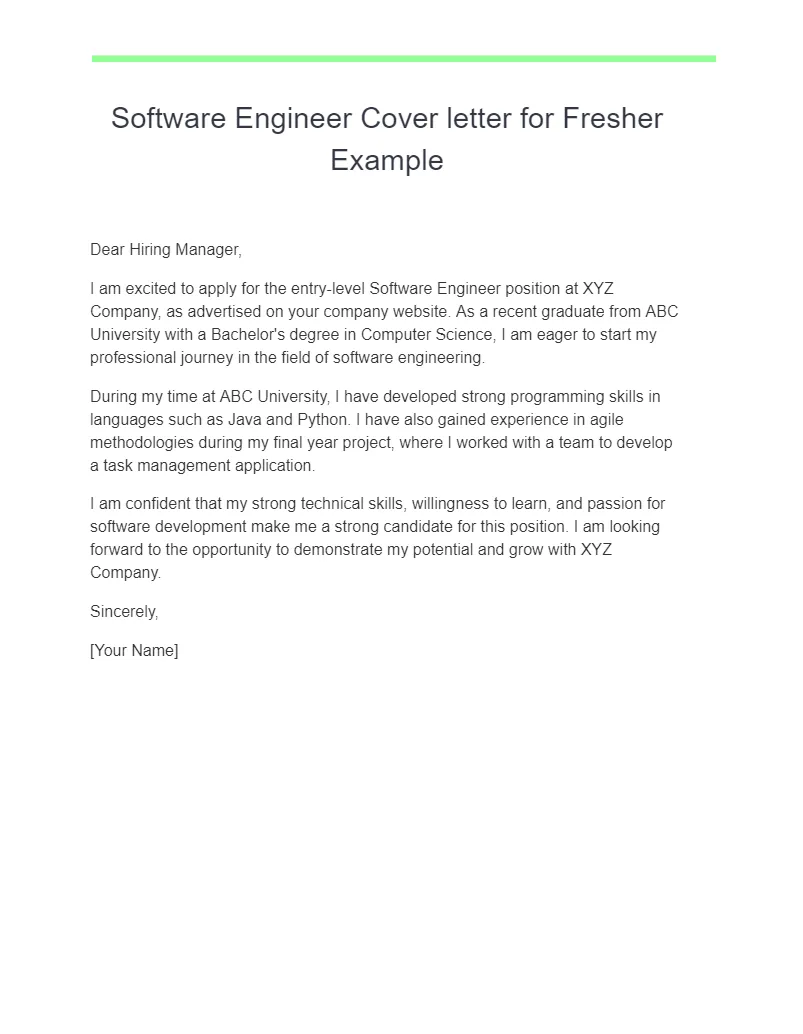
Why a Cover Letter Matters for Software Engineers
In the competitive world of software engineering, a well-crafted cover letter is your first opportunity to make a strong impression on a potential employer. It’s more than just a formality; it’s a crucial tool that allows you to showcase your personality, passion, and the unique value you bring to the table. While your resume provides a snapshot of your skills and experience, the cover letter gives you the space to elaborate on your accomplishments and explain why you’re the perfect fit for the role and the company. Think of it as your personal introduction, a chance to connect with the hiring manager on a more human level and demonstrate your genuine interest in the opportunity. A compelling cover letter can significantly increase your chances of getting noticed and securing an interview.
Understanding the Importance of a Cover Letter
A cover letter serves several vital purposes in the job application process. It highlights your key skills and experiences in the context of the specific job requirements, enabling the hiring manager to quickly assess your suitability. It allows you to personalize your application and demonstrate your understanding of the company’s needs and culture. Furthermore, a cover letter provides an opportunity to elaborate on any gaps in your resume, explain career transitions, or address specific concerns the hiring manager might have. By tailoring your cover letter to each job, you signal your genuine interest and initiative, setting you apart from generic applicants. When crafting your letter, consider the recruiter’s perspective; they are looking for someone who understands the role and the company and can articulate their value proposition effectively.
Highlighting Your Unique Value Proposition
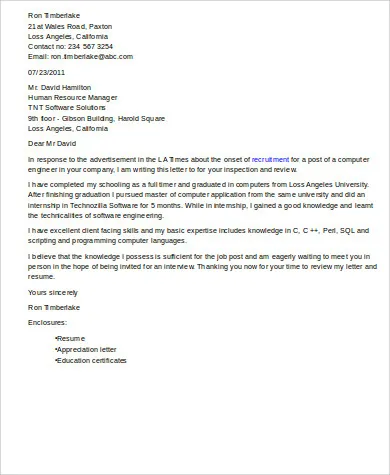
Your cover letter is where you sell yourself. It’s your chance to articulate your unique value proposition to the hiring manager. What makes you stand out from other candidates with similar qualifications? Do you have a particular expertise in a specific programming language or framework? Have you successfully led a project from start to finish? Do you have experience in a particular industry or domain? Highlight the specific skills, experiences, and accomplishments that align with the job requirements and demonstrate how you can contribute to the company’s success. Use concrete examples and quantify your achievements whenever possible. For example, instead of saying “Improved code efficiency,” say “Improved code efficiency by 20%, resulting in faster application performance and reduced server costs.” This level of detail demonstrates your impact and adds credibility to your claims.
Key Components of a Software Engineer Cover Letter
A well-structured cover letter typically includes several key components. First, start with your contact information, the date, and the hiring manager’s name and title (if available). Then, begin with a compelling opening paragraph that grabs the reader’s attention and clearly states the position you’re applying for. The body of the letter should elaborate on your relevant skills and experience, highlighting your accomplishments and demonstrating how you meet the job requirements. Use specific examples and quantify your achievements whenever possible. The letter should close with a strong call to action, expressing your enthusiasm for the opportunity and your availability for an interview. Finally, proofread your cover letter carefully to ensure it is free of errors and presents you in a professional light. Structure is important for clarity and impact.
Contact Information and the Opening
Begin your cover letter with your contact information, including your name, address, phone number, and email address. Next, include the date and the hiring manager’s name and title if available. If you don’t know the hiring manager’s name, you can use a generic greeting like “Dear Hiring Manager.” The opening paragraph should immediately state the position you’re applying for and express your interest in the role. Briefly mention where you saw the job posting and why you’re excited about the opportunity. Avoid generic openings; instead, try to personalize your greeting and make it clear why you’re a great fit for the specific company and position. A strong opening creates a positive first impression and encourages the reader to continue.
Professional Formatting and Design

The formatting and design of your cover letter are crucial for readability and professionalism. Use a clean, easy-to-read font like Arial or Times New Roman, with a font size of 11 or 12 points. Maintain consistent margins (typically 1 inch on all sides) and use single spacing between lines and a double space between paragraphs. Avoid using excessive formatting or colors that might distract the reader. Break up large blocks of text with bullet points and subheadings to improve readability. Keep your cover letter concise; aim for a maximum of one page. A well-formatted cover letter demonstrates attention to detail and reflects your professionalism and respect for the reader’s time. Always save your cover letter as a PDF to ensure that the formatting remains consistent across different devices.
Showcasing Your Technical Skills and Experience
The body of your cover letter should elaborate on your technical skills and experience, providing specific examples of how you’ve used those skills in past projects or roles. Refer to the job description and highlight the skills and experience that directly align with the requirements. Provide concrete examples of your accomplishments, quantifying your achievements whenever possible. For instance, instead of saying you “Developed a web application,” describe the specific technologies you used, the features you implemented, and the positive outcomes of your work. Were you able to improve efficiency, reduce costs, or increase user engagement? Use data to back up your claims and demonstrate your impact. This demonstrates your understanding of the role and the value you bring to the company.
Mentioning Specific Technologies and Tools
Software engineering is all about specific technologies and tools. In your cover letter, make sure to explicitly mention the technologies and tools you are proficient in. This demonstrates your technical competence and helps the hiring manager quickly assess your suitability. Highlight relevant programming languages, frameworks, libraries, and development environments. For example, if the job requires experience with Python and Django, be sure to mention your proficiency in those specific technologies. Also, include any experience with version control systems like Git, and any relevant project management software like Jira or Trello. Being specific about your technical skills showcases your expertise and lets the hiring manager know that you have the necessary tools to succeed in the role.
Quantifying Achievements and Projects

Whenever possible, quantify your achievements and the results of your projects. Instead of saying “Improved website performance,” state “Improved website loading time by 30%, resulting in a 15% increase in user engagement.” Quantifiable results are much more impactful than vague descriptions. Mention the size and scope of the projects you’ve worked on and your specific role within the team. Did you lead a team? Manage a budget? Were you responsible for a specific deliverable? Use numbers and data to demonstrate your impact and provide tangible evidence of your skills and experience. If you contributed to open-source projects, mention your contributions and the impact they had. Quantifying your accomplishments helps the hiring manager quickly understand your value and the positive contributions you can make to the company.
Emphasizing Your Problem-Solving Abilities
Software engineers are, at their core, problem solvers. Your cover letter should highlight your ability to analyze complex problems, develop effective solutions, and implement them successfully. Provide examples of how you have overcome technical challenges in the past. Explain the problem, the steps you took to solve it, and the outcome of your efforts. Did you identify a bug in a critical system? Did you optimize code to improve performance? Did you implement a new feature that increased user satisfaction? Demonstrate your analytical thinking, your ability to troubleshoot issues, and your ability to think critically and find creative solutions. This is one of the most valued skills in a software engineer. Show you can think on your feet and come up with solutions under pressure.
Demonstrating Your Passion for Software Engineering
Software engineering is more than just a job; for many, it’s a passion. Show your enthusiasm for the field and for the specific opportunity. Mention any personal projects, side projects, or contributions to open-source projects that demonstrate your commitment to continuous learning and your love for software development. Explain what excites you about the company and the role. What aspects of the company’s products or services resonate with you? Why are you interested in the specific technology stack they use? Express your genuine interest and enthusiasm for the work, and the hiring manager will be more likely to remember you. When it comes to jobs, attitude matters. And passion is the cornerstone of a good attitude.
Tailoring Your Cover Letter to the Job Description

The most successful cover letters are tailored to each job application. Avoid using a generic template. Instead, carefully review the job description and identify the key requirements, skills, and experiences the employer is looking for. Then, customize your cover letter to address those specific requirements. Highlight your relevant skills and experiences, and explain how they align with the job’s needs. Research the company and the role to demonstrate your understanding of the company’s mission, values, and goals. This shows that you’ve taken the time to understand the opportunity and are genuinely interested in the position. Tailoring your cover letter shows that you’re not just sending out a generic application; you’re genuinely interested in the specific role.
Researching the Company and the Role
Before writing your cover letter, research the company and the role. Visit the company’s website, read their “About Us” page, and explore their products or services. Research the company’s culture, values, and mission statement. Look for information about the team you might be joining and the projects you might be working on. Understanding the company and the role helps you tailor your cover letter to the specific needs of the employer. In your cover letter, mention specific aspects of the company or the role that resonate with you. This shows that you’ve done your homework and that you’re genuinely interested in the opportunity. This information also provides you with the tools necessary to highlight how your skills and experience will fit into their mission.
Addressing the Specific Requirements
The job description is your guide. Carefully review it and identify the specific requirements the employer is looking for. Then, address each requirement in your cover letter, explaining how your skills and experience align with the stated needs. Provide concrete examples of your accomplishments and quantify your achievements whenever possible. If the job requires experience with a particular technology or framework, mention your proficiency and provide examples of how you’ve used it in the past. If the job requires specific soft skills, such as communication or teamwork, provide examples of how you’ve demonstrated those skills in a professional setting. Tailoring your cover letter to the specific requirements of the job shows the hiring manager that you are the right candidate and that you have the qualifications to succeed in the role.
Using Keywords Effectively
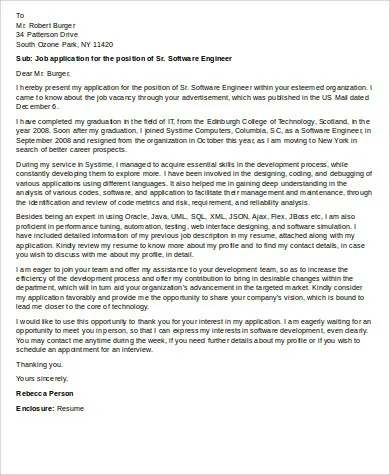
Use keywords from the job description in your cover letter. Employers often use applicant tracking systems (ATS) to screen resumes and cover letters. These systems scan for specific keywords, so it’s important to incorporate them into your application. Identify the key skills, technologies, and experiences mentioned in the job description and include them in your cover letter. Don’t just copy and paste; integrate the keywords naturally into your writing. Use synonyms or related terms to avoid keyword stuffing and make your letter more readable. While keywords are important, don’t sacrifice clarity or readability. Make sure your cover letter reads naturally and accurately reflects your skills and experience.
The Closing and Call to Action
The closing of your cover letter should reiterate your interest in the role and express your enthusiasm for the opportunity. Thank the hiring manager for their time and consideration. Clearly state your availability for an interview and provide your contact information again. End with a professional closing, such as “Sincerely” or “Best regards,” followed by your name. A strong closing leaves a positive final impression and encourages the hiring manager to contact you. Do not leave your closing paragraph vague or with any sense of uncertainty.
Expressing Your Enthusiasm
In your closing paragraph, reiterate your enthusiasm for the role and the company. Explain why you’re excited about the opportunity and what you hope to achieve. Mention something specific that you learned about the company during your research. Be genuine and show that you are truly interested in the position and the company’s mission. A clear expression of enthusiasm can make your cover letter memorable and increase your chances of getting an interview. A hiring manager wants someone who wants to be there. Show them you do!
Requesting an Interview

Make a clear and direct request for an interview in your closing paragraph. Let the hiring manager know that you are available to discuss your qualifications further and that you are eager to learn more about the opportunity. Provide your contact information again, making it easy for the hiring manager to reach you. A clear call to action ensures that you are proactive in the job application process. Be sure to thank the hiring manager for their time and consideration. This shows that you respect the hiring manager’s time and is a polite and professional gesture.
Proofreading and Editing Your Cover Letter
Before submitting your cover letter, carefully proofread and edit it to ensure it is free of errors and presents you in a professional light. Check for grammar, spelling, punctuation, and formatting errors. Read your cover letter aloud to catch any awkward phrasing or unclear sentences. Have a friend or family member review your cover letter for clarity and accuracy. A polished and error-free cover letter demonstrates your attention to detail and reflects your professionalism. It is one of the most important parts of a cover letter. No one wants to hire someone who is sloppy or doesn’t care about the details. Proofread, proofread, proofread!
Checking for Grammar and Spelling Errors
Grammar and spelling errors can undermine your credibility and make a negative impression on the hiring manager. Use a grammar checker and a spell checker to identify and correct any errors. Read your cover letter carefully to catch any mistakes the automated tools might miss. Pay attention to punctuation and ensure that your sentences are clear and concise. A well-written cover letter is a reflection of your professionalism and attention to detail. It shows the hiring manager that you take pride in your work and that you are committed to excellence. Double-check everything before submitting. It takes seconds but will make a huge difference.
Ensuring a Polished and Professional Tone
Maintain a polished and professional tone throughout your cover letter. Use clear and concise language and avoid jargon or slang. Write in a formal tone, but don’t be afraid to let your personality shine through. Be respectful and courteous, and address the hiring manager by name whenever possible. Avoid using overly casual language or overly enthusiastic expressions. Your goal is to present yourself as a confident, capable, and professional candidate. A well-written cover letter presents you in the best possible light. Your tone needs to match the company’s culture. Research the company, its employees, and the products it sells. Then, mimic the tone used in their communications.
Best Practices for Sending Your Cover Letter
Once your cover letter is complete, there are several best practices to follow when sending it. Ensure you adhere to the application instructions provided by the employer. Typically, you will submit your cover letter and resume as attachments to your application. Always save your cover letter and resume as PDF files to preserve their formatting. Before submitting, double-check the email address and ensure you’re sending the application to the correct recipient. A mistake here can cause your application to be lost and never seen. Following these best practices ensures your application is received correctly and presents you in the best possible light.
File Format and Naming Conventions
Always save your cover letter and resume as PDF files. PDF files preserve the formatting of your documents and ensure that they look the same regardless of the device or software used to open them. Use a clear and consistent naming convention for your files. A good example would be “Your Name_CoverLetter.pdf” and “Your Name_Resume.pdf”. This makes it easy for the hiring manager to identify your documents. If the job posting specifies a particular file name format, be sure to follow the instructions carefully. Double-check all these requirements before submitting.
Following Up on Your Application
After submitting your application, it’s appropriate to follow up with the hiring manager or recruiter after a reasonable amount of time. If the job posting specifies a timeframe for contact, adhere to it. Otherwise, wait a week or two before sending a polite email to inquire about the status of your application. In your follow-up email, reiterate your interest in the role and express your enthusiasm for the opportunity. Keep your email concise and professional. If you haven’t heard back after a second follow-up, you can consider that the employer has chosen to move forward with other candidates. Following up shows initiative and demonstrates your continued interest in the position. However, don’t be overly persistent. Be respectful of the hiring manager’s time.