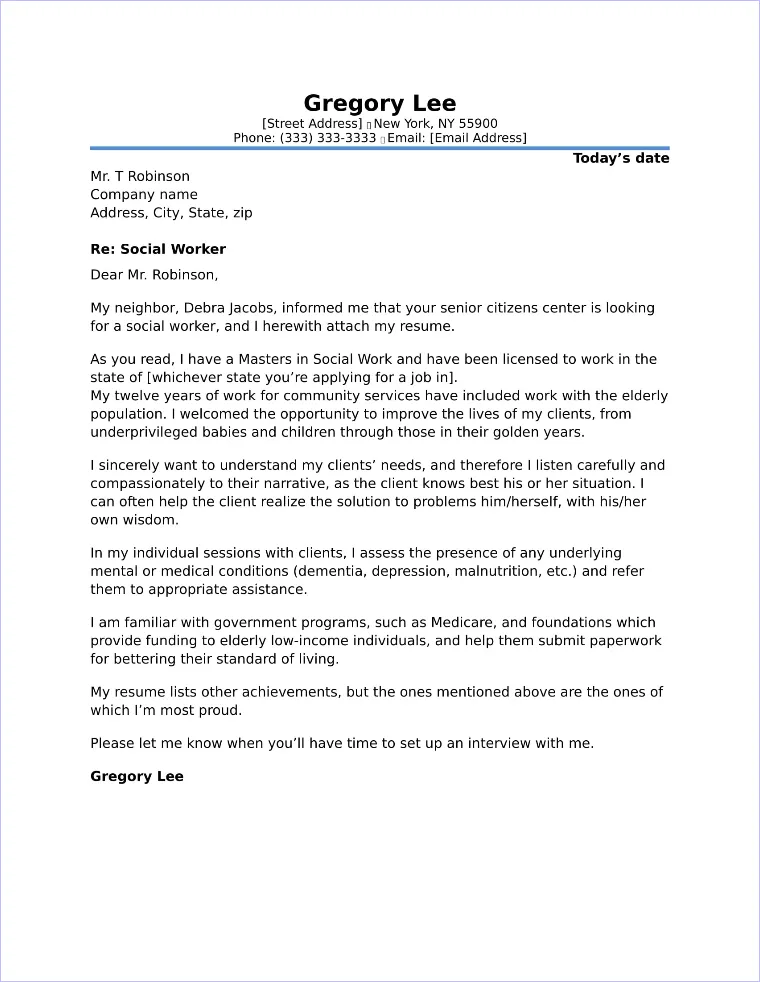
Understanding the Social Worker Cover Letter
A cover letter is an essential tool in the social work profession, serving as a direct introduction to potential employers. Unlike a resume which often provides a comprehensive list of qualifications, a cover letter offers an opportunity to highlight your unique skills, experiences, and motivations. It is your chance to provide a personalized narrative that demonstrates your passion for the field and your understanding of the specific job requirements. This guide will walk you through the critical steps to create a compelling cover letter that emphasizes your strengths, increasing your chances of securing an interview. In a profession built on compassion and effective communication, a well-crafted cover letter allows you to showcase these traits from the outset. It sets the stage for a more in-depth conversation about your qualifications and your fit within the organization. It is a tool that differentiates you from other applicants and captures the attention of the hiring manager. A successful cover letter can transform a job application into a compelling story.
Why a Cover Letter Matters
In the competitive landscape of social work, a cover letter is not merely a formality, it is a strategic tool that can significantly influence the outcome of your job application. A well-written cover letter enables you to provide context to your resume, elaborate on your skills and experiences, and demonstrate your personality and enthusiasm for social work. It is your chance to tell your story, express your motivations, and highlight why you are the ideal candidate. Without a cover letter, your application might lack that personal touch necessary to set you apart. Hiring managers often see the cover letter as a key indicator of your communication skills, your attention to detail, and your genuine interest in the role and the organization. It can often make or break your chances of getting an interview, making it an essential component of your job application. Moreover, a thoughtfully written cover letter showcases your understanding of the profession, allowing you to clearly articulate your career goals and how your skills align with the specific demands of the job.
Highlighting Relevant Skills and Experience

Your cover letter is an opportune space to accentuate those skills and experiences that make you a strong candidate. While a resume provides a chronological account of your career history, the cover letter allows you to highlight the most relevant aspects of your background in alignment with the job description. Focus on skills that directly match the requirements of the position, such as empathy, active listening, crisis intervention, case management, and advocacy. For each skill, provide specific examples of how you have demonstrated that skill in practice, whether in previous roles or volunteer experiences. You can tailor your letter to emphasize specific accomplishments that are pertinent to the target position, using data and examples to effectively show your impact. By linking your skills and experience directly to the job requirements, you demonstrate your understanding of the role and your ability to excel in it. Use strong action verbs and, whenever possible, quantify your accomplishments to make them even more compelling. This targeted approach will help you create a narrative that effectively showcases your value and distinguishes you from other applicants.
Essential Components of a Cover Letter
A well-structured cover letter should include several key components, each contributing to a comprehensive and persuasive application. These components collectively ensure clarity, professionalism, and a strong appeal to the hiring manager. Begin with a professional header that includes your contact information and the date. Following the header, include the recipient’s contact information. A well-crafted opening paragraph should immediately capture the reader’s attention and state your purpose for writing. Subsequent body paragraphs should provide detailed information about your relevant skills, experience, and accomplishments. The concluding paragraph should reiterate your interest in the position and include a call to action, such as requesting an interview. Finally, proofread the entire letter meticulously for any errors in grammar, spelling, and punctuation. The thoughtful combination of these components presents a professional and persuasive case for your candidacy, helping your cover letter stand out from the competition. Maintaining clear and consistent formatting, using a professional font and appropriate spacing, is also crucial to ensure your letter is readable and visually appealing.
Header Section
The header of your cover letter establishes the tone for professionalism and provides essential contact information. Start by including your full name, address, phone number, and email address at the top left of the page. Ensure your email address is professional and appropriate. Next, include the current date below your contact information, followed by the hiring manager’s name, title, and the organization’s address. If you are unable to find the hiring manager’s name, research the company’s website or contact the HR department to find it. Addressing the letter to a specific person makes your application more personal and shows your initiative. Always double-check the accuracy of the recipient’s information to demonstrate attention to detail and respect for the hiring process. Proper formatting is crucial to a professional appearance, ensuring the header is neatly organized and easy to read. The header section is the foundation of your cover letter, conveying your professionalism and making it simple for the employer to contact you.
Personalization and Addressing

Personalization is vital for making your cover letter stand out. Always address your cover letter to a specific person, such as the hiring manager or the director of social work. Research the company’s website or LinkedIn to find the correct name. If you cannot find a specific name, you can use a general title such as “Hiring Manager” or “Dear [Department] Team.” Avoid generic greetings like “To Whom It May Concern,” which can make your application feel impersonal. Tailor your letter to the specific job and organization. Reference the job posting and highlight the skills and experiences that directly align with the position’s requirements. Demonstrating that you have taken the time to understand the organization and the role is an excellent way to demonstrate your genuine interest. Mentioning the organization’s mission or values can also make your letter more compelling. Personalization demonstrates that you are invested in the role and have thoughtfully considered how your skills and experience can contribute to the organization’s success. This level of detail makes your application more memorable, helping you build a positive connection with the reader and making it more likely to be noticed.
Opening Paragraph Crafting
The opening paragraph is your critical opportunity to seize the hiring manager’s attention and to establish the overall tone of your cover letter. Begin with a strong, concise statement of your purpose, clearly identifying the position you are applying for and where you saw the job posting. Immediately express your enthusiasm for the role and the organization. You might briefly mention a key skill or experience that closely aligns with the job requirements. Avoid using generic opening lines. Try to include a personal touch, for example, referencing something specific that drew you to the organization or mentioning a relevant accomplishment. Be direct and focused, stating your interest clearly and concisely. The opening paragraph should function as a hook, encouraging the reader to continue reading. It should be engaging and demonstrate your understanding of the position and your genuine interest in the opportunity. Avoid clichés and concentrate on making a strong and memorable first impression.
Expressing Your Enthusiasm and Interest
Demonstrating your enthusiasm and interest is critical throughout your cover letter. Go beyond a mere statement of interest; show your passion for social work by explaining why you are drawn to the role and the organization. Mention any specific aspects of the organization’s mission, values, or programs that resonate with you. Express how your own values align with the organization’s goals. Research the organization beforehand and demonstrate your understanding of their work and their impact. Share specific examples of how you have demonstrated your commitment to social work in the past. This might include volunteer work, professional experience, or involvement in relevant organizations. When you genuinely express your enthusiasm, you create a positive connection with the hiring manager. Your passion will shine through and make a lasting impression. Show that you are not simply looking for a job but that you are genuinely excited about the opportunity to contribute to the organization’s mission.
Body Paragraphs Detailing Experience

The body paragraphs are where you can provide in-depth information about your relevant experience. Use these sections to highlight your skills, accomplishments, and qualifications. Start by discussing the experience that is most pertinent to the job description. For each role, describe your key responsibilities and highlight your achievements. Provide specific examples of how you have used your skills to achieve positive outcomes. Utilize the STAR method (Situation, Task, Action, Result) to effectively structure your examples. This method helps you present your accomplishments in a clear and concise manner. Quantify your achievements whenever possible. For example, instead of writing, “Managed a caseload,” write, “Managed a caseload of 50 clients, providing support and resources to improve their well-being.” Tailor your descriptions to match the keywords and requirements of the job posting. Clearly demonstrate how your past experiences have adequately prepared you for the role you are applying for, focusing on the skills, knowledge, and abilities most relevant to the position.
Showcasing Achievements and Impact
When detailing your experience, don’t just list your responsibilities. Emphasize your achievements and the impact you have made in your previous roles. Use action verbs to describe your accomplishments, such as “implemented,” “managed,” “developed,” and “achieved.” Instead of simply stating what you did, explain the results of your actions. For example, instead of writing, “Provided counseling services,” write, “Provided counseling services that resulted in a 20% reduction in client relapse rates.” Focus on the positive outcomes you achieved and the value you brought to your previous employers or clients. Show how you have made a difference in the lives of others. Highlight any awards, recognitions, or positive feedback you received. Be specific and provide concrete examples that demonstrate your skills and abilities. The goal is to effectively demonstrate how you have used your skills to create a positive impact in previous roles, making your application more compelling and clearly demonstrating the value you can bring to the organization.
Quantifying Accomplishments
Quantifying your accomplishments is a powerful way to distinguish your cover letter. Utilize numbers and data to demonstrate the impact of your work. This offers concrete evidence of your skills and achievements, making your claims more credible and impressive. Rather than stating, “Improved client outcomes,” state, “Improved client outcomes by 15% through the implementation of a new intervention program.” Instead of stating, “Managed a large caseload,” state, “Managed a caseload of 75 clients, providing individual and group therapy.” Whenever possible, include specific metrics, percentages, and statistics. These numbers provide the hiring manager with a clear understanding of your value and the results you are capable of achieving. Quantifying your accomplishments also highlights your attention to detail and your proficiency in tracking and measuring results. Always ensure the data you provide is accurate and verifiable. Quantifying your achievements turns your cover letter into a compelling testament to your abilities, demonstrating the value you will contribute to the organization.
Tailoring the Cover Letter to the Job

Tailoring your cover letter to each specific job is crucial for making a strong impression. Generic cover letters are easily identified and often overlooked. To tailor your letter, carefully review the job description, identifying the key requirements, skills, and qualifications the employer seeks. Subsequently, customize your letter to align your experience, skills, and accomplishments with those specific requirements. Use the same keywords and phrases from the job description to demonstrate that you understand the role and are a good fit. Focus on the skills and experiences that are most relevant to the position. Highlight specific examples that showcase your abilities. Research the organization and the specific department to which you are applying. Tailoring your cover letter demonstrates your genuine interest in the role and indicates that you’ve taken the time to understand the employer’s needs. This personalized approach significantly increases your chances of getting noticed and securing an interview. Demonstrating that you have understood the specific job and the organization clearly illustrates your initiative and your commitment to the role.
Researching the Organization
Before you submit your cover letter, make sure you thoroughly research the organization to which you are applying. This showcases your genuine interest and helps you tailor your letter to their specific needs. Visit the organization’s website to learn about their mission, values, programs, and services. Review their social media profiles and any recent news articles to gain a better understanding of their current projects and initiatives. Understanding the organization’s culture and goals helps you align your cover letter and effectively demonstrate how your skills and experiences can contribute to their success. Mentioning specific aspects of the organization’s work or mission will clearly demonstrate that you have invested time in the application process and are not simply submitting a generic application. This research enables you to personalize your letter, effectively express your enthusiasm, and create a stronger connection with the hiring manager. Utilize the gathered information to demonstrate how your skills and experiences align with the organization’s goals, thus making you a more compelling candidate. Showing that you understand the organization’s work and share their values will undoubtedly leave a positive and memorable impression.
Matching Skills to Job Requirements
Carefully align your skills with the job requirements outlined in the job description. This confirms you are addressing the employer’s specific needs and demonstrating that you are a well-qualified candidate. Highlight the skills that directly align with the requirements, such as communication, empathy, case management, crisis intervention, and advocacy. For each skill, provide specific examples of how you have demonstrated it in your previous roles. Use the same keywords and phrases from the job description to clearly demonstrate that you understand the position and are capable of meeting the employer’s needs. Describe your experiences in a manner that effectively showcases your abilities and accomplishments. If the job description emphasizes specific software, certifications, or experience working with particular populations, be sure to highlight those aspects of your background. Clearly connecting your skills with the job requirements proves your understanding of the role and your ability to excel in it. This targeted approach significantly enhances the relevance and appeal of your cover letter to the hiring manager, thus increasing your chances of securing an interview.
Closing the Cover Letter Effectively

The closing paragraph offers your final opportunity to leave a lasting impression. Reiterate your strong interest in the position and express your gratitude to the hiring manager for their time and consideration. Clearly state your intention to follow up, if appropriate, and include a call to action. Express your enthusiasm for the opportunity and your eagerness to discuss your qualifications further. In the closing, express your gratitude for their attention. Include a call to action, such as requesting an interview or expressing your availability for a phone call. Offer to provide any additional information they may require. Ensure the closing is professional and conveys your confidence and eagerness to move forward in the hiring process. The concluding section should reinforce your interest and facilitate the next step for the hiring manager. The closing should leave the reader with a positive impression, motivating them to contact you.
Expressing Gratitude and Call to Action
Always express your gratitude to the hiring manager for considering your application. Thank them for their time and attention. This demonstrates respect and professionalism, leaving a positive impression. Include a clear call to action in your closing paragraph. This is where you let the hiring manager know what the next step should be, such as scheduling an interview or contacting you for more information. Make it as easy as possible for them to take the next step. For instance, state your availability for an interview at their earliest convenience and provide your contact information once again. Ensure your call to action is both clear and concise. It should reinforce your enthusiasm for the position and make it easy for the hiring manager to move your application forward. This ensures that your closing is not only polite, but also results-oriented. Expressing gratitude and including a strong call to action increases your chances of receiving a positive response and moving forward in the hiring process.
Proofreading and Editing
Before submitting your cover letter, meticulously proofread and edit it for any errors in grammar, spelling, punctuation, and formatting. Errors can undermine your professionalism and create a negative impression. Read the letter slowly and carefully, paying close attention to detail and searching for any mistakes. Utilize a spell checker and a grammar checker, but also manually review the letter for any errors that automated tools might overlook. Make sure the language is clear, concise, and professional. Verify that your sentences are well-structured and easy to understand. Ask a friend or colleague to read your cover letter and provide feedback; their fresh perspective can often catch mistakes that you might have missed. Proofreading is a critical step in the application process, as errors can easily create a negative impression. Be certain your cover letter is polished and error-free, since this attention to detail demonstrates your care for the quality of your work and significantly increases your chance of making a strong and lasting impression.
Checking for Errors and Clarity

Beyond basic grammatical checks, ensure that your cover letter is clear, concise, and easy to read. The goal is to effectively communicate your qualifications and make a favorable impression on the hiring manager. Avoid using jargon or overly complex language. Use clear and direct language that highlights your key skills and experiences. Ensure your sentences are well-structured and easy to understand. Verify that your paragraphs flow logically, and that your ideas are presented in a coherent manner. Review the content for clarity to ensure your message is easily understood. If possible, have a friend or colleague review your letter and offer feedback, as they can identify any areas where the meaning might be unclear or where improvements can be made. Make sure that the content is relevant to and aligned with the job description. Clear, concise writing is essential for conveying your message effectively and making a positive impression. Your cover letter should stand as a clear and compelling presentation of your qualifications and your enthusiasm for the position.
Formatting and Presentation
The formatting and overall presentation of your cover letter are essential to ensuring it is both professional and easy to read. Utilize a professional font, such as Times New Roman, Arial, or Calibri, and ensure that the font size remains consistent throughout the document. Employ standard 1-inch margins on all sides. Verify the text is well-spaced, and that your paragraphs are clearly separated. Use bolding, italics, or other formatting sparingly and only to emphasize key points. Organize your letter logically, with a distinct header, introduction, body paragraphs, and closing. Make sure your letter is well-formatted and visually appealing. A clean, professional presentation indicates your attention to detail and shows respect for the hiring manager. The overall visual appearance of your letter should reflect the professionalism you bring to the job. Thoroughly proofread the entire letter to check for any formatting errors. A well-formatted cover letter is easier to read and will certainly make a strong impression, highlighting your careful attention to detail.