Understanding the Scrum Master Role
Before you even begin to write your cover letter for a Scrum Master position, it’s crucial to understand the core of the role. A Scrum Master is a servant leader who facilitates the team’s adherence to Scrum principles. They guide, coach, and mentor the team and the organization on Agile practices. Their primary goal is to remove impediments, ensuring the team can function at its highest efficiency and deliver value iteratively. They are not managers in the traditional sense, but rather facilitators who empower the team to self-organize and make decisions. A strong understanding of this role is the foundation upon which you will build your cover letter, allowing you to highlight your relevant experience and skills effectively. Demonstrate this understanding by showcasing your knowledge of Scrum values, principles, and practices. Make it clear that you are not just looking for a job, but that you are passionate about Agile methodologies and committed to helping teams succeed.
Key Responsibilities of a Scrum Master
A Scrum Master’s responsibilities are diverse and multifaceted. They include facilitating Scrum events such as Sprint Planning, Daily Scrums, Sprint Reviews, and Sprint Retrospectives. They also coach the Development Team, Product Owner, and the organization in Scrum practices. Removing impediments that hinder the team’s progress is another crucial responsibility. This involves identifying and resolving issues that prevent the team from achieving its Sprint goals. Scrum Masters also help the team to self-organize, collaborate, and communicate effectively. They protect the team from outside distractions and ensure the team follows the Scrum framework. Furthermore, they should also facilitate communication within the team and with stakeholders. Highlighting your experience in these areas in your cover letter will significantly strengthen your application. Providing specific examples of how you’ve handled these responsibilities will demonstrate your capabilities and make you a more attractive candidate. For example, you might mention how you have successfully facilitated a Sprint Retrospective or removed a critical impediment that allowed a team to complete a Sprint.
Highlighting Relevant Skills

Scrum Masters need a diverse set of skills to be effective. These skills are not just technical; they are also strongly centered on people. Highlight your skills in your cover letter, matching them to the job description. These skills include facilitation, coaching, conflict resolution, and problem-solving. Strong communication skills, both written and verbal, are also crucial for interacting with the team, stakeholders, and other Scrum Masters. You should also possess a solid understanding of Agile principles and Scrum framework. Emphasize your ability to foster a collaborative and positive team environment. Showcase your adaptability and your capacity to work under pressure. Provide examples of how you have used these skills in previous roles. Consider using keywords from the job description to showcase your alignment. For instance, if the job description emphasizes the need for a strong facilitator, be sure to mention your experience in leading meetings and resolving conflicts.
Communication and Leadership
Communication and leadership are two of the most important skills for a Scrum Master. You must be able to communicate effectively with team members, stakeholders, and management. Leadership skills are essential for guiding the team and ensuring that it adheres to Scrum principles. In your cover letter, provide examples of how you have successfully communicated complex information clearly and concisely. This could involve summarizing project updates, facilitating discussions, or presenting findings to stakeholders. Demonstrate your leadership abilities by describing instances where you have motivated a team, resolved conflicts, or driven process improvements. Highlight your ability to listen actively, provide feedback, and build consensus. These examples will illustrate your capability to take initiative and lead by example, crucial qualities for a Scrum Master. Remember to highlight your experience in both verbal and written communication, emphasizing your ability to tailor your message to your audience.
Agile Methodologies Expertise
A deep understanding of Agile methodologies is fundamental for a Scrum Master. Your cover letter should clearly demonstrate your expertise in Agile principles, values, and practices, specifically emphasizing Scrum. Mention your experience with Agile tools and techniques, such as Sprint Planning, Daily Scrums, Sprint Reviews, Sprint Retrospectives, and backlog management. You could also talk about your experience with other Agile frameworks like Kanban or XP, if applicable, but ensure that your primary focus is on Scrum. If you have certifications such as Certified Scrum Master (CSM) or Professional Scrum Master (PSM), be sure to include these as well. Furthermore, show your understanding of Agile values, which emphasize collaboration, adaptation, and responding to change. It is helpful to showcase your knowledge in your experience with different Agile methodologies, for instance, when and how you have implemented them.
Crafting a Compelling Cover Letter

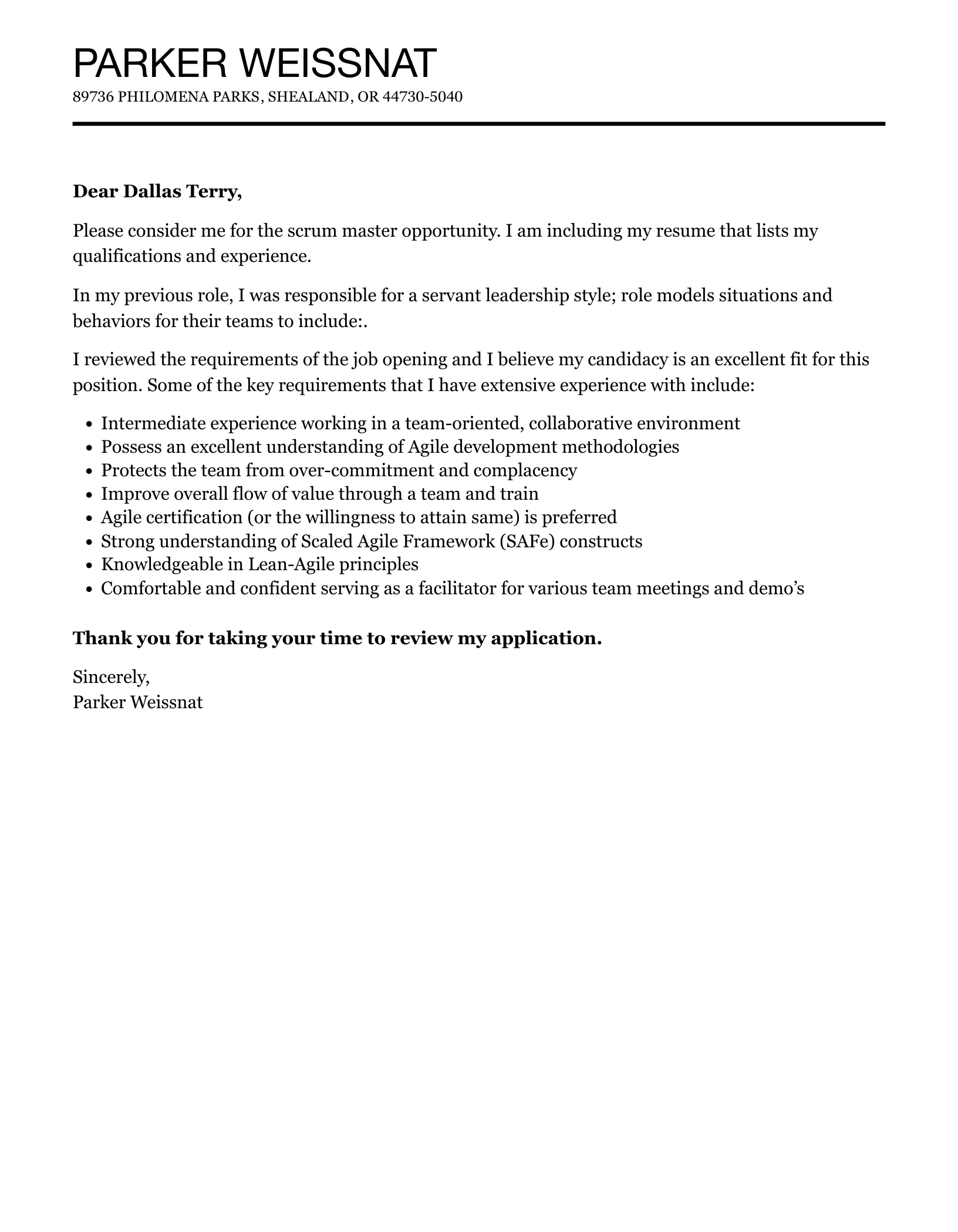
Your cover letter is your chance to make a strong first impression. It should be well-written, concise, and tailored to the specific job and company. Start with a clear and engaging opening, briefly stating the position you’re applying for and how you learned about it. The body of your letter should highlight your most relevant skills and experiences, providing specific examples to back up your claims. Don’t just list your responsibilities; illustrate how you made a positive impact in your previous roles. Show enthusiasm for the Scrum Master role and a genuine interest in the company. Use action verbs and quantify your achievements whenever possible. For instance, instead of saying “I managed a team,” you might write, “I led a team of 8 developers, resulting in a 20% increase in project completion rates.” Make sure to personalize your letter by researching the company and addressing it to the hiring manager if possible. A compelling cover letter shows that you understand the company’s needs and how you can meet them.
Formatting Your Cover Letter
Formatting is a critical aspect of your cover letter. Choose a professional and easy-to-read font, such as Arial, Calibri, or Times New Roman, and use a font size between 10 and 12 points. Ensure your letter has clear headings and subheadings to make it easy for the reader to navigate. Use bullet points to highlight your key accomplishments and skills, making the information scannable. Maintain consistent margins and spacing throughout the document. Your cover letter should be no more than one page long, so be concise and focus on the most relevant information. Use a business letter format with your contact information at the top, followed by the date, the hiring manager’s name and title (if you know it), and the company’s address. End with a professional closing, such as “Sincerely” or “Best regards,” and your full name.
Tailoring Your Letter
Generic cover letters are easily spotted and often disregarded. To make your cover letter stand out, tailor it to each specific job application. Carefully review the job description and identify the key skills and experiences the employer is seeking. Then, use your cover letter to highlight the aspects of your background that directly align with those requirements. Customize your letter by mentioning the company’s name, its values, and any specific projects or initiatives that resonate with you. Research the company’s website, social media profiles, and industry news to gain a better understanding of its culture and goals. Demonstrate that you’ve done your homework and that you’re genuinely interested in the position and the organization. Highlighting specific projects or accomplishments that match the job description will show the hiring manager that you are a good fit for the role.
Showcasing Achievements

Instead of simply listing your job responsibilities, use your cover letter to showcase your achievements. Provide specific examples of how you have made a positive impact in previous roles. Quantify your accomplishments whenever possible. Instead of saying “Improved team performance,” you might write, “Improved team velocity by 15% in six months by implementing daily stand-up meetings and improved sprint planning.” Highlight any successful projects you have managed, obstacles you have overcome, or process improvements you have implemented. Use the STAR method (Situation, Task, Action, Result) to structure your examples. Briefly describe the situation, explain the task you were assigned, detail the actions you took, and clearly state the results of your efforts. This method helps provide a clear and concise account of your achievements, making your cover letter more compelling and memorable. It’s more important to show than to tell, so focus on providing evidence of your abilities.
Quantifying Your Impact
Quantifying your impact is a powerful way to demonstrate your value as a Scrum Master. Use numbers, percentages, and specific metrics to illustrate your achievements. For example, instead of saying “Reduced project delays,” you might write, “Reduced project delays by 25% by implementing improved risk management strategies.” Providing quantifiable results makes your accomplishments more tangible and convincing. Think about the key performance indicators (KPIs) that are important to a Scrum team, such as sprint velocity, cycle time, and defect rates. Describe how you have influenced these metrics in your previous roles. For example, mention that you improved the team’s velocity or decreased the number of bugs in each sprint. Quantifying your impact shows that you understand how to measure success and that you are dedicated to improving team performance. This approach makes it easy for the hiring manager to understand the value that you bring to the table.
Common Mistakes to Avoid
Several common mistakes can undermine your cover letter. Avoid generic templates and tailor your letter to each job. Don’t simply rehash your resume; provide new, relevant information. Be careful with spelling and grammar; errors can create a negative impression. Refrain from negative language or criticizing past employers. Avoid using jargon or overly technical terms that the hiring manager might not understand. Don’t exceed one page in length. Avoid vague statements and instead provide specific examples of your achievements. Ensure your letter is well-organized and easy to read. Failing to research the company and address the letter to a specific person is another common mistake. By avoiding these pitfalls, you can ensure your cover letter makes a positive impression and increases your chances of landing an interview. Proofreading and editing your letter is an essential part of the process to avoid these mistakes and present a professional image.
Proofreading and Editing

Proofreading and editing your cover letter is a crucial step in the application process. Even the most skilled candidates can make errors, so it’s important to review your letter carefully. Check for spelling mistakes, grammatical errors, and punctuation issues. Ensure your sentences are clear, concise, and easy to understand. Read your letter aloud to catch any awkward phrasing or typos. Ask a friend, colleague, or career counselor to review your cover letter as well. Fresh eyes can often spot errors you might have missed. Make sure your formatting is consistent throughout the document. Pay close attention to the tone of your letter. It should be professional, enthusiastic, and tailored to the specific job and company. Proofreading and editing your cover letter demonstrates your attention to detail and commitment to presenting yourself in the best possible light. It shows the hiring manager that you are meticulous and professional, qualities highly valued in a Scrum Master.
Call to Action & Closing
Your cover letter should conclude with a clear call to action. Express your interest in the position and state that you would welcome the opportunity to discuss your qualifications further in an interview. Provide your contact information, including your phone number and email address, so the hiring manager can easily reach you. Thank the hiring manager for their time and consideration. Use a professional closing, such as “Sincerely,” “Best regards,” or “Thank you,” followed by your full name. Consider adding a postscript (P.S.) to highlight a key skill or achievement that directly relates to the job requirements. This can be a way to ensure a specific point is not overlooked. Your call to action should leave the reader with a clear understanding of what you want them to do next. A well-crafted closing reinforces your enthusiasm, professionalism, and commitment to securing the Scrum Master position.