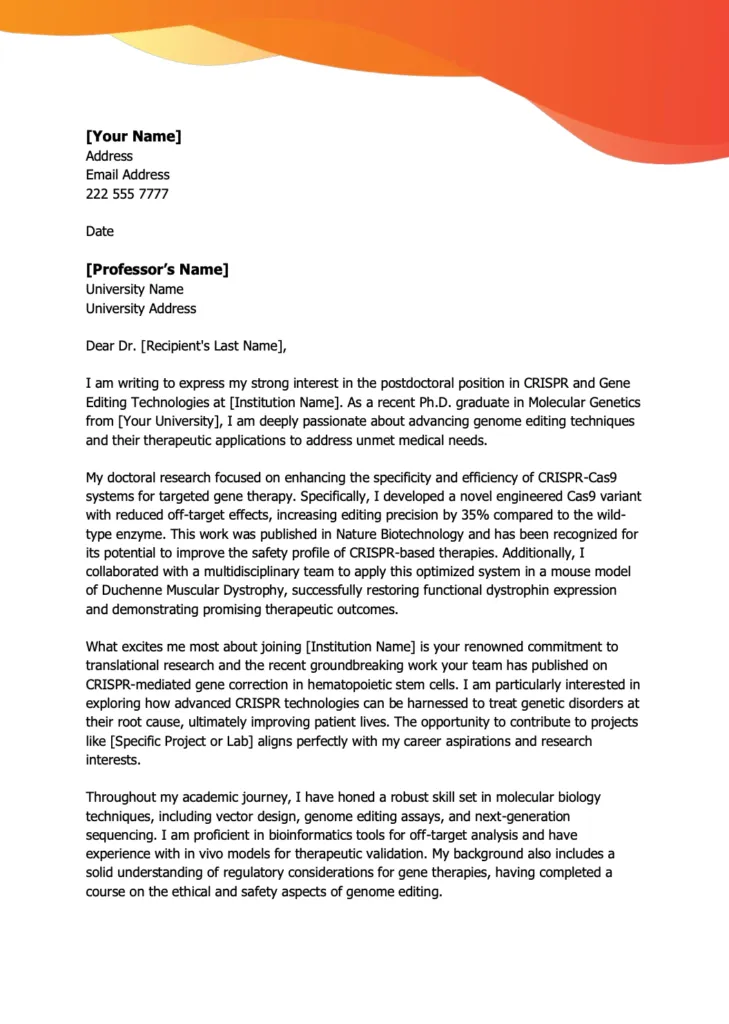
Understanding the Postdoc Cover Letter
A postdoc cover letter is a crucial document in the academic job application process. It serves as your introduction to the hiring committee, providing an opportunity to showcase your qualifications and express your interest in a specific position. Unlike a resume or curriculum vitae (CV), a cover letter allows you to provide context, explain your motivations, and demonstrate how your skills and experience align with the specific research group and the goals of the position. Crafting a compelling cover letter is essential for making a positive first impression and increasing your chances of securing an interview.
Purpose of a Postdoc Cover Letter
The primary purpose of a postdoc cover letter is to persuade the hiring committee that you are the ideal candidate for the position. It allows you to highlight your research experience, skills, and achievements in a way that complements your CV. It also gives you the chance to explain why you are interested in this particular position, what you hope to achieve, and how your research interests align with the group’s objectives. Moreover, the cover letter demonstrates your communication skills, attention to detail, and your understanding of the research field. It should be tailored to the specific position and research group, showcasing your unique value proposition.
Key Components of a Postdoc Cover Letter

A well-structured postdoc cover letter typically includes several key components, each serving a specific purpose in presenting your qualifications. Start with your contact information and a professional salutation. Then, clearly state the position you are applying for and where you found the job posting. The body of the letter should then focus on your research experience and skills, highlighting relevant publications and achievements. It’s vital to demonstrate how your research interests align with the group’s goals, express your own research goals, and showcase your suitability for the position. Finally, conclude with a strong closing statement and your signature.
Contact Information and Salutation
Begin your cover letter with your full name, address, phone number, and email address at the top. Following this, address the hiring committee or the specific person mentioned in the job posting. If no name is provided, research the principal investigator (PI) or the head of the research group, and address the letter to them. Use a professional salutation, such as “Dear Dr. [Last Name]” or “Dear Professor [Last Name].” Avoid generic greetings like “To Whom It May Concern,” as they suggest a lack of effort and personalization. This initial step sets the tone for the rest of your letter and demonstrates your attention to detail and professionalism.
Research Experience and Skills
In this section, provide a concise overview of your research experience. Focus on the skills and techniques you’ve mastered, the projects you’ve undertaken, and the methodologies you’re familiar with. Highlight experiences that align with the requirements of the postdoc position. Use action verbs to describe your accomplishments, such as “conducted,” “analyzed,” “developed,” and “managed.” Quantify your achievements whenever possible (e.g., “analyzed data from over 100 participants”). Tailor this section to the specific requirements outlined in the job posting, and avoid simply repeating information from your CV. The goal is to illustrate how your skills and experience make you a strong fit for the position.
Highlighting Relevant Publications and Achievements

Publications and achievements are key indicators of your research capabilities. In your cover letter, mention your most significant publications, emphasizing their relevance to the postdoc position. Include the title, journal, and a brief summary of your contribution. If you have any preprints or manuscripts submitted for publication, mention those as well. Highlight any awards, grants, or fellowships you’ve received, as these demonstrate recognition of your work. Quantify your achievements where possible (e.g., “published three first-author papers in high-impact journals”). Always ensure that the publications mentioned are relevant to the research area and the specific position.
Aligning with the Research Group’s Goals
Demonstrate that you’ve researched the research group and understand its objectives. Explain how your research interests and skills align with their current projects. Discuss specific publications or projects from the group that resonate with your interests and experience. Show a genuine understanding of the group’s work and how your contribution can add value. This demonstrates that you are not only interested in the position but also willing to contribute to the team’s success. The more specific you are, the better. Mention any shared methodologies, research areas, or goals to show you’ve done your homework.
Expressing Your Research Interests and Goals
Clearly articulate your research interests and how they align with the postdoc position and the research group’s focus. Outline your research goals during the postdoc and explain what you hope to achieve. Discuss specific projects you’re interested in contributing to or proposing. Show that you have a vision for your research and career development, and that this position is a stepping stone toward your long-term goals. Mention any new skills or knowledge you hope to gain during the postdoc. Expressing your goals indicates your enthusiasm and motivation to contribute to the research community and advance your career.
Demonstrating Your Suitability for the Position

In your cover letter, you need to explicitly demonstrate why you are a good fit for the position. Emphasize the skills, experiences, and qualities that make you an ideal candidate. Refer directly to the job description and highlight the skills and experience that match the required criteria. If the position requires experience in a specific technique or software, ensure that you mention your proficiency. Discuss how your previous experiences have prepared you for this role and how you can contribute to the research team. This section should leave no doubt in the hiring committee’s mind that you are the right person for the job.
Formatting and Style
Maintain a professional and clear style throughout your cover letter. Use a standard font such as Times New Roman or Arial, with a font size of 11 or 12 points. Keep your letter concise, typically one page long. Use clear and concise language and avoid jargon unless it is appropriate for the field. Organize your letter logically with clear paragraphs, each focusing on a specific aspect of your qualifications and interest. Use proper grammar, spelling, and punctuation. Ensure there are no typos or grammatical errors by proofreading thoroughly before submitting. A well-formatted and easy-to-read cover letter is critical.
Proofreading and Editing
Proofreading and editing are critical steps in the cover letter writing process. Carefully review your letter for any grammatical errors, typos, or inconsistencies. It is highly recommended to ask a colleague, mentor, or career advisor to review your cover letter. Get feedback on the content, clarity, and overall presentation. Proofread multiple times, as errors can easily be missed. Ensure that your letter is polished and professional before submitting. The goal is to present a flawless document that reflects your attention to detail and commitment to excellence. Poorly proofread cover letters can significantly diminish your chances.
Essential Tips for Postdoc Cover Letters

Several tips can help you create a compelling postdoc cover letter. Start by researching the research group, tailoring your letter to the specific position, and highlighting relevant skills and experiences. Focus on your achievements and quantify them whenever possible. Demonstrate your understanding of the research field and your alignment with the group’s objectives. Proofread your letter carefully and ask for feedback from others. A well-written cover letter should clearly and concisely communicate your qualifications and motivations, making a strong impression on the hiring committee.
Tailoring Your Letter to Each Position
Do not send a generic cover letter. Instead, customize each cover letter to the specific requirements and expectations of the postdoc position. Read the job description carefully and tailor your letter to highlight the skills, experiences, and achievements that match the criteria. Research the research group and mention their specific projects or publications that align with your interests. Tailoring your letter demonstrates your interest in the specific position and your understanding of the group’s goals. Generic cover letters will likely be discarded, so make the effort to personalize each application.
Show, Don’t Tell
Rather than simply stating your skills and abilities, provide concrete examples to demonstrate them. For example, instead of saying “I am a good communicator,” describe how you successfully presented your research at a conference. If you say “I have experience in data analysis,” then mention the specific software you used and the types of data you analyzed. Providing specific instances of your accomplishments, using action verbs, and including quantifiable results makes your claims more credible and impactful. Showcasing your achievements through specific examples is far more effective than making generic statements.
Highlighting Achievements with Numbers

Whenever possible, quantify your achievements to make them more impactful. For example, instead of saying “I increased sales,” say “I increased sales by 20%.” Instead of saying “I managed a team,” say “I managed a team of five researchers.” Numbers provide concrete evidence of your accomplishments and make it easier for the hiring committee to understand the scope of your achievements. If you published papers, mention how many papers you have published and the impact factor of the journals. Providing data demonstrates your ability to achieve results and your contribution to the field.
Common Mistakes to Avoid
Several common mistakes can undermine the effectiveness of your cover letter. Avoid generic statements that apply to any position, instead, focus on being specific. Do not fail to proofread, as typos and grammatical errors make a negative impression. Avoid simply restating your CV; instead, provide context and explain your motivations. Avoid using vague language and unclear statements. Don’t write a letter that is too long or too short, ensure it is concise and to the point. By avoiding these mistakes, you can significantly increase the chances that your cover letter makes a positive impression.
Using Vague Language and Generic Statements
Avoid using vague language and generic statements that do not provide any specific information. Instead of saying “I have experience in research,” describe your specific research experience, mentioning the types of research you conducted. Avoid generic phrases that could apply to anyone, like “I am a hard worker.” Instead, provide specific examples of your work ethic and achievements. Ensure your language is clear, concise, and tailored to the specific position and your unique skills. This ensures that the hiring committee understands your qualifications and what you bring to the table.
Failing to Proofread

Failing to proofread your cover letter is a significant error. Typos, grammatical errors, and inconsistencies can create a negative impression and make it appear as though you are not detail-oriented. Proofread your cover letter carefully for any errors and ask a colleague or mentor to review it as well. Multiple proofreads are essential. Pay attention to formatting, punctuation, and grammar. A polished, error-free cover letter demonstrates your professionalism and commitment. A cover letter filled with errors indicates a lack of attention to detail, and that won’t help in making a good impression.
Finalizing and Submitting Your Cover Letter
Before submitting your cover letter, double-check all the information for accuracy. Ensure that you have addressed the letter to the correct person and that your contact information is up-to-date. Proofread your letter one last time. Save your cover letter as a PDF file to preserve the formatting. Attach your cover letter to your application, along with your CV and any other required documents. Submit your application before the deadline. Finally, send your application and wish you the best of luck, you have done everything you can.