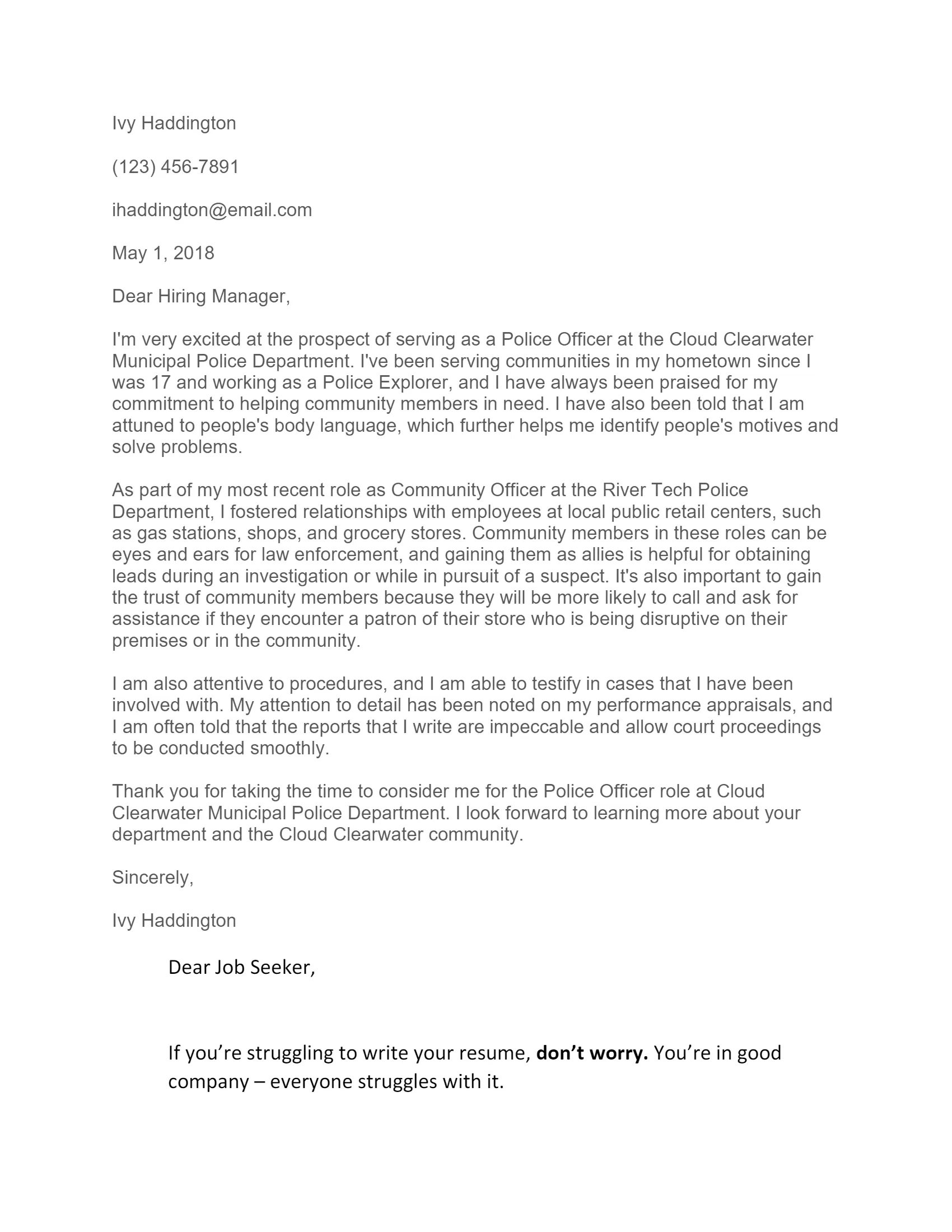
What is a Police Cover Letter
A police cover letter is a crucial document that accompanies your resume when applying for a law enforcement position. It serves as your first introduction to the hiring manager and provides an opportunity to express your interest in the role, highlight your relevant skills and qualifications, and demonstrate your understanding of the police department’s mission and values. Unlike a resume, which is a factual summary of your experience, a cover letter allows you to showcase your personality, writing skills, and genuine interest in becoming a police officer. It’s a chance to make a strong first impression and persuade the hiring manager to consider you for an interview. A well-crafted cover letter can significantly increase your chances of landing an interview and ultimately securing the job.
Importance of a Cover Letter for Police Officer
In the competitive field of law enforcement, a cover letter is not just an optional addition to your resume; it’s a necessity. The importance of a cover letter for a police officer cannot be overstated. It allows you to personalize your application and tailor it to the specific requirements of the police department and the job. It also provides context to your resume, explaining how your experiences and skills align with the position. A cover letter demonstrates your communication skills, attention to detail, and genuine interest in the role, all of which are critical qualities for a police officer. Moreover, it allows you to address any potential concerns or gaps in your resume, such as a career change or a period of unemployment. By submitting a compelling cover letter, you show the hiring manager that you have taken the time to understand the role and the department, setting yourself apart from other applicants.
Key Elements of a Strong Police Cover Letter

A strong police cover letter should include several key elements to effectively communicate your qualifications and suitability for the role. Begin with a professional heading that includes your contact information and the date. Address the hiring manager by name, if possible, to show that you’ve done your research. In the opening paragraph, state the position you’re applying for and express your enthusiasm for the opportunity. In the body of the letter, highlight your relevant skills, experience, and qualifications, providing specific examples to support your claims. Demonstrate your understanding of the police department’s mission and values and explain why you are a good fit. Conclude by restating your interest, expressing your eagerness for an interview, and thanking the hiring manager for their time and consideration. Finally, proofread the letter carefully for any grammatical errors or typos. Remember that a well-structured and tailored cover letter can significantly increase your chances of being noticed and selected for an interview.
Formatting Your Police Cover Letter
Proper formatting is essential to make your police cover letter easy to read and visually appealing. Use a professional-looking font, such as Times New Roman or Arial, in a standard size (11 or 12 points). Maintain consistent formatting throughout the letter, including the use of single-spaced lines with a space between paragraphs. Use clear and concise language, avoiding overly complex sentences or jargon. Keep the letter to one page, as hiring managers often have limited time to review applications. Divide the letter into distinct sections, such as an introduction, body paragraphs highlighting your qualifications, and a conclusion. Ensure your contact information, including your name, address, phone number, and email address, is prominently displayed at the top of the letter. Finally, use appropriate margins (typically 1 inch on all sides) to create a balanced and organized appearance. Properly formatting your cover letter demonstrates your attention to detail and professionalism, essential qualities for a police officer.
How to Write a Police Cover Letter Step by Step
Writing a compelling police cover letter involves several key steps. First, research the police department and the specific job you’re applying for. Then, address the hiring manager by name, if possible. In the opening paragraph, state the position you’re applying for and briefly mention why you’re interested. In the body paragraphs, highlight your qualifications, skills, and experiences that align with the job requirements. Provide specific examples to demonstrate your abilities and achievements. Show your understanding of the role and the department’s mission and values. Express your enthusiasm for the opportunity and explain why you’re a good fit. In the concluding paragraph, restate your interest, express your eagerness for an interview, and thank the hiring manager for their time and consideration. Finally, carefully proofread the letter for any grammatical errors or typos. By following these steps, you can create a police cover letter that effectively showcases your qualifications and increases your chances of getting an interview.
Research the Police Department

Before writing your cover letter, thoroughly research the police department you’re applying to. Visit their website to learn about their mission, values, and recent initiatives. Understand their specific requirements for the position, including any special skills or qualifications they’re seeking. If possible, find out the name of the hiring manager or the person who will be reviewing your application. Tailor your cover letter to the department’s specific needs and values, demonstrating that you understand their goals and are a good fit for their culture. This research will not only help you write a more effective cover letter but also show the hiring manager that you are genuinely interested in the position and have taken the time to learn about the department.
Address the Hiring Manager
Addressing the hiring manager by name is a crucial step in personalizing your cover letter and demonstrating your attention to detail. Whenever possible, find out the name of the hiring manager or the person responsible for reviewing applications. This shows that you’ve taken the time to research the department and are genuinely interested in the role. If you can’t find the name, use a professional salutation, such as “Dear Hiring Manager” or “Dear Recruitment Team.” Avoid generic greetings like “To Whom It May Concern,” as they can make your letter feel impersonal. Using the hiring manager’s name, if available, creates a more direct and engaging tone, making your application stand out from the crowd. This small detail can significantly improve your chances of a positive first impression.
Highlight Your Qualifications
In the body of your cover letter, highlight your qualifications that directly relate to the police officer position. Review the job description carefully and identify the key skills and requirements the department is looking for. Then, use specific examples from your past experiences to demonstrate how you possess those qualifications. Mention any relevant education, training, or certifications you have. If you have experience in law enforcement or related fields, such as security or military service, be sure to showcase those experiences. Quantify your achievements whenever possible, using numbers or statistics to illustrate your impact. For example, you could mention the number of arrests you’ve made, the number of investigations you’ve successfully completed, or the awards you’ve received. By highlighting your qualifications in a clear and concise manner, you can show the hiring manager that you are a strong candidate for the role.
Showcase Your Relevant Skills

Beyond your qualifications, your cover letter should showcase the skills essential for a police officer. These include communication skills, both written and verbal, interpersonal skills, problem-solving abilities, critical thinking skills, and the ability to work under pressure. Provide specific examples of how you have demonstrated these skills in the past. For instance, describe a situation where you successfully resolved a conflict, handled a difficult situation, or worked effectively as part of a team. You should also mention your ability to remain calm and composed in stressful situations, your attention to detail, and your commitment to ethical conduct. By showcasing these skills, you can demonstrate that you have the qualities necessary to be a successful police officer. Tailor your skills to the specific requirements listed in the job description. This will make your application more targeted and increase your chances of being noticed.
Demonstrate Your Understanding of the Role
A strong cover letter demonstrates your understanding of the role of a police officer and the responsibilities it entails. Explain what interests you about the position and why you are drawn to law enforcement. Show your knowledge of the police department’s mission, values, and goals. Discuss your understanding of the challenges and rewards associated with the job. Highlight your commitment to serving and protecting the community and your dedication to upholding the law. Mention your awareness of the importance of integrity, professionalism, and ethical conduct in law enforcement. Express your willingness to work long hours, handle difficult situations, and make tough decisions. By demonstrating your understanding of the role, you show the hiring manager that you have given careful consideration to your career choice and are prepared for the challenges that come with it.
Express Your Enthusiasm
Expressing genuine enthusiasm for the police officer position is crucial in your cover letter. Let your passion for law enforcement shine through. Clearly state why you are excited about the opportunity and what motivates you to serve the community. Mention specific aspects of the role or the police department that appeal to you. Show that you’ve researched the department and are genuinely interested in their work. Use positive and energetic language to convey your enthusiasm. Avoid sounding generic or insincere. Your enthusiasm will make your application more memorable and increase your chances of getting an interview. Demonstrating genuine interest will show the hiring manager that you are motivated and dedicated to the role. This excitement can set you apart from other applicants and make you a more appealing candidate.
Proofread and Edit Your Cover Letter

Before submitting your police cover letter, proofread and edit it carefully for any errors. Typos, grammatical mistakes, and spelling errors can undermine your credibility and make a negative impression on the hiring manager. Read the letter multiple times, preferably aloud, to catch any mistakes you may have missed. Check for clarity, conciseness, and coherence. Ensure that your writing style is professional and that your tone is appropriate for a formal application. Ask a friend, family member, or career counselor to review your cover letter and provide feedback. They can often identify errors or areas for improvement that you may have overlooked. By taking the time to proofread and edit your cover letter, you can ensure that it reflects your professionalism, attention to detail, and commitment to excellence. This step is essential for making a positive first impression and increasing your chances of getting an interview.
Cover Letter Examples and Templates
Using cover letter examples and templates can be a helpful way to get started and ensure that you include all the necessary elements. There are numerous police cover letter examples and templates available online. Look for examples from credible sources and tailor them to your specific situation. Remember to personalize the template to reflect your unique qualifications and the requirements of the police department you’re applying to. Use these examples as a guide to structure your letter, identify the key components, and learn how to effectively highlight your skills and experience. Adapt the language and tone to match your personality and the specific job description. Be sure to replace the template’s generic information with your own details and customize it to the specific police department. By using examples and templates, you can save time and ensure that your cover letter is well-written, professional, and tailored to the role.
Common Mistakes to Avoid
Avoiding common mistakes is essential for writing a strong police cover letter. One of the most common mistakes is using a generic or impersonal cover letter that is not tailored to the specific police department or job. Ensure your cover letter is unique and speaks directly to the requirements of the specific position. Another common mistake is including irrelevant information or rambling excessively. Keep your letter concise and focused on the qualifications and skills that are most relevant to the role. Failure to proofread and edit your cover letter for errors is a significant mistake. Always proofread your letter carefully to eliminate any typos, grammatical errors, or spelling mistakes. Another mistake is to use slang, informal language, or inappropriate humor. Your cover letter should be professional and respectful in tone. Avoid negative language or criticizing previous employers. Finally, avoid exaggerating your qualifications or making false claims. Honesty and integrity are crucial in law enforcement. By avoiding these common mistakes, you can create a cover letter that makes a positive impression and increases your chances of getting an interview.
Following Up on Your Application

After submitting your police cover letter and resume, it’s important to follow up on your application to demonstrate your continued interest and initiative. After a reasonable waiting period, typically a week or two, send a brief email or make a phone call to the hiring manager or the contact person listed in the job posting. In your follow-up, express your continued interest in the position and reiterate your qualifications. Briefly mention something specific from your cover letter or resume to remind the hiring manager of your application. Inquire about the status of your application and when you can expect to hear back regarding an interview. Thank the hiring manager for their time and consideration. Be polite, professional, and concise in your communication. Following up shows your enthusiasm for the opportunity and your commitment to the application process. It also gives you a chance to reiterate your interest and stand out from other applicants. However, be mindful not to be too persistent, as this could be counterproductive. Following up with a well-crafted and timely email or phone call can make a positive impact.