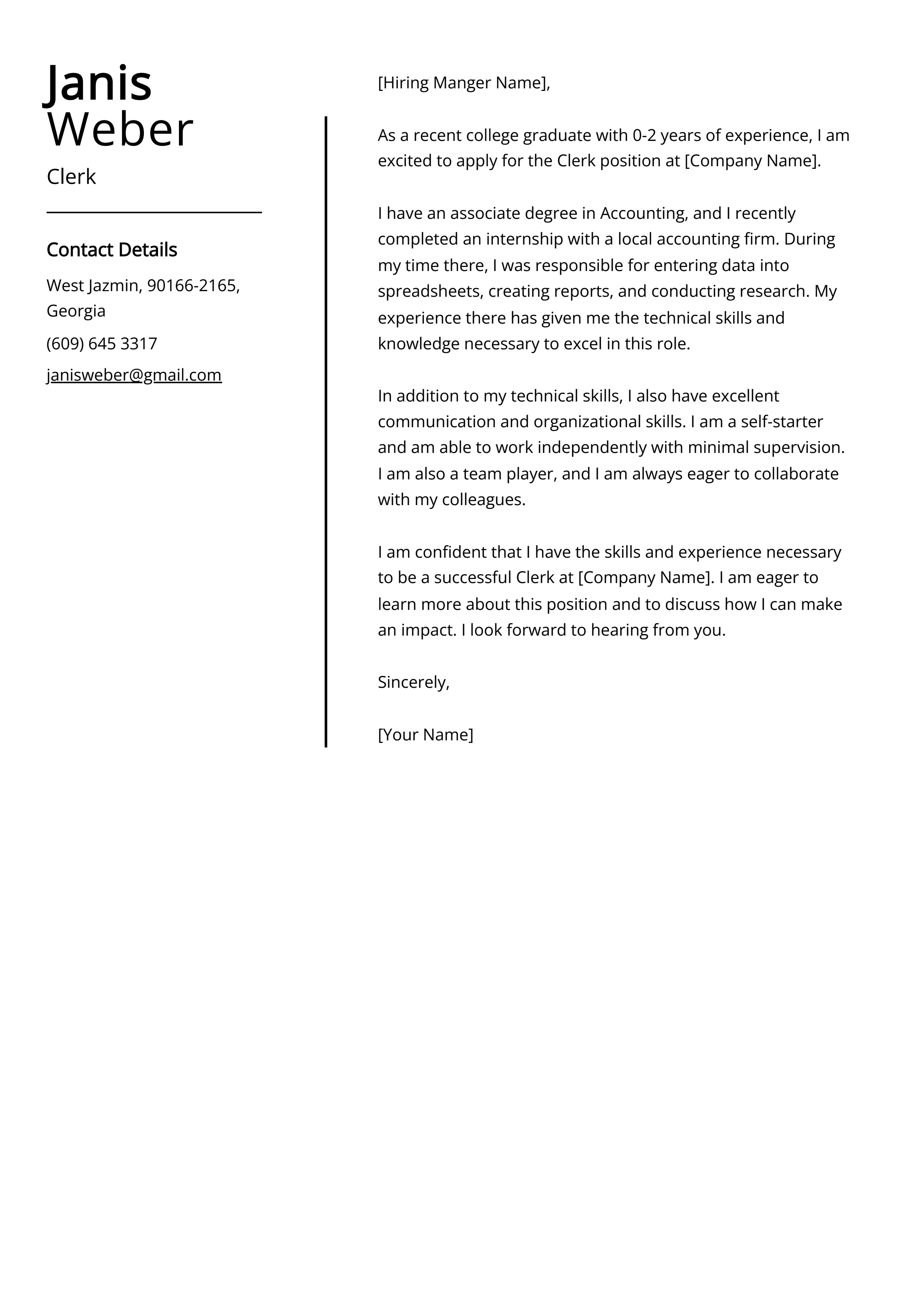
Understanding the Importance of an Office Clerk Cover Letter
An office clerk cover letter serves as your introduction to a potential employer, providing a snapshot of your qualifications and expressing your interest in the position. It’s your chance to make a strong first impression and differentiate yourself from other applicants. In a competitive job market, a well-crafted cover letter can be the deciding factor in whether or not you get an interview. It allows you to go beyond the confines of your resume and elaborate on your skills, experiences, and motivations. Think of it as a personalized marketing tool that highlights why you are the perfect fit for the office clerk role. A compelling cover letter demonstrates your communication skills, attention to detail, and genuine interest in the company. Ignoring this crucial step could mean missing out on a great opportunity.
Key Components of a Successful Cover Letter
A successful office clerk cover letter is more than just a formality; it’s a carefully constructed document that showcases your professionalism and suitability for the role. Several key elements must be included to make a positive impact. These components work together to create a cohesive narrative, demonstrating your skills, experience, and enthusiasm. A well-structured cover letter will guide the hiring manager through your qualifications, making it easy for them to see why you’re the best candidate. Failure to include these essential elements can weaken your application and reduce your chances of getting hired. Remember, a cover letter is your chance to shine, so make sure it highlights your strengths and addresses the specific requirements of the job.
Contact Information

This section ensures that the hiring manager can easily reach you. Accuracy is paramount here, as any errors could lead to missed opportunities. Include your full name, address, phone number, and professional email address. It’s best practice to use a clean and professional email address. Avoid using nicknames or unprofessional language in your email address. This section should be formatted clearly and placed at the top of the letter, often aligned to the left or right side of the page. The information needs to be consistent with what’s on your resume. The goal is to make it as easy as possible for the employer to contact you for an interview.
Applicant’s Name and Contact Details
Begin with your full name at the top. This makes it clear who the letter is from. Directly beneath your name, include your complete mailing address. Then, add your phone number, ensuring it’s a number where you can be easily reached. Finally, include your professional email address. This section should be accurate, up-to-date, and professional in appearance. Double-check all details to avoid errors. Ensure your email address sounds professional and reflects your seriousness about the role.
Recipient’s Information
Directly below your contact information, provide the recipient’s details. If possible, address the letter to a specific person (e.g., the hiring manager). Research the company website or LinkedIn to find the appropriate contact. If you can’t find a name, use a professional title, such as ‘Hiring Manager’ or ‘Human Resources Department.’ Include the company name, the department (if applicable), and the company’s address. This shows that you have taken the time to learn about the company and tailor your application accordingly. Proper recipient information demonstrates that you care about the details and are invested in the application process.
Professional Salutation

The salutation sets the tone for your entire letter. Always start with a professional greeting. The best practice is to use ‘Dear Mr./Ms./Mx. [Last Name]’ if you know the hiring manager’s name. If you don’t know the name, options include ‘Dear Hiring Manager,’ or ‘Dear Human Resources Team.’ Avoid overly casual greetings. The salutation is your first interaction in the letter, so it needs to be polite and respectful. This sets a positive tone and makes a good first impression, signaling respect for the potential employer.
Crafting a Compelling Opening Paragraph
The opening paragraph is your opportunity to immediately grab the hiring manager’s attention. Start by clearly stating the position you’re applying for and how you learned about the opportunity. This shows your specific interest in the role and how you discovered the job posting. Briefly mention your key qualifications or a compelling achievement that makes you stand out. This hook will make the reader want to keep reading. Expressing your enthusiasm for the company and the role from the start shows that you are genuinely interested in the position. Make sure this opening paragraph is concise, engaging, and sets the stage for the rest of your cover letter.
Highlighting Relevant Skills and Experience
This is where you demonstrate your suitability for the office clerk position by focusing on your relevant skills and experiences. Clearly articulate how your background aligns with the job requirements. Use specific examples to illustrate your capabilities, providing concrete evidence of your achievements. Tailor your examples to match the key responsibilities outlined in the job description. This section should be informative and persuasive, aiming to convince the hiring manager that you are the ideal candidate. This section needs to be structured, easy to follow, and well-organized. Showcase how your skills can contribute to the company’s success.
Skills to Showcase for Office Clerk Positions

Office clerk positions require a blend of soft and hard skills to succeed. Focus on skills that directly relate to the job requirements. These may include strong organizational skills, proficiency in Microsoft Office Suite (Word, Excel, Outlook), data entry accuracy, excellent communication skills, and the ability to manage multiple tasks simultaneously. Highlight any experience with office equipment (printers, scanners, etc.). Demonstrate attention to detail, as accuracy is critical in office tasks. Also, mention your ability to work independently and as part of a team. Provide examples of how you have used these skills in previous roles. The best way to get the hiring manager to want to see your resume is by showing them your skills in action.
Experience and Achievements
Go beyond listing your job duties; focus on quantifiable achievements. Describe specific accomplishments and how they benefited your previous employers. Use the STAR method (Situation, Task, Action, Result) to structure your examples and provide context. Highlight instances where you improved efficiency, accuracy, or productivity. Use action verbs to make your descriptions more impactful. If possible, include any awards or recognition received for your work. This helps you demonstrate that you’re not just competent but exceptional. Providing quantifiable achievements shows your skills in action, with proof of how they helped the company.
Quantifying Achievements
Quantifying your achievements adds credibility and impact to your cover letter. Instead of saying you ‘improved organization,’ say that you ‘reduced filing errors by 20%.’ Use numbers to showcase your accomplishments whenever possible. This might involve the number of documents processed, the amount of time saved, or the percentage of accuracy achieved. Quantifiable results make your achievements more tangible and easier for the hiring manager to understand. Be specific and provide measurable data to support your claims. The use of numbers shows you are not just a great fit, but the perfect fit.
Demonstrating Company Research

Demonstrating that you have researched the company shows that you have a genuine interest in the role and the organization. Mention specific details about the company, its mission, or recent projects that resonate with you. Tailor your cover letter to show how your skills and experience align with the company’s needs and values. This shows that you have taken the time to learn about the company and are not simply sending out a generic cover letter. This demonstrates a proactive approach to your job search. Always customize your letter to fit the specific organization. Mentioning specific things about the company will make you stand out from other candidates.
Expressing Enthusiasm and Interest
Expressing genuine enthusiasm and interest in the role is crucial. Show that you are excited about the opportunity and the company. Describe why you are interested in the specific position and what you hope to achieve. Relate your skills and experience to the company’s mission and values. Convey your passion and commitment to the company’s success. Be sincere and authentic in your expression of interest. Avoid using generic phrases and clichés. The goal is to make the reader see how enthusiastic you are about the role.
Call to Action and Closing
End your cover letter with a strong call to action. Clearly state your interest in an interview and how you can be contacted. Thank the hiring manager for their time and consideration. Express your confidence in your ability to contribute to the company. Leave a positive and memorable impression. The closing paragraph should reinforce your enthusiasm and summarize your key qualifications. Make it easy for the hiring manager to take the next step.
Proper Closing and Signature

Choose a professional closing, such as ‘Sincerely,’ ‘Best regards,’ or ‘Thank you.’ Always capitalize the first letter of your closing and end with a comma. Leave space for your signature if you are printing the letter. Type your full name below the closing. This ensures that the letter is properly concluded and signed. Make sure you use a closing that reflects professionalism and respect for the hiring manager. Your signature is a symbol of your personal commitment to the application process.
Proofreading and Formatting
Proofreading is critical to ensure your cover letter is free of errors. Check for grammatical mistakes, spelling errors, and typos. Read the letter aloud to catch any awkward phrasing or sentences. Have a friend or family member review your cover letter for accuracy and clarity. Formatting is also essential. Use a clear and professional font, such as Times New Roman, Arial, or Calibri. Maintain consistent formatting throughout the document. Use proper margins, spacing, and indentation for an organized appearance. A well-formatted and error-free cover letter demonstrates your attention to detail and professionalism. Proofread and format your letter to stand out and shine.