Understanding the Importance of a Nursing Cover Letter
In the competitive field of nursing, a well-crafted cover letter is your first opportunity to make a positive impression on a potential employer. It serves as a crucial introduction, offering a glimpse into your professional background, skills, and aspirations. While a resume provides a concise overview of your qualifications, the cover letter allows you to delve deeper, providing context and demonstrating your personality. It’s not just about listing your experience; it’s about showcasing why you are the ideal candidate for the specific nursing position. A compelling cover letter can significantly increase your chances of securing an interview and ultimately landing your dream job.
Why a Cover Letter Matters for Nurses
A cover letter offers the unique ability to personalize your application. In the nursing profession, where compassion and empathy are paramount, this personalized touch is extremely valuable. It allows you to articulate your genuine interest in the role and the healthcare facility. It gives you the space to elaborate on specific experiences or skills, providing a more in-depth understanding of your capabilities than a resume alone can provide. Moreover, it highlights your ability to communicate effectively, an essential skill for nurses who need to interact with patients, families, and other healthcare professionals on a daily basis. In essence, your cover letter is your chance to stand out from the crowd and demonstrate why you are the perfect fit for the nursing position.
How a Cover Letter Complements Your Resume

The cover letter and resume work together to present a comprehensive picture of your qualifications. Your resume acts as a detailed list of your skills, experience, and education, providing a factual foundation for your application. The cover letter then builds upon this foundation, offering a narrative that explains how your skills and experience align with the specific requirements of the nursing position. It provides context, allowing you to interpret the information presented in your resume and emphasizing the relevance of your achievements to the role. It also provides a platform to showcase your personality and communication style, which are critical for many nursing positions. By working together, the cover letter and resume paint a complete picture of your professional self, greatly increasing your chances of getting hired.
Key Elements of a Successful Nursing Cover Letter
Contact Information and Professional Greeting
Begin your cover letter with your full contact information, including your name, address, phone number, and email address. Make sure to use a professional email address. Next, address the hiring manager by name if possible. Research the facility to find out who is responsible for hiring. A generic greeting, such as “To Whom It May Concern,” is acceptable if you are unable to find a specific name, but personalizing the greeting shows that you have taken the initiative to research the facility and the position. Always maintain a professional tone throughout the cover letter, reflecting your commitment to excellence and your respect for the hiring process.
Highlighting Your Nursing Skills and Experience

The body of your cover letter is where you showcase your skills and experience. Review the job description carefully and identify the key skills and qualifications the employer is seeking. Then, use specific examples from your work history to demonstrate how you have used those skills in previous roles. Focus on skills relevant to the position. Don’t simply list your duties. Instead, describe situations where you successfully applied your skills to achieve positive outcomes for patients or the healthcare facility. Use action verbs and quantify your accomplishments whenever possible to make a strong impression. Showing how your skills meet the requirements demonstrates you are a good match for the position.
Quantifying Your Achievements in Nursing
Whenever possible, quantify your achievements. Instead of saying that you “improved patient care,” state that you “reduced patient fall rates by 15%” or that you “increased patient satisfaction scores by 10%.” This level of detail provides concrete evidence of your impact and highlights your ability to drive positive results. Use numbers, percentages, and other metrics to demonstrate the value you brought to your previous roles. Specific examples are far more compelling than general statements. By quantifying your achievements, you provide tangible proof of your capabilities and make a stronger case for your candidacy.
Showcasing Your Passion for Nursing
Nursing is a profession that requires empathy, compassion, and a genuine desire to help others. Your cover letter should reflect your passion for nursing and your commitment to patient care. Share what motivates you to be a nurse. Talk about what you enjoy most about the profession and how you approach your work. Highlight your specific areas of interest and explain why you are drawn to the specific nursing position you are applying for. Show the employer that you’re not just looking for a job; you are dedicated to a fulfilling career. Your enthusiasm should shine through and convince the hiring manager that you truly care about making a difference in the lives of your patients.
Tailoring Your Cover Letter to the Specific Position

Avoid using a generic cover letter. Customize each cover letter to the specific position and healthcare facility. Review the job description carefully and identify the key requirements. Then, tailor your cover letter to address those specific requirements. Highlight the skills and experiences that are most relevant to the position. If you have experience in a particular specialty, be sure to mention it. Showing the hiring manager that you understand the role and are a good fit will drastically improve your odds. By tailoring your cover letter, you demonstrate that you have taken the time to understand the position, which makes a strong impression.
Researching the Healthcare Facility
Before you start writing your cover letter, research the healthcare facility. Visit their website, read about their mission and values, and learn about their recent initiatives. If possible, research the hiring manager. Knowing something about the facility and the hiring manager allows you to personalize your cover letter and show that you are genuinely interested in the opportunity. You can also use your research to identify specific areas where you can contribute. Researching the facility is an important step in tailoring your cover letter and making a positive impression.
Addressing the Job Requirements
As you write your cover letter, make sure to directly address the job requirements. The job description will list the skills, experience, and qualifications that the employer is seeking. Use your cover letter to demonstrate that you meet those requirements. Provide specific examples from your work history to show how you have used those skills in previous roles. Be specific, and avoid making general statements. Use keywords from the job description to ensure that your application is easily scanned by applicant tracking systems (ATS). Make sure to address all of the key requirements of the role. By carefully addressing the requirements, you demonstrate that you are a good match for the position.
Formatting Your Nursing Cover Letter

Using a Professional and Readable Format
Use a professional and easy-to-read format for your cover letter. Choose a standard font, such as Times New Roman, Arial, or Calibri. Use a font size between 10 and 12 points. Use clear headings and subheadings to organize your content. Keep your paragraphs concise and easy to read. Avoid using long blocks of text. Use bullet points to highlight key skills and accomplishments. Proofread your cover letter carefully to eliminate any errors in grammar or spelling. A well-formatted cover letter is easy to read and makes a positive impression. It demonstrates your attention to detail and your commitment to excellence.
Proofreading and Editing Your Cover Letter
Before you submit your cover letter, proofread and edit it carefully. Check for any errors in grammar, spelling, and punctuation. Ensure that your writing is clear, concise, and easy to understand. Check that your formatting is consistent and professional. Consider having a friend or colleague review your cover letter for you. Fresh eyes may catch errors that you have missed. Proofreading and editing your cover letter will ensure that it presents you in the best possible light and demonstrates your professionalism. It is a critical step.
Seeking Feedback from Others

Don’t hesitate to seek feedback from trusted sources. Ask a friend, family member, career counselor, or mentor to review your cover letter and provide suggestions. They can offer a fresh perspective and identify areas where you can improve your writing or strengthen your message. Ask them about clarity, organization, grammar, and overall impact. Incorporating feedback can lead to a more polished and effective cover letter that increases your chances of getting an interview. Constructive criticism is a valuable tool for career success. Be open to suggestions and willing to revise your cover letter based on the feedback you receive.
Common Mistakes to Avoid in a Nursing Cover Letter
Generic and Unfocused Content
Avoid using generic, cookie-cutter cover letters. These letters often lack originality and fail to capture the attention of the hiring manager. Tailor your cover letter to each specific nursing position, highlighting the skills and experiences that are most relevant to the role. If you use a template, make sure to customize it to reflect your qualifications and the requirements of the job. Generic content sends the message that you are not truly interested in the position. Focus on specific details to showcase how your unique skills and experiences make you the ideal candidate for the job.
Grammatical Errors and Typos

Grammatical errors and typos can undermine your credibility and make a negative impression on the hiring manager. Proofread your cover letter carefully before submitting it. Use spell-check and grammar-check tools, but also read your cover letter aloud to catch any errors. Consider having a friend or colleague review your cover letter for you. A polished cover letter demonstrates your attention to detail and your commitment to excellence. Mistakes can signal to the employer that you are not careful or that you do not pay attention to detail, which is critical for the nursing profession.
Failing to Showcase Accomplishments
Don’t simply list your duties. Instead, showcase your accomplishments and the positive results you achieved in previous roles. Quantify your achievements whenever possible, using numbers, percentages, and other metrics. Give specific examples of how you have improved patient care, reduced costs, or increased efficiency. Highlighting your accomplishments demonstrates your value and sets you apart from other candidates. Employers want to see that you have a proven track record of success and that you can make a difference in their organization.
Nursing Cover Letter Examples for Various Specialties
Examples of cover letters vary depending on the nursing specialty, such as registered nursing, licensed practical nursing, and nurse practitioner roles. Each example will emphasize different aspects of your skills and experience to reflect the specific requirements of the position. Make sure to research and tailor your cover letter to your chosen specialty.
Registered Nurse (RN) Cover Letter Example
An RN cover letter should highlight experience in patient assessment, medication administration, and care planning. It may showcase experience in various healthcare settings, such as hospitals, clinics, or long-term care facilities. It should also demonstrate your ability to collaborate with physicians and other healthcare professionals. Be sure to highlight any specialized certifications or training, such as certifications in critical care, emergency care, or medical-surgical nursing. Highlight your leadership skills and your ability to manage a team of nurses and nursing assistants. Focus on your ability to deliver high-quality patient care in a variety of settings.
Licensed Practical Nurse (LPN) Cover Letter Example
An LPN cover letter should focus on patient care, assisting RNs, and providing basic medical services under the supervision of a registered nurse or physician. You may highlight experience in areas such as taking vital signs, administering medications, and providing wound care. Also showcase your ability to provide compassionate care and support to patients. Emphasize your ability to work as part of a team and your commitment to providing a safe and comfortable environment for patients. Detail any specific training or certifications, such as IV therapy or phlebotomy. The cover letter should focus on providing hands-on care and assisting with patient needs.
Nurse Practitioner (NP) Cover Letter Example
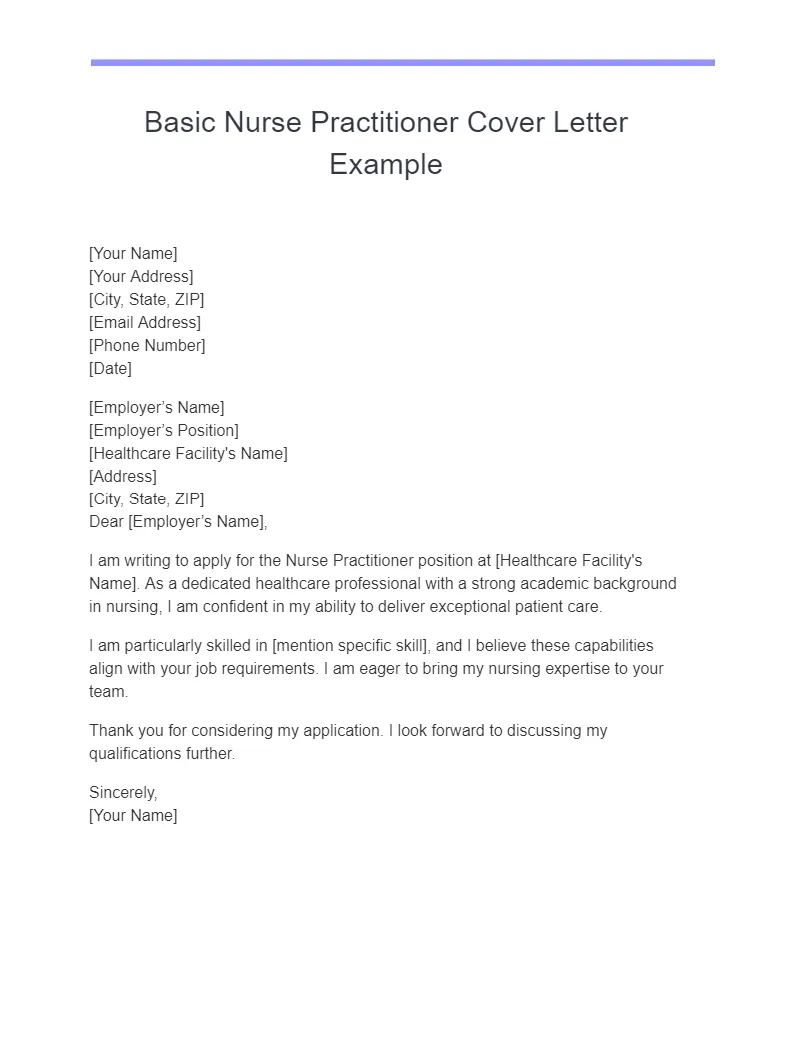
An NP cover letter should emphasize advanced clinical skills, patient assessment, and the ability to diagnose and treat illnesses. Focus on any specializations, such as family medicine, geriatrics, or pediatrics. It is important to demonstrate experience in performing physical examinations, ordering diagnostic tests, and prescribing medications. Highlight your ability to collaborate with physicians and other healthcare professionals. This is a role that requires a high degree of autonomy, so showcase your ability to work independently and make clinical decisions. Emphasize your experience in treating patients, developing and implementing care plans, and providing patient education.
Tips for Writing a Compelling Cover Letter Conclusion
Expressing Your Enthusiasm and Availability
Conclude your cover letter by reiterating your interest in the position and the healthcare facility. Express your enthusiasm for the opportunity and your belief that you are a strong fit for the role. Restate your key qualifications briefly and confidently. This will reinforce your value to the hiring manager. End the letter on a positive note, leaving the hiring manager with a lasting impression of your commitment to nursing and your desire to make a valuable contribution to the organization.
Providing Contact Information for Follow-Up
In your conclusion, make it clear that you are available for an interview and how the hiring manager can contact you. Provide your phone number and email address again, so they can easily reach you. It is helpful to state your availability for an interview to expedite the hiring process. Thank the hiring manager for their time and consideration. End the letter with a professional closing, such as “Sincerely” or “Respectfully,” followed by your name.
Frequently Asked Questions about Nursing Cover Letters
Can I use the same cover letter for every job application?
No, it is not recommended to use the same cover letter for every job application. Tailor your cover letter to each specific position and healthcare facility. Customize your letter by highlighting the skills and experiences that are most relevant to the job description. Generic letters may be viewed as a lack of effort and interest. Tailoring the cover letter shows you have taken the time to understand the role and the organization, making it more impactful.
How long should a nursing cover letter be?
Generally, a nursing cover letter should be no more than one page in length, typically between 250 and 400 words. Keep the letter concise and focused, highlighting your most relevant qualifications and experiences. Use clear and concise language and avoid lengthy paragraphs.
What should I include in my nursing cover letter?
A nursing cover letter should include an introduction, a body that highlights your skills and experiences, and a conclusion. The introduction should state your interest in the position and the healthcare facility. The body should demonstrate your skills and experience with specific examples and quantify your achievements when possible. The conclusion should reiterate your interest, summarize your key qualifications, and provide contact information for follow-up.
Final Thoughts on Writing a Winning Nursing Cover Letter
Crafting a compelling cover letter is a critical step in your nursing job search. A well-written cover letter can set you apart from the competition and increase your chances of securing an interview. Take the time to research the healthcare facility, tailor your letter to the specific position, and highlight your key skills and experiences. By following the guidelines in this article, you can create a cover letter that effectively showcases your qualifications and helps you land your dream job in the nursing profession. Remember to proofread carefully and seek feedback from others before submitting your application. Good luck with your job search!