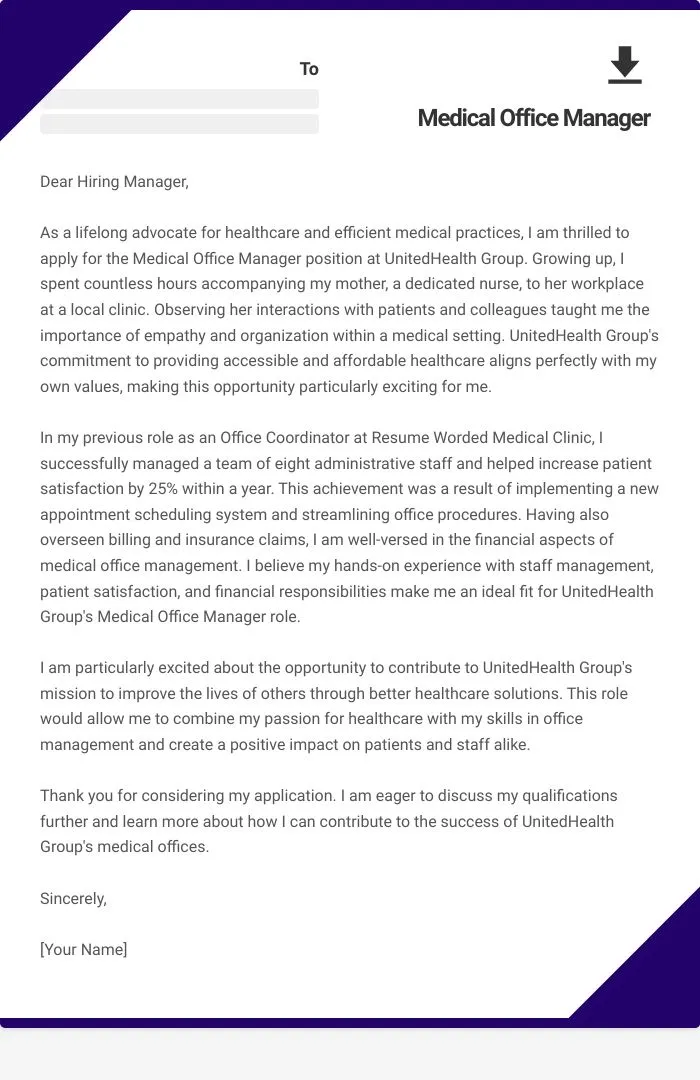
What is a Medical Office Cover Letter
A medical office cover letter is a crucial document that accompanies your resume when applying for a job in a medical setting. It serves as your introduction to a potential employer, allowing you to showcase your qualifications, skills, and enthusiasm for the position. Unlike a resume, which provides a factual overview of your experience, a cover letter gives you the opportunity to elaborate on your relevant experiences and explain why you are the ideal candidate. It is a personalized document, tailored to the specific job you are applying for and the medical office where you hope to work. It is your chance to make a positive first impression and persuade the hiring manager to read your resume and consider you for an interview. A well-written cover letter can significantly increase your chances of landing your dream job in the medical field.
Importance of a Medical Office Cover Letter
The medical field is competitive. A cover letter is very important in this case, as it allows you to distinguish yourself from other applicants. It provides the context that a resume alone cannot. A cover letter demonstrates your written communication skills, attention to detail, and your understanding of the specific requirements of the role. It also shows your genuine interest in the position and the organization, which can set you apart from candidates who may have simply submitted a resume without any additional effort. Medical professionals often have to deal with sensitive and complex situations on a daily basis, so the ability to communicate effectively in writing is critical. Your cover letter is the first impression a potential employer gets of your communication skills, which can be a deciding factor in their decision-making process. Therefore, a cover letter is essential for anyone seeking employment in a medical office.
Key Components of a Medical Office Cover Letter

A strong medical office cover letter includes several key components, each playing a vital role in conveying your qualifications and enthusiasm. The structure of your letter needs to be clear, concise, and professional. It is very important that you make a good impression. Every part of your cover letter should be well written and easy to understand, and the format should be clean and easy to read. These components work together to present a compelling case for your candidacy.
Contact Information
Start your cover letter with your contact information, and then the recipient’s information. This section ensures that the hiring manager can easily reach you and also adds a touch of professionalism to your document.
Applicant’s Information
Include your full name, address, phone number, and professional email address. Make sure the information is current and accurate.
Recipient’s Information

Include the name of the hiring manager (if known), their title, the name of the medical office, and the office’s address. If you are unsure of the hiring manager’s name, research the company website or LinkedIn, or use a general title like ‘Hiring Manager’.
Professional Greeting
Use a professional greeting. If you know the hiring manager’s name, use ‘Dear Mr./Ms./Mx. [Last Name]’. If not, use a professional greeting such as ‘Dear Hiring Manager’ or ‘To Whom It May Concern’.
Body Paragraphs
The body paragraphs are the heart of your cover letter. Use them to showcase your skills, experience, and enthusiasm for the position. They provide an opportunity to persuade the hiring manager that you are a strong candidate for the role.
First Paragraph Opening and Purpose

In the opening paragraph, state the position you are applying for and where you saw the job posting. Briefly mention why you are interested in the role and the medical office. Express your enthusiasm and show that you have a basic understanding of the company’s mission. Make sure your introduction is clear, concise, and immediately grabs the reader’s attention. This sets the stage for the rest of your letter and shows the hiring manager why you are a suitable candidate.
Second Paragraph Highlighting Skills and Experience
In the second paragraph, focus on your skills and experience that are relevant to the job description. Provide specific examples that demonstrate your abilities and how they align with the needs of the medical office. Highlight accomplishments and quantify them whenever possible. Use keywords from the job description to show that you are a good fit for the role. This is where you persuade the hiring manager that your skills align with the requirements of the role and that you can successfully perform the job responsibilities.
Third Paragraph Demonstrating Enthusiasm and Fit
In the third paragraph, express your enthusiasm for the position and the medical office. Explain what attracts you to the role and why you are a good fit for the company culture. Show that you have researched the company and understand its values and mission. Mention how your career goals align with the organization’s objectives. This paragraph demonstrates your passion for the role and shows your interest in the company.
Concluding Paragraph

Summarize your key qualifications and reiterate your interest in the position. Reiterate your enthusiasm and confidence in your ability to excel in the role. Express your appreciation for the opportunity and state your availability for an interview. Use a call to action, such as ‘I look forward to hearing from you’ or ‘Thank you for your time and consideration’.
Closing and Signature
Use a professional closing, such as ‘Sincerely’ or ‘Best regards’. Leave space for your handwritten signature, then type your full name. If submitting electronically, a typed signature is acceptable.
Formatting Tips for Medical Office Cover Letters
The formatting of your cover letter is an important aspect of making a good first impression. A well-formatted cover letter is easy to read, professional, and shows attention to detail. It shows that you care about the presentation of your application.
Font and Size

Choose a professional and readable font such as Times New Roman, Arial, or Calibri. Use a font size between 10 and 12 points for the body text. This ensures your cover letter is easy on the eyes and looks polished.
Margins and Spacing
Use standard 1-inch margins on all sides of the page. Use single spacing within paragraphs and double spacing between paragraphs. This creates a clean and organized layout.
Proofreading and Editing
Proofread your cover letter carefully for any grammatical errors, spelling mistakes, or typos. Ask someone else to review it as well. Ensure that the tone and language are professional and that the information is accurate and relevant. A well-proofread cover letter shows attention to detail, which is critical in any medical setting.
Medical Office Cover Letter Samples

Reviewing sample cover letters can provide you with valuable insights and guidance on structuring and writing your own letter. Each of the below sample cover letters are for different roles. Always customize the provided samples to fit your specific qualifications and the job description of the position you are applying for. Tailoring your cover letter is crucial to showcasing your suitability for a specific role.
Sample Cover Letter for a Medical Assistant
Dear [Hiring Manager name],
I am writing to express my keen interest in the Medical Assistant position at [Medical Office Name], as advertised on [Platform]. With my [Number] years of experience in the medical field and my certification in [Certification], I am confident in my ability to contribute to your team. In my previous role at [Previous Clinic Name], I was responsible for patient intake, vital signs, and assisting with examinations. I am proficient in electronic health records (EHR) systems such as [EHR System] and possess strong interpersonal skills that allow me to build rapport with patients. I am eager to apply my skills and contribute to a patient-centered environment. Thank you for your time and consideration.
Sincerely, [Your Name]
Sample Cover Letter for a Medical Secretary
Dear [Hiring Manager name],
I am writing to express my interest in the Medical Secretary position at [Medical Office Name], as advertised on [Platform]. With [Number] years of experience in medical administration, I am confident I have the skills to contribute positively to your organization. In my previous role at [Previous Clinic Name], I managed patient scheduling, handled insurance verification, and maintained patient records. I am highly proficient in using medical software such as [Software] and have excellent communication and organizational skills. I am eager to apply my administrative abilities to support the efficient operation of your office. I am excited about the opportunity to contribute to a patient-focused environment and am very much looking forward to hearing from you.
Sincerely, [Your Name]
Sample Cover Letter for a Medical Receptionist
Dear [Hiring Manager name],
I am writing to express my interest in the Medical Receptionist position at [Medical Office Name], as advertised on [Platform]. I am excited by the opportunity to contribute to a welcoming and efficient front office environment. With my experience in managing patient inquiries, scheduling appointments, and handling insurance verification, I am confident in my ability to excel in this role. In my previous role at [Previous Clinic Name], I was responsible for greeting patients, answering phones, and managing patient flow. I am proficient in using patient management software, and I am a highly organized and empathetic individual. I am eager to support your practice in providing excellent patient care.
Sincerely, [Your Name]
Final Tips for Medical Office Cover Letters
Keep the cover letter concise and to the point, generally no more than one page. Tailor each letter to the specific job requirements and the medical office’s values. Highlight your unique skills and experiences that make you a standout candidate. Proofread your cover letter carefully. Ensure it is free of errors. Send your cover letter as a PDF file unless the job application instructions specify otherwise. Sending a polished, well-written, and customized cover letter significantly increases your chances of securing an interview. This is the first step in a successful job application.