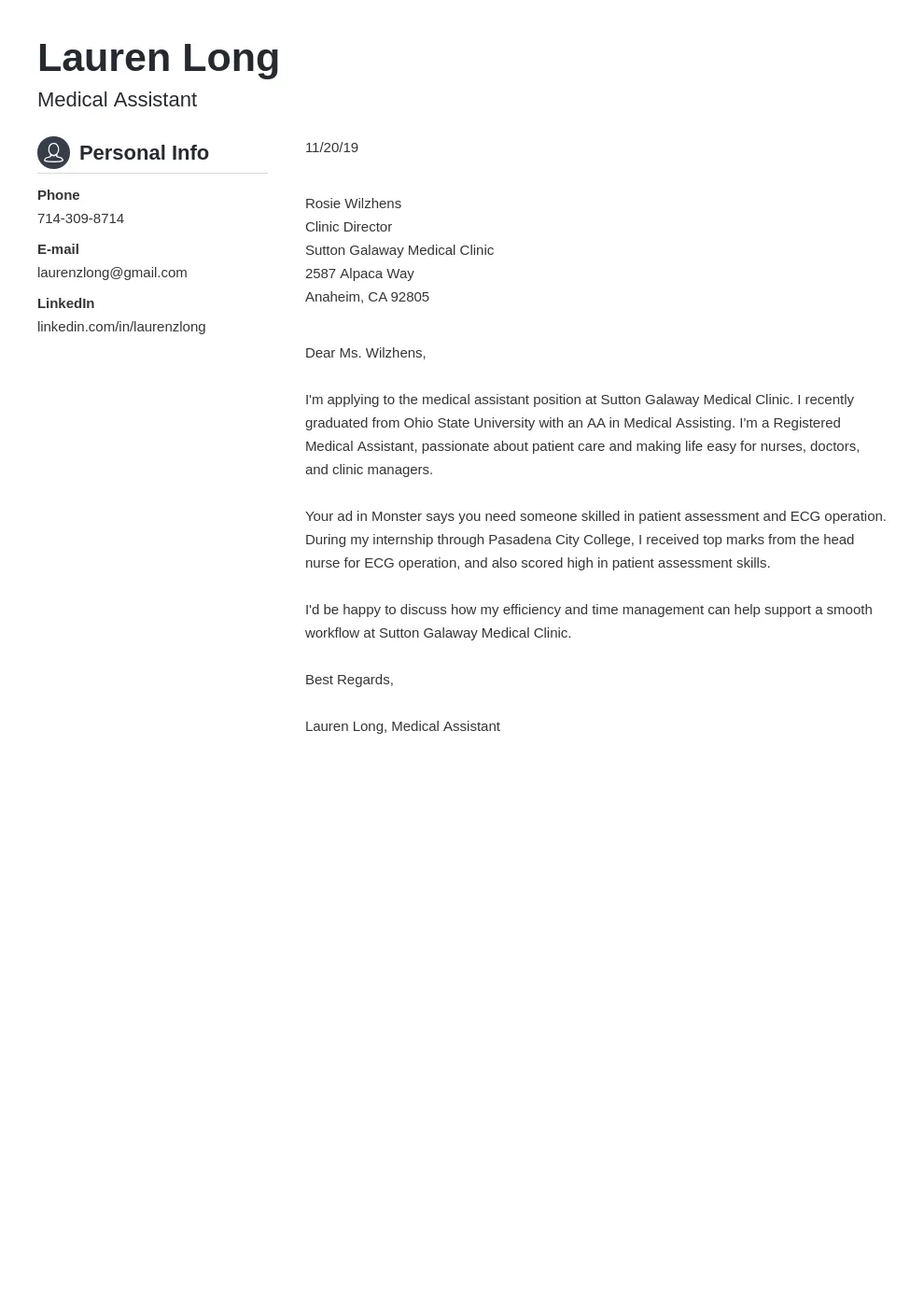
Why a Medical Assistant Cover Letter Matters
In the competitive field of healthcare, securing a Medical Assistant position requires more than just a stellar resume. A well-crafted cover letter serves as your first impression, offering a unique opportunity to showcase your personality, passion, and suitability for the role. It provides a platform to explain your career aspirations, elaborate on relevant experiences, and highlight the value you bring to a healthcare team. A compelling cover letter is not just a formality; it’s a crucial tool in distinguishing yourself from other applicants and capturing the attention of hiring managers. By taking the time to create a personalized cover letter, you demonstrate your genuine interest in the specific position and the healthcare facility, which can significantly increase your chances of getting an interview.
Highlighting Your Medical Assistant Skills
Your Medical Assistant cover letter is the ideal place to shine a light on your skills and experiences. Start by carefully reviewing the job description and identifying the key skills and qualifications the employer is seeking. Then, in your cover letter, highlight how your abilities and experiences align with these requirements. Be specific. Instead of simply stating that you have “good communication skills,” provide examples of how you have effectively communicated with patients, doctors, and other healthcare professionals. Quantify your achievements whenever possible. For instance, if you have experience managing patient records, mention the number of records you’ve managed or any improvements you made to the process. Remember, the goal is to persuade the employer that you possess the skills and experience they need.
Key Skills to Showcase

Medical assistants need a diverse skill set to excel in their roles. Your cover letter should touch on this skill set. Emphasize your proficiency in both clinical and administrative tasks, and don’t overlook the importance of soft skills. This includes communication, empathy, and problem-solving. Make sure your cover letter clearly demonstrates the following skills.
Clinical Skills
Clinical skills form the foundation of a Medical Assistant’s role. You need to describe your experience with these skills, highlighting any specializations or certifications. If you have experience in taking patient histories, measuring vital signs, assisting with examinations, or performing basic lab tests, mention it. Any experience in phlebotomy, administering medications, or assisting with minor procedures should also be included. If you are certified in CPR or First Aid, mention it. The goal is to illustrate your capacity to provide direct patient care and support physicians in delivering quality healthcare. The more detailed you are, the better, including the amount of experience, and the types of equipment you’ve worked with.
Administrative Skills
Administrative duties are an essential part of a Medical Assistant’s role. In your cover letter, emphasize your proficiency with scheduling appointments, managing patient records, handling billing and insurance claims, and other administrative tasks. Detail your experience with electronic health records (EHR) systems or other relevant software. Indicate your knowledge of medical terminology and billing codes. Mention if you have experience with insurance verification, prior authorizations, or patient communication, demonstrating your ability to efficiently manage office operations and ensure a smooth workflow. A background in administrative tasks shows you are organized and efficient.
Soft Skills

Soft skills are invaluable in any healthcare setting. Your Medical Assistant cover letter must show how you have developed strong communication, empathy, and teamwork. Highlight your ability to communicate clearly and effectively with patients, explain medical procedures, and address concerns. Emphasize your ability to be empathetic, showing compassion for patients. Detail experiences where you have worked effectively as part of a team, supported colleagues, and contributed to a positive work environment. Demonstrate your problem-solving abilities and adaptability, indicating your capacity to handle stressful situations and learn new skills. Focus on your ability to be a team player.
Structuring Your Medical Assistant Cover Letter
A well-structured cover letter is easy to read and visually appealing. It allows the hiring manager to quickly understand your key qualifications and what you can bring to the role. Avoid any typos or grammatical errors, as these can reflect poorly on your attention to detail. You need to be clear about what you want to achieve. Follow a standard business letter format and be sure that you are being clear and concise. You can also tailor your cover letter to match the tone of the healthcare facility.
Header and Contact Information
Start your cover letter with a professional header that includes your full name, contact information (phone number and email address), and the date. Include the hiring manager’s name, title, and the healthcare facility’s address, if available. This ensures that your letter looks professional and that the hiring manager can easily contact you.
Professional Salutation

Use a professional salutation. Use “Dear Mr./Ms./Mx. [Last Name]” if you know the hiring manager’s name. If the name is unavailable, use “Dear Hiring Manager” or “Dear [Department Name] Hiring Team.” Avoid generic greetings such as “To Whom It May Concern.” It is important to be professional and formal.
Opening Paragraph Grab Attention
Your opening paragraph is the first impression you make, so make it count. Start with a strong statement that immediately grabs the reader’s attention. State the position you are applying for and how you found the job. Mention any relevant connections or referrals. Briefly summarize your key qualifications or your most significant achievement that aligns with the job requirements. Show enthusiasm, and let the reader know why you are interested in the role. This opening should be concise and make the reader want to continue reading.
Body Paragraphs Show Value
The body paragraphs are where you highlight your skills, experience, and achievements. Each paragraph should focus on a specific aspect of your qualifications, demonstrating how you meet the job requirements. Use specific examples and provide quantifiable results whenever possible. Address the key skills mentioned in the job description and provide evidence of your proficiency. Show how your skills and experiences align with the needs of the healthcare facility. Don’t just list your responsibilities, describe what you have achieved in your previous roles. Show what you can bring to the table.
Closing Paragraph and Call to Action

In your closing paragraph, reiterate your interest in the position and express your enthusiasm for the opportunity. Summarize your key qualifications and restate your value. Include a clear call to action, such as requesting an interview or stating your availability for an interview. Thank the hiring manager for their time and consideration. Use a professional closing such as “Sincerely” or “Best regards,” followed by your full name.
Formatting and Design
Ensure your cover letter is visually appealing and easy to read. Use a professional font such as Times New Roman, Arial, or Calibri, in a standard size (11 or 12 points). Maintain consistent formatting throughout the document, including spacing, margins, and bullet points (if used). Keep the letter concise, ideally within one page. Use clear headings and bullet points to organize information and make it scannable. Proofread the document carefully to catch any errors, ensuring a polished and professional appearance. If you are submitting electronically, save the cover letter as a PDF file to ensure that the formatting remains consistent across different devices.
Review and Proofreading
Before submitting your cover letter, review it carefully. Check for any grammatical errors, typos, or inconsistencies in formatting. Have someone else proofread your cover letter, as a fresh pair of eyes can often catch mistakes that you might miss. Ensure that your cover letter aligns with the job description and highlights the skills and qualifications the employer is seeking. Make sure you have included all the relevant information. Make any necessary revisions to refine the content, and make sure that it is optimized and error-free. Ensure that your cover letter is tailored to each specific job and showcases your understanding of the healthcare facility and the role. A polished and well-crafted cover letter significantly improves your chances of getting an interview.