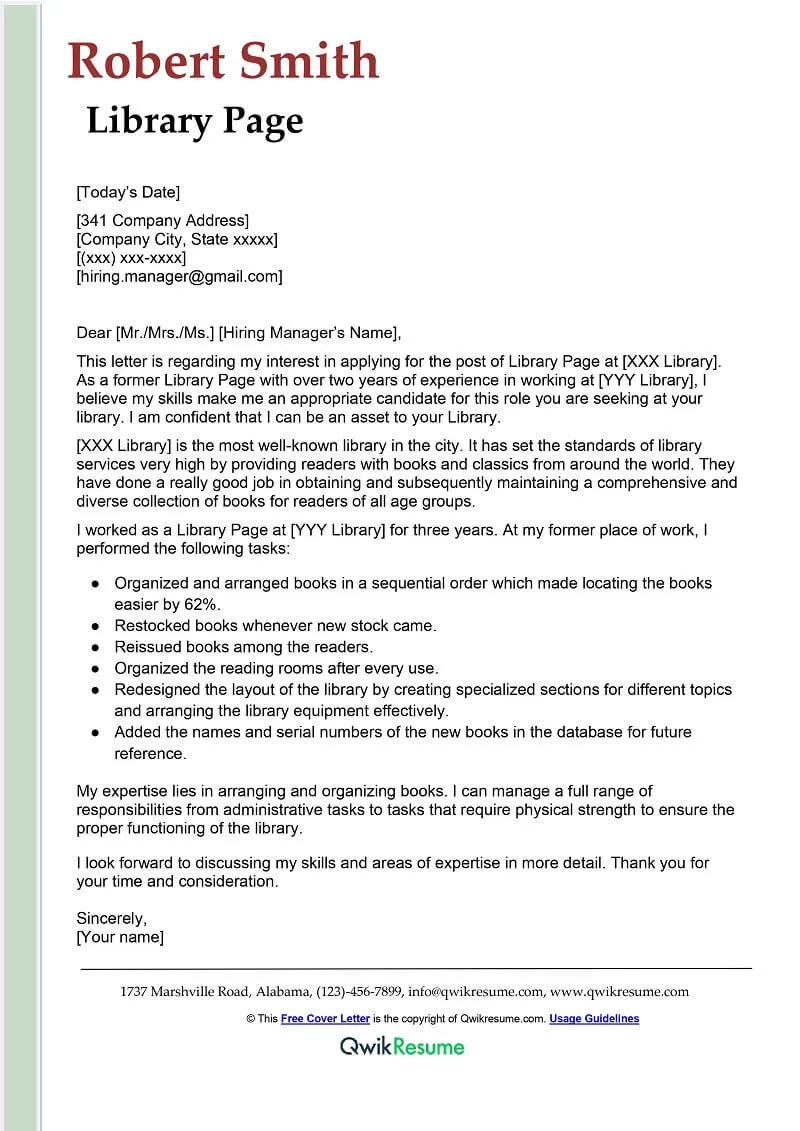
Understand the Importance of a Librarian Cover Letter
A well-crafted librarian cover letter is your first opportunity to make a positive impression on a potential employer. It’s more than just a formality; it’s a crucial tool that can significantly increase your chances of landing an interview. A cover letter allows you to highlight your skills, experience, and passion for the library profession in a way that a resume alone cannot. It offers a personalized narrative, connecting your qualifications to the specific needs of the library and the role you’re applying for. In a competitive job market, a compelling cover letter sets you apart from other applicants and demonstrates your genuine interest in the position and the institution.
What is a Librarian Cover Letter?
A librarian cover letter is a formal document submitted with your resume when applying for a librarian position. It serves as an introduction to your qualifications and a summary of your most relevant skills and experiences. Unlike a resume, which provides a factual overview of your work history and education, a cover letter allows you to tell your story, express your enthusiasm for the role, and explain why you’re the best fit for the job. It provides a space to elaborate on specific achievements, connect your skills to the job requirements, and showcase your personality and communication skills. It’s your chance to make a strong, positive first impression and to demonstrate why you deserve an interview.
Why is a Cover Letter Necessary?

In the context of a librarian job application, a cover letter is a vital component. It complements your resume by providing context and depth to your qualifications. It allows you to address any specific requirements or preferences mentioned in the job description, such as particular software skills or experience with certain library systems. Moreover, a cover letter shows that you are proactive and have taken the time to customize your application, which demonstrates your commitment to the role and the library. It also provides an opportunity to elaborate on skills not explicitly listed in your resume, such as your communication skills, problem-solving abilities, or collaborative approach. It’s a chance to showcase your passion for libraries and how you see yourself contributing to the specific institution.
Key Components of a Winning Librarian Cover Letter
A successful librarian cover letter incorporates several key components that work together to make a compelling case for your candidacy. Each element should be carefully crafted to present you in the best possible light, highlighting your relevant skills and experience while demonstrating your enthusiasm for the role. These components, when thoughtfully combined, can significantly increase your chances of securing an interview.
Contact Information and Date
Start your cover letter with your contact information. This typically includes your full name, phone number, email address, and optionally, your LinkedIn profile URL. Place this information at the top of the letter, either aligned to the left or right. Following your contact information, include the date. This is the date you are submitting the letter. The date is important because it helps the employer keep track of the application. Ensure your contact information is up-to-date and professional-looking. This is the first thing the hiring manager will see, so accuracy and clarity are essential.
Professional Greeting

Address your letter to the hiring manager or the specific person mentioned in the job posting. If you cannot find a name, use a professional greeting such as “Dear Hiring Manager” or “Dear [Library Name] Hiring Team.” Avoid generic greetings like “To Whom It May Concern.” Doing your research and addressing the letter to a specific person demonstrates your attention to detail and genuine interest in the position. It adds a personal touch and makes the letter more impactful. Always maintain a professional tone and avoid casual or informal language.
Opening Paragraph — Captivate Immediately
The opening paragraph is your chance to grab the reader’s attention. Clearly state the position you are applying for and where you saw the job posting. Briefly mention why you are excited about the opportunity and the library itself. If possible, start with a strong statement that reflects your passion for libraries or your relevant experience. This paragraph should be concise and compelling, setting the tone for the rest of your letter. It should immediately communicate your enthusiasm and highlight your key qualifications in a brief overview. The goal is to make the reader want to learn more about you.
Body Paragraphs — Showcase Your Skills
The body paragraphs are the core of your cover letter, where you demonstrate your qualifications and connect them to the job requirements. Use this space to highlight your relevant experience, skills, and achievements. Structure these paragraphs logically, addressing the key aspects of the job description one by one. Support your claims with specific examples and quantifiable results whenever possible. Focus on what you can bring to the role and the value you can provide to the library. The goal is to show, not just tell, the hiring manager why you are the perfect fit.
Highlight Relevant Experience

Focus on the experience most relevant to the librarian position you are applying for. Select the experiences that directly align with the responsibilities and requirements listed in the job description. For each experience, provide a brief overview of your role and responsibilities. Explain how your previous roles have prepared you for this new position. Use action verbs to describe your accomplishments. This section is about demonstrating how your past experiences make you qualified for this specific opportunity. You need to demonstrate your experience in such areas as reference, cataloging, and collection development.
Quantify Achievements
Whenever possible, quantify your achievements with specific numbers and data. Instead of saying “Improved user satisfaction,” say “Increased user satisfaction by 15% through improved reference services.” Quantifying your achievements makes your claims more credible and provides tangible evidence of your capabilities. This could include metrics such as the number of programs you organized, the number of patrons you assisted, or the percentage increase in library usage under your leadership. Providing data-driven results immediately showcases your effectiveness and impact in previous roles.
Address the Job Requirements
Carefully review the job description and address each of the key requirements outlined. Explain how your skills, experience, and qualifications meet those requirements. Use the language from the job posting to demonstrate that you understand what the library is looking for. This section is about aligning your skills with the specific needs of the role. Provide examples of how you have successfully used those skills in previous roles. Mention specific technologies, systems, or procedures you’re familiar with, aligning with the library’s needs.
Closing Paragraph — Call to Action

In your closing paragraph, summarize your interest in the position and reiterate your enthusiasm. Express your confidence in your ability to contribute to the library’s success. Include a call to action, such as stating that you are eager to discuss your qualifications further in an interview. Thank the hiring manager for their time and consideration. End with a strong, positive note, leaving the reader with a lasting impression of your suitability for the role.
Formal Closing and Signature
Use a formal closing such as “Sincerely,” “Respectfully,” or “Thank you.” Leave space for your handwritten signature, or if submitting electronically, type your full name. Ensure your signature is legible and professional. Double-check your contact information one last time before submitting your cover letter. The conclusion should be polite and leave a positive impression. A well-executed closing ensures that your cover letter ends on a professional note.
Formatting and Proofreading for Perfection
The presentation of your cover letter is as important as its content. A well-formatted and error-free cover letter demonstrates your attention to detail and professionalism. Following formatting guidelines and proofreading your letter carefully can make a significant difference in how your application is perceived by potential employers.
Formatting Guidelines

Use a professional font such as Times New Roman, Arial, or Calibri, with a font size between 10 and 12 points. Use standard margins (1 inch on all sides) and single-space your text, with a double space between paragraphs. Align your text to the left, avoiding justification. Keep your cover letter concise, ideally no more than one page in length. Use clear headings and bullet points to break up the text and make it easier to read. A well-formatted letter is easier on the eye and presents a polished image.
Proofreading Tips
Thoroughly proofread your cover letter for any spelling errors, grammatical mistakes, and typos. Use a spell checker and grammar checker, but also read the letter carefully yourself. It’s helpful to read the letter out loud or have a friend or colleague review it. Ensure your contact information is accurate. Pay close attention to the details, such as the correct use of punctuation and capitalization. Proofreading demonstrates that you value precision, a critical skill for a librarian.
Common Mistakes to Avoid in Your Cover Letter
Avoiding common mistakes in your cover letter can significantly increase your chances of success. These mistakes can undermine your application and leave a negative impression on the hiring manager. It’s important to be aware of these pitfalls and take steps to avoid them. By focusing on these key areas, you can significantly improve the quality and impact of your cover letter.
Generic Language and Clichés

Avoid using generic language and clichés. These phrases make your cover letter sound unoriginal and impersonal. Replace common phrases with specific examples that demonstrate your skills and accomplishments. Instead of saying “I am a team player,” provide an example of how you have worked effectively in a team. Focus on your unique strengths and what sets you apart from other applicants. Be specific and avoid using overly used, vague expressions.
Typos and Grammatical Errors
Typos and grammatical errors are one of the biggest turn-offs for potential employers. They indicate a lack of attention to detail and a lack of professionalism. Always proofread your cover letter carefully before submitting it. Use spell check and grammar check, but also read the letter yourself to catch any errors. Ask a friend or colleague to review your letter for a fresh perspective. A polished, error-free cover letter sends a clear message that you are meticulous and professional.
Focusing on Yourself Too Much
While it’s important to highlight your skills and experience, avoid making your cover letter all about you. Instead, focus on how your skills and experience align with the needs of the library and the specific role. Show that you understand the library’s mission, values, and goals. Demonstrate how you can contribute to their success. Connect your abilities to the job requirements, showing your understanding of the role and the library’s needs. Tailor your letter to show how you can make a difference for them.
Tailoring Your Cover Letter to the Specific Job
Customizing your cover letter for each job application is critical to demonstrating your genuine interest and suitability for the role. A generic cover letter will not stand out; it shows a lack of effort and commitment. Tailoring your cover letter shows the hiring manager that you’ve taken the time to understand the specific requirements of the position and the needs of the library.
Researching the Library and the Position
Before you start writing, research the library and the specific position. Visit the library’s website, read their mission statement, and learn about their services and programs. Understand the challenges and opportunities the library faces. Carefully review the job description and identify the key skills, experience, and qualifications the employer is looking for. This research will help you tailor your cover letter to the specific needs of the library and demonstrate your genuine interest in the role.
Matching Your Skills to the Job Description
Use the job description as a guide to highlight the skills and experiences that are most relevant to the position. Identify the keywords and phrases used in the job description and incorporate them into your cover letter. Provide specific examples of how you have successfully demonstrated these skills in your previous roles. Tailor your cover letter to demonstrate your ability to meet the requirements and expectations of the job. This will show the hiring manager that you are a good fit for the position.
Examples of Strong Action Verbs to Use
Using strong action verbs is key to making your cover letter impactful. Action verbs help you describe your accomplishments and demonstrate your abilities. Here are some examples:
- Managed
- Led
- Developed
- Implemented
- Created
- Organized
- Trained
- Supervised
- Researched
- Collaborated
- Improved
- Increased
Use these verbs to describe your accomplishments and quantify your results whenever possible. This will make your cover letter more engaging and convincing.
Cover Letter Example
The example of a cover letter is not possible to provide here due to the restrictions of the output format. However, I can provide information on the elements of a good cover letter and guide how you can craft it based on the previous sections.