What is a Legal Cover Letter and Why is it Important?
A legal cover letter is a crucial document accompanying your resume when applying for legal positions. It serves as your introduction to a potential employer, providing an opportunity to showcase your personality, skills, and enthusiasm for the role. Unlike your resume, which is a factual summary of your experience, the cover letter allows you to explain why you are the ideal candidate and how your qualifications align with the specific job requirements. It’s your chance to make a strong first impression and set yourself apart from other applicants. A well-crafted legal cover letter can significantly increase your chances of securing an interview and ultimately landing your desired job in the legal field. It also provides a platform to demonstrate your writing skills, which are essential in any legal profession.
Key Components of a Legal Cover Letter
A successful legal cover letter comprises several key components that work together to create a compelling narrative. These include your header and contact information, a professional salutation, an engaging opening paragraph, well-structured body paragraphs highlighting your skills and experience, a closing paragraph with a call to action, and a professional closing. Each section plays a vital role in conveying your qualifications and suitability for the position. Understanding these components and how to effectively integrate them into your letter is essential for creating a winning application that captures the attention of the hiring manager and encourages them to read your resume. Proper formatting and a polished presentation further enhance the impact of your cover letter.
Header and Contact Information

Begin your legal cover letter with a clear and professional header. Include your full name, address, phone number, and email address. This information should be consistently formatted and easy to read. Following this, include the date and the recipient’s information, which includes the hiring manager’s name, title, and the law firm or organization’s address. Ensuring accuracy is paramount; double-check all details to avoid any errors that could reflect negatively on your attention to detail. This section is the first impression on the hiring manager and sets a tone of professionalism and organization. A clean and well-formatted header demonstrates your commitment to presenting yourself as a polished candidate.
The Salutation
The salutation sets the tone for your entire letter. Ideally, address the hiring manager by name (e.g., “Dear Mr. Smith”). Researching the hiring manager’s name shows initiative and personalization. If the hiring manager’s name is unavailable, use a professional alternative like “Dear Hiring Manager” or “Dear [Law Firm Name] Hiring Team.” Avoid generic greetings like “To Whom It May Concern” as they lack personalization. The salutation should be formal and respectful, setting a positive tone from the beginning of your letter. If the job posting specifies a contact person, use their name. Proper salutation etiquette is crucial for making a positive first impression.
The Opening Paragraph Grabbing Attention
The opening paragraph is your opportunity to capture the reader’s attention. State the specific position you are applying for and where you found the job posting. Briefly mention your interest in the position and the law firm or organization. Make a strong statement about your qualifications and why you are interested in the role. Consider including a brief, compelling statement about your unique value proposition. Avoid generic opening lines. Instead, aim to hook the reader from the start by showcasing your enthusiasm and relevant skills. Your opening should immediately convey your suitability for the role and entice the reader to continue reading.
Body Paragraph 1 Highlighting Skills and Experience

The first body paragraph should focus on highlighting your relevant skills and experience. Carefully review the job description and identify the key skills and qualifications the employer is seeking. Provide specific examples from your past experiences that demonstrate your abilities. Quantify your accomplishments whenever possible, using numbers and data to showcase your achievements. For example, if you handled cases, mention how many or the success rate. Show how your skills match the needs of the position. Tailor your examples to the specific requirements outlined in the job description. Mention the relevant experience, such as drafting legal documents, conducting legal research, or managing client communications.
Body Paragraph 2 Demonstrating Interest and Alignment
In your second body paragraph, show your genuine interest in the specific law firm or organization and explain why you are a good fit for their culture. Research the firm’s values, mission, and recent achievements. Explain how your values align with theirs and how you can contribute to their success. Detail what specifically attracts you to their work. Show that you understand the legal field and the type of cases the firm handles. If you have a particular interest in a specific area of law, mention that. Showing knowledge of the firm will demonstrate your initiative and desire to join their team. If you have met anyone from the firm, mention it.
Body Paragraph 3 Showcasing Achievements and Results
The third body paragraph is where you showcase your results and achievements. Focus on specific accomplishments that prove your ability to excel in the role. Use the STAR method (Situation, Task, Action, Result) to structure your examples, providing context, outlining the task you undertook, the actions you took, and the positive results you achieved. Quantify your achievements whenever possible to provide tangible evidence of your capabilities. For example, state how you improved efficiency, reduced costs, or increased client satisfaction. Provide evidence of the positive impact you have made in your previous roles. Highlight your ability to overcome challenges and achieve results. This will demonstrate your value as a candidate and leave a lasting impression.
The Closing Paragraph Call to Action

Your closing paragraph should reiterate your interest in the position and express your enthusiasm for the opportunity. Reiterate your key qualifications and reiterate your interest in the position. Thank the hiring manager for their time and consideration. Include a clear call to action, such as stating that you are available for an interview and eager to discuss your qualifications further. Provide your contact information again, making it easy for the hiring manager to reach you. Finish with a professional closing, such as “Sincerely” or “Respectfully,” followed by your typed name. The closing paragraph is your last chance to leave a positive impression, so make it count.
Formatting and Design Tips for a Professional Look
Formatting and design are vital for making your cover letter easy to read and visually appealing. Use a professional font such as Times New Roman, Arial, or Calibri, and set the font size to 11 or 12 points. Use single-line spacing with a blank line between each paragraph to enhance readability. Maintain consistent margins (1 inch on all sides). Avoid excessive use of bolding, italics, or underlining. Keep the letter to one page, as hiring managers often have limited time. Use bullet points to highlight key skills or accomplishments. Ensure your letter is free from any grammatical errors or typos. Proper formatting and design enhance the overall impression and demonstrate your professionalism.
Proofreading and Editing Ensuring Accuracy
Proofreading and editing are essential steps to ensure your legal cover letter is polished and error-free. Carefully proofread your letter for any grammatical errors, spelling mistakes, and typos. Read the letter aloud to check the flow and clarity of your writing. Use grammar and spell-check tools, but don’t rely on them entirely. Have a friend, family member, or career counselor review your letter for feedback. Pay close attention to the tone, ensuring it’s professional and suitable for the legal field. Correct any formatting inconsistencies. A well-proofread and edited cover letter demonstrates your attention to detail and professionalism, increasing your chances of getting an interview.
Common Mistakes to Avoid in a Legal Cover Letter

Avoiding common mistakes can significantly improve your cover letter. Avoid generic templates. Do not use clichés or overly formal language. Do not make spelling or grammatical errors. Do not exceed one page in length. Do not include irrelevant information or details unrelated to the job description. Avoid lying or exaggerating your experience. Do not send the wrong cover letter for a specific job. Do not have a negative tone or bad-mouthing previous employers. Making these mistakes can hurt your chances of getting an interview. Ensure your cover letter is tailored to the specific job. Prioritize quality over quantity.
Tailoring Your Legal Cover Letter to Specific Jobs
Customization is critical for maximizing your cover letter’s effectiveness. Always tailor your cover letter to each specific job you apply for. Carefully review the job description and identify the key requirements. Highlight the skills and experiences that align with the job’s needs. Use keywords from the job description to showcase your qualifications. Research the law firm or organization and address how your skills and values align with theirs. Showing that you understand the requirements of the position will make your cover letter stand out. Generic cover letters are easily discarded. Tailoring demonstrates your interest and attention to detail.
Legal Cover Letter Template Example and Structure
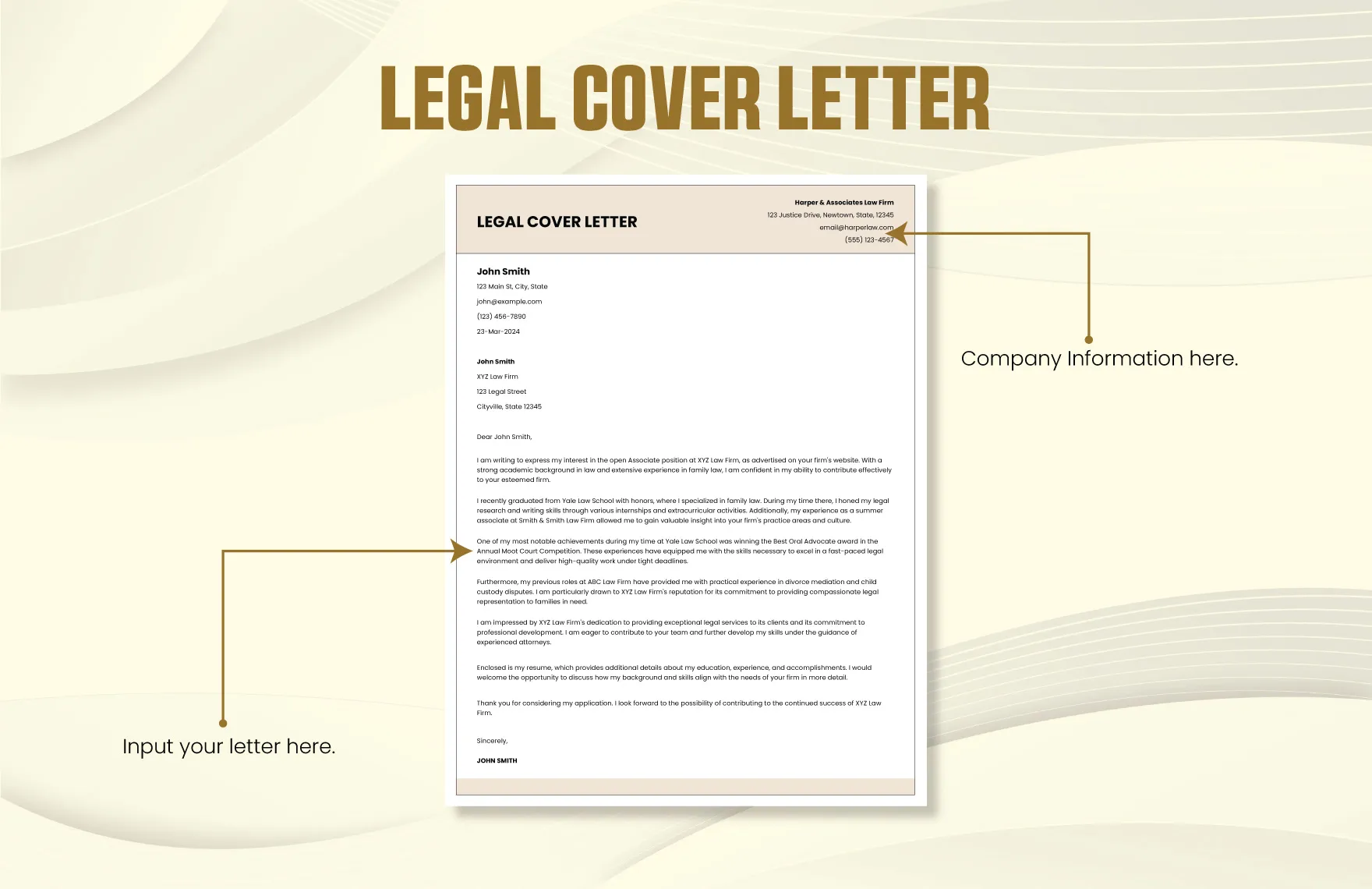
A good template can help you structure your cover letter effectively. Start with a header, including your contact information and the date. Then, include the recipient’s information, such as the hiring manager’s name, title, and law firm’s address. Use a professional salutation. Use an opening paragraph stating the position and your interest. In the body paragraphs, highlight your skills, experience, and achievements. Include examples and quantify your achievements. In your closing paragraph, express your interest and include a call to action. End with a professional closing and your typed name. Several templates are available online, but customize the template with your personal information. The structure provides a framework to present your qualifications.
Example Legal Cover Letter

Here’s a sample example to illustrate how a legal cover letter should be written. [Insert an example of a complete legal cover letter here, covering all the required components like the header, salutation, opening, body paragraphs highlighting skills and experiences, closing, etc. The example should be formatted professionally, using clear language and addressing a specific legal role]. Use this as a reference when creating your own cover letter. Always remember to replace the example content with your own information and experiences.
Tips for Sending Your Legal Cover Letter
Once your legal cover letter is ready, follow these tips for sending it. Always save your cover letter in PDF format to preserve the formatting. If submitting online, follow the application instructions carefully. Proofread the email or application before submitting. Ensure your resume and cover letter are consistent in terms of information and formatting. If sending by email, include a concise subject line, stating the position you are applying for. In the email, briefly reiterate your interest and attach your cover letter and resume. Follow up with the hiring manager (if permitted) after a reasonable period. These steps will enhance your chances of making a positive impression. Sending your cover letter correctly demonstrates your attention to detail.