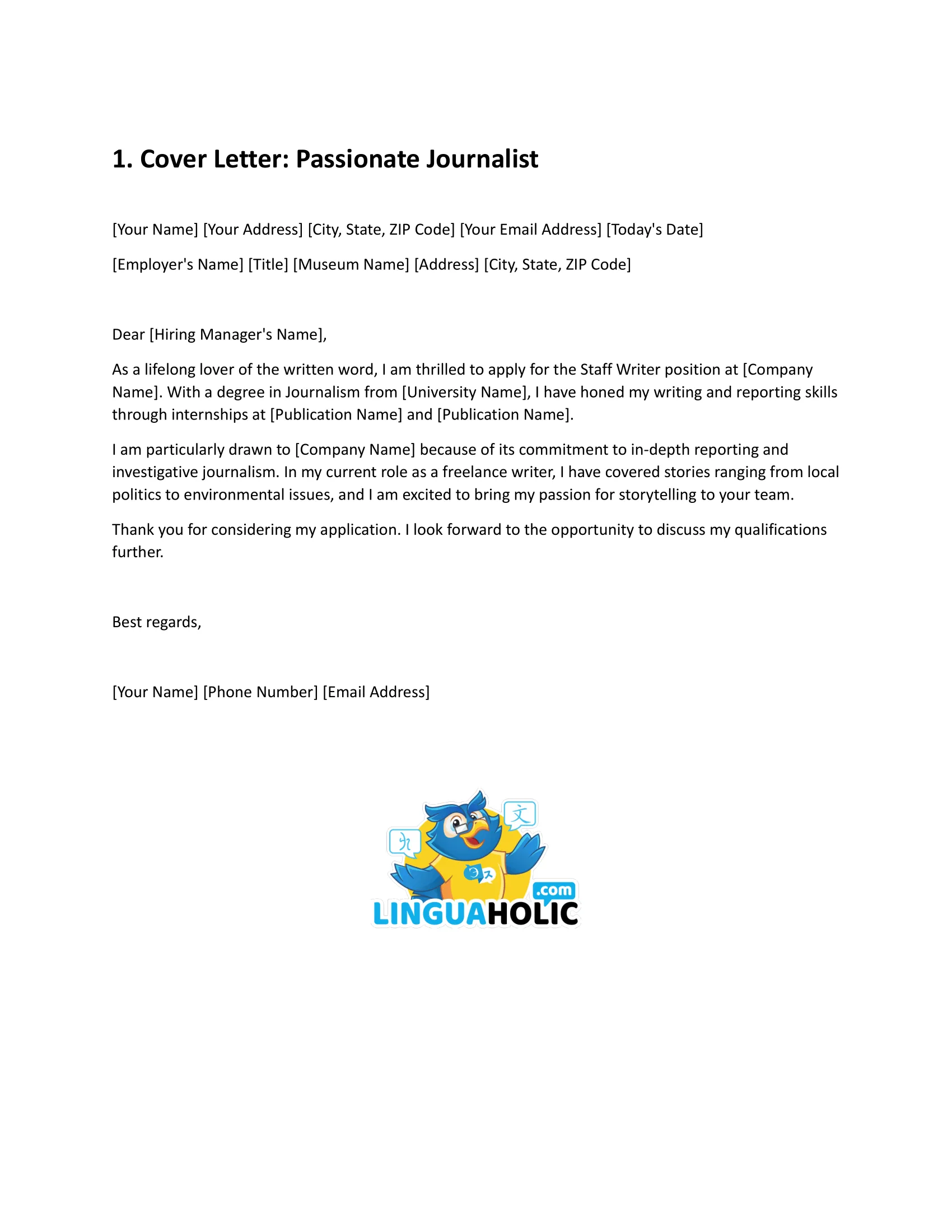
Understanding the Importance of a Journalism Cover Letter
In the competitive world of journalism, a well-crafted cover letter is your first opportunity to make a lasting impression on potential employers. It’s more than just a formality; it’s your chance to showcase your personality, skills, and passion for storytelling. While your resume provides a snapshot of your experience, your cover letter allows you to tell a compelling narrative, explaining why you’re the perfect fit for the role and the organization. It’s where you can demonstrate your writing prowess, your understanding of the media landscape, and your enthusiasm for journalism. Neglecting this crucial step can significantly hinder your chances of landing your dream job. A strong cover letter sets you apart from the crowd, highlighting your unique qualifications and demonstrating your genuine interest in the opportunity. In a field where clear and concise communication is paramount, your cover letter is your first test.
Why a Cover Letter Matters for Journalism
A cover letter serves multiple vital purposes in your job application. Firstly, it demonstrates your genuine interest in the specific role and the publication or organization. Generic applications are easily spotted, and a well-tailored cover letter signals that you’ve taken the time to research the company and understand their needs. Secondly, it allows you to elaborate on your resume, providing context and depth to your experiences. You can highlight specific projects, skills, and achievements that align with the job requirements. Thirdly, it showcases your writing abilities, which are crucial in journalism. Your cover letter is a sample of your writing style, your ability to communicate effectively, and your storytelling capabilities. Finally, it’s an opportunity to express your personality and enthusiasm, making you more memorable to the hiring manager. It’s a chance to make a human connection and create a positive first impression that goes beyond the facts presented in your resume.
Key Elements of a Compelling Journalism Cover Letter

A winning journalism cover letter is a carefully constructed document that combines professionalism, clarity, and a touch of personality. It needs to be structured logically, conveying key information while engaging the reader. A well-crafted cover letter should include clear contact information, a personalized greeting, a compelling opening, a strong body highlighting your relevant skills and experiences, a tailored section demonstrating your understanding of the publication, a powerful closing, and, of course, meticulous proofreading. Each element plays a crucial role in creating a positive and lasting impression, making the hiring manager want to learn more about you. Remember that your cover letter is a reflection of your attention to detail, your communication skills, and your genuine interest in the role and the organization.
Formatting Your Cover Letter
Proper formatting is essential for presenting your cover letter professionally. Ensure it is easy to read and visually appealing. Use a standard business letter format with a clear font like Times New Roman or Arial, a font size between 11 and 12 points, and 1-inch margins on all sides. Keep the tone formal yet engaging, and use a clear, concise writing style. Avoid excessive jargon and keep sentences and paragraphs relatively short. Ensure your letter fits on a single page, as hiring managers often have limited time to review applications. Use bullet points or numbered lists to highlight key achievements and skills. Proofread meticulously for any grammatical errors or typos before submitting. Adhering to these formatting guidelines demonstrates your attention to detail and professionalism, both vital qualities in journalism.
Contact Information and Date
At the top of your cover letter, include your full name, address, phone number, and email address. This information should be clearly presented and easy to find. Below your contact information, include the date. This helps the hiring manager quickly identify when the letter was written and submitted. Using a professional email address is also crucial, as it creates a positive first impression. Ensure your contact information is up-to-date and accurate. This section is the foundation, allowing the hiring manager to contact you if they are interested in your application. Make sure the date format is consistent and uses a recognized style to make your letter look more professional.
Addressing the Hiring Manager

Whenever possible, address your cover letter to a specific person. Research the hiring manager’s name and title, showing you’ve taken the time to learn about the organization. If you can’t find a specific name, use a formal greeting like “Dear Hiring Manager” or “Dear [Department Name] Hiring Team.” Avoid generic greetings like “To Whom It May Concern” as they suggest a lack of research. Using a name adds a personal touch and demonstrates your genuine interest in the role. It creates a more engaging connection and makes the letter feel less impersonal. A personalized greeting immediately grabs the reader’s attention and makes them more likely to read the rest of your letter carefully.
Crafting a Strong Opening
Your opening paragraph is your first and often only chance to grab the reader’s attention. Start strong by stating the position you are applying for and how you learned about the opportunity. Briefly mention your most relevant skill or experience to immediately capture the hiring manager’s interest. You can also express your enthusiasm for the role and the organization. Avoid generic phrases like “I am writing to express my interest.” Instead, focus on what makes you stand out. Highlight a specific achievement, a relevant skill, or your passion for journalism to demonstrate your suitability for the role. The goal is to create a positive first impression and make the hiring manager want to read on. A compelling opening ensures your cover letter is read and considered carefully.
Highlighting Your Skills and Experience
The body of your cover letter should showcase your skills and experience most relevant to the job requirements. Carefully review the job description and identify the key skills and qualifications the employer is seeking. Provide concrete examples of how you have demonstrated these skills in previous roles or projects. Quantify your achievements whenever possible using numbers and data to illustrate your impact. Use strong action verbs to describe your accomplishments, such as “wrote,” “edited,” “investigated,” or “reported.” Tailor the examples to match the specific needs of the organization, highlighting your ability to contribute to their goals. Show, don’t just tell, the hiring manager why you are the best candidate by providing specific examples and demonstrating your skills. This section is where you demonstrate your value and make your application stand out.
Showcasing Relevant Journalism Experience

Provide detailed information about your journalism experience, including internships, freelance work, and any relevant academic projects. For each experience, mention the publication or organization, your role, and the duration of your involvement. Describe your responsibilities and the types of stories you covered. Include details about your writing, editing, and reporting experience, emphasizing any specializations or areas of expertise. If you have a portfolio, be sure to include a link or mention specific examples of your work. Tailor your experience to match the specific job requirements, emphasizing relevant skills and achievements. Highlight any awards, recognitions, or positive feedback you received. Demonstrate your knowledge and experience in the field of journalism and show how you can contribute to the success of the organization.
Quantifying Achievements and Impact
Whenever possible, quantify your achievements to demonstrate your impact. Use numbers and data to illustrate your successes. For example, instead of saying “Increased social media engagement,” say “Increased social media engagement by 30% in six months.” If you’ve written a series of articles, mention the number of articles or the readership numbers. If you’ve conducted an investigative report, mention the impact of your findings. Providing quantifiable results adds credibility to your claims and demonstrates your ability to achieve results. Use statistics, percentages, and specific numbers to showcase your achievements. This helps the hiring manager assess your effectiveness and understand the value you can bring to the organization. Numbers make a stronger impact than vague descriptions.
Demonstrating Your Writing Skills
Your cover letter is a showcase of your writing ability. Use clear, concise language and avoid jargon. Vary your sentence structure and tone to keep the reader engaged. Show, don’t just tell, the hiring manager about your writing skills. Use compelling storytelling to showcase your ability to capture attention and convey information effectively. Ensure your writing is free of grammatical errors and typos. Pay attention to details such as sentence structure, word choice, and overall clarity. Demonstrate your ability to write for different audiences and in various styles, depending on the job requirements. A well-written cover letter demonstrates your strong command of the English language and highlights your ability to communicate effectively. This is especially important in the field of journalism, where strong writing skills are essential.
Tailoring Your Letter to the Specific Job

Avoid using a generic cover letter. Tailor your letter to each specific job application. Carefully review the job description and identify the key requirements and qualifications. Highlight the skills and experiences that match the job description. Research the publication or organization to understand their mission, values, and the types of stories they cover. Demonstrate your understanding of their work and how you can contribute to their goals. Customize your letter to reflect your genuine interest in the specific opportunity. Tailoring shows that you care enough to invest time in preparing your application. It makes you stand out from other candidates who may be using a generic template, and significantly increases your chances of getting an interview. This level of personalization shows your commitment to the role and organization.
Researching the Publication or Organization
Thoroughly research the publication or organization before writing your cover letter. Visit their website, read their recent articles, and understand their style and audience. Research their mission, values, and the types of stories they cover. Identify any specific projects or initiatives you are interested in. This research will help you tailor your cover letter and demonstrate your understanding of their work. Show that you have taken the time to understand their goals and challenges, and that you can contribute to their success. Understanding the organization shows you’re committed and interested in contributing meaningfully to their success. This demonstrates you are more than just looking for a job. You are looking to be part of the team.
Emphasizing Your Fit with the Culture
Demonstrate how your values and work style align with the organization’s culture. Read about the organization’s mission, values, and any information about its workplace culture, if available. Highlight any skills or experiences that align with their values. If the organization emphasizes teamwork, mention your experience working collaboratively. If they value innovation, showcase your creativity and willingness to try new things. Showing that you will fit within the culture of the team will greatly increase your chances of being hired. This demonstrates you’re not only qualified, but also a good fit for the team. This will help the hiring manager visualize you working with the team.
Writing a Powerful Closing

Your closing paragraph is your last chance to make a strong impression. Summarize your key qualifications and reiterate your interest in the position. Express your enthusiasm and make a call to action. Thank the hiring manager for their time and consideration. Mention your availability for an interview. Avoid generic phrases such as “Thank you for your consideration.” Instead, personalize your closing. Keep it concise, professional, and memorable. Make the closing impactful, leaving a lasting impression. The closing is just as important as the opening. Use it as a way to cement the hiring manager’s positive impression of you.
Expressing Enthusiasm and Call to Action
Express your genuine enthusiasm for the role and the organization. Reiterate your interest and why you are excited about the opportunity. Make a clear call to action by stating that you are available for an interview and look forward to hearing from them soon. Make it easy for the hiring manager to contact you. Provide your contact information again, and be sure to follow up a week or two after sending your application. A strong call to action keeps the hiring manager engaged. It shows confidence and initiative, which are valuable traits in journalism. End on a positive and confident note, signaling your eagerness for the next step in the hiring process.
Proofreading and Editing Your Cover Letter
Proofreading and editing are critical steps in ensuring your cover letter is polished and professional. Check for grammatical errors, typos, and any inconsistencies. Have someone else read your letter for a fresh perspective. Pay close attention to sentence structure, word choice, and overall clarity. Use spell-check and grammar-check tools, but don’t rely on them entirely. Read your letter aloud to catch awkward phrasing or any potential issues. A well-edited cover letter demonstrates your attention to detail and your commitment to quality. It also helps avoid any misunderstandings. A professional cover letter is essential in the field of journalism, where precision and accuracy are paramount. Proofreading is a must; even the smallest mistake can hurt your application.
Common Mistakes to Avoid

Avoid these common mistakes to make your cover letter stand out positively. First, do not use a generic cover letter. Customize it to each job you apply for. Second, avoid lengthy or rambling paragraphs, keeping your writing concise. Third, do not include irrelevant information, focusing on the skills and experiences that are most relevant to the job. Fourth, avoid typos and grammatical errors. Always proofread carefully. Fifth, do not use a negative tone or complain about previous employers. Sixth, don’t oversell yourself; be confident, but remain realistic about your skills and experience. Following these guidelines will help you create a compelling cover letter.
Using Strong Action Verbs
Use strong action verbs to describe your accomplishments and responsibilities. Action verbs make your cover letter more dynamic and engaging. Instead of writing “responsible for writing articles,” write “wrote articles.” Avoid weak verbs such as “helped” or “assisted.” Instead, use verbs such as “created,” “managed,” “developed,” “implemented,” “investigated,” “reported,” and “edited.” Choose verbs that accurately reflect your contributions and achievements. Using strong action verbs makes your cover letter more impactful and demonstrates your skills and abilities effectively. This also highlights your value to the employer. An action-oriented tone is a must in journalism.
Example Cover Letter Template
While every cover letter should be tailored, here’s a basic template to get you started
[Your Name] [Your Address] [Your Phone Number] [Your Email]
[Date]
[Hiring Manager Name] [Hiring Manager Title] [Organization Name] [Organization Address]
Dear [Mr./Ms./Mx. Last Name],
[Opening paragraph: State the position, how you found it, and your most relevant skill or achievement]
[Body paragraph 1: Highlight relevant skills and experience, providing examples. Quantify achievements]
[Body paragraph 2: Show your understanding of the organization and how you can contribute. Include details about your portfolio]
[Closing paragraph: Summarize your key qualifications, express your enthusiasm, and make a call to action]
Sincerely, [Your Signature] [Your Typed Name]
Remember to customize this template to match the specific requirements of the job and the organization. It is simply a starting point, and each cover letter should be unique and personalized.