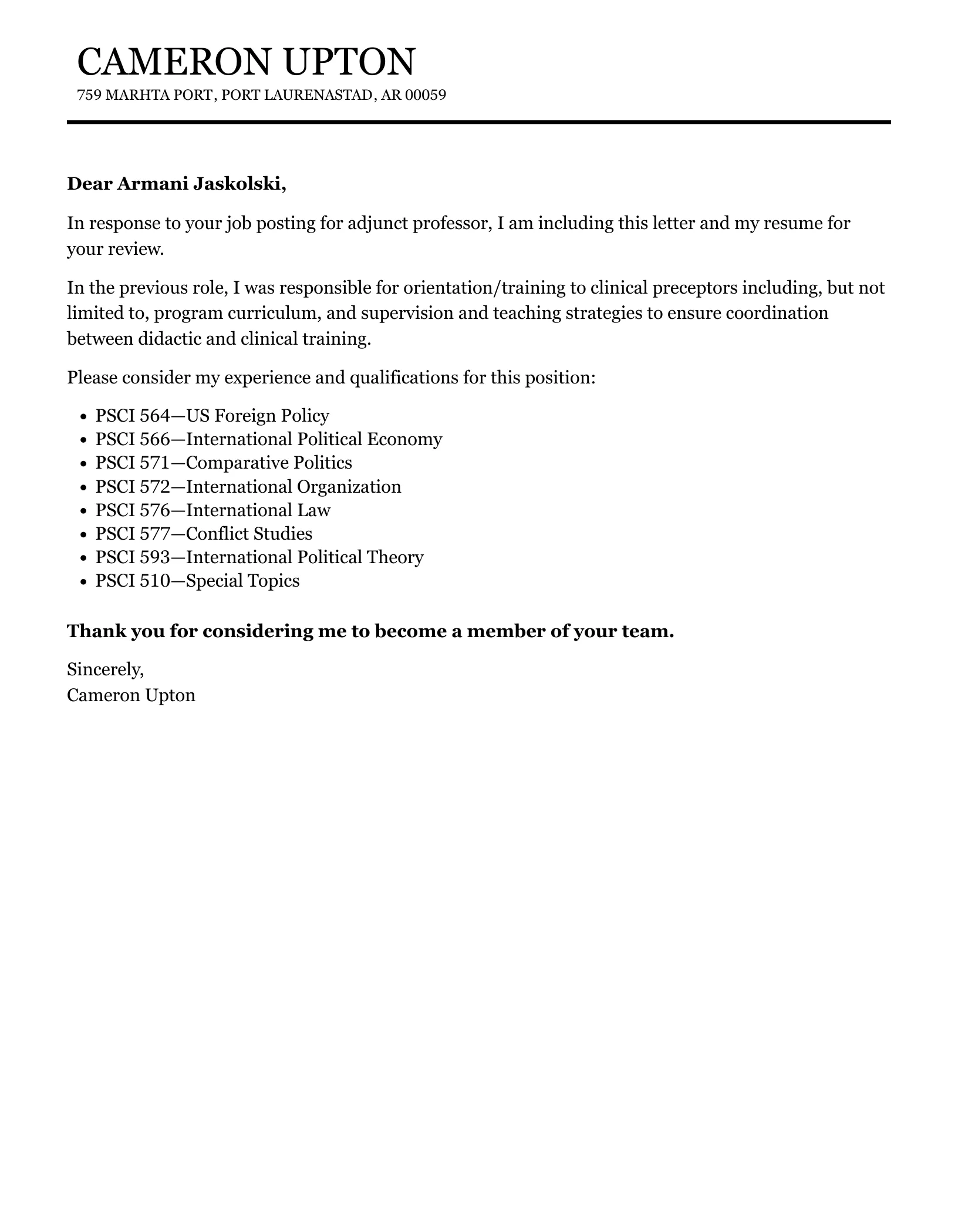
Cover Letter Essentials
A well-crafted cover letter is essential for any job application, especially when you lack direct experience. It serves as your introduction to the hiring committee and allows you to highlight your skills, qualifications, and enthusiasm for the position. While it’s true that experience is valuable, a compelling cover letter can effectively showcase your potential and convince the reader that you’re a strong candidate. This guide breaks down the key components of a successful cover letter for an adjunct professor position, even if you’re just starting your academic career. Remember, the goal is to demonstrate your value and make a positive first impression.
Header Information
Your Contact Details

Begin your cover letter with your contact information. This should be at the top, left-aligned. Include your full name, phone number, professional email address, and optionally, your LinkedIn profile URL. Make sure your email address is professional; avoid using nicknames or informal addresses. Accuracy is key here, as this is how the hiring committee will contact you. Double-check all details to ensure they are correct and easily accessible. This section establishes your identity and provides the means for the recipient to reach you.
Date
Below your contact information, include the date you are writing the letter. This is a simple, yet important detail that helps the recipient understand when the application was submitted. The date should be formatted consistently (e.g., Month Day, Year) and placed under your contact information. Ensure it is current, reflecting the date you are sending the cover letter. This formatting standard is crucial for professional correspondence, offering clarity on the application’s timeline and demonstrating attention to detail.
Recipient’s Contact Information
Next, provide the recipient’s contact information. This includes the name of the hiring manager (if known), their title, the department, and the university or college’s address. Addressing the letter to a specific person is always preferable, as it shows that you’ve done your research and are genuinely interested in the position. If you can’t find a specific name, use a general salutation such as “Dear Hiring Committee.” This shows professionalism and attentiveness. Using the correct information significantly increases your chances of making a positive impression.
Opening Paragraph

Expressing Enthusiasm
Start your cover letter with a strong opening that immediately captures the reader’s attention. Express your enthusiasm for the position and the institution. Mention where you found the job posting and why it caught your eye. Consider including a brief, compelling statement about your interest in the specific field or the university’s mission. This sets a positive tone and shows that you’re genuinely interested in the opportunity. Your opening paragraph should clearly state the position you are applying for and what excites you about it. An enthusiastic start is a key element.
Stating the Position
Clearly state the specific adjunct professor position you are applying for. Be precise, using the exact title from the job posting. This ensures that the hiring manager knows you understand the requirements of the role and that your application is targeted. Mention the department and any specific subjects you are qualified to teach. This is the foundation of your letter, immediately communicating your goal. Avoid ambiguity; make it clear what role you are seeking. Use the official title to convey accuracy.
Highlighting Transferable Skills

Since you may lack direct experience as an adjunct professor, focus on highlighting transferable skills. These are skills you’ve gained through education, research, volunteer work, or other experiences that are relevant to teaching and academic roles. This section allows you to bridge the gap between your current experience and the requirements of the job. Think about how your skills translate to the demands of the position. Emphasize any experience you have with public speaking, mentoring, leadership, communication, or project management. These will be assets in the classroom.
Skills from Education
Your educational background is a significant asset. Discuss how your coursework and academic achievements have prepared you for an adjunct professor role. Mention relevant courses, research projects, or presentations you’ve completed. Highlight any teaching assistant roles or opportunities to present information to large groups. If you’ve received any academic awards, or scholarships, or been involved in any extracurricular activities that required you to instruct or lead, mention them. Show how your education has equipped you with the necessary skills and knowledge.
Skills from Other Experiences
If you have experience outside of academia, identify transferable skills. For example, if you’ve worked in a professional setting, highlight your communication, organization, and time-management skills. If you’ve volunteered, talk about any leadership or training experience you’ve had. Even part-time jobs can demonstrate valuable skills like responsibility, customer service, or problem-solving. Adapt your experiences to the specific needs of the role. Make sure your chosen examples directly address the requirements listed in the job description. These skills can be highly valued.
Emphasizing Relevant Coursework

Showcase your familiarity with specific topics. Mention any coursework that aligns with the subjects you would be teaching. Describe any projects or assignments that demonstrated your understanding of the subject matter. If you have experience developing lesson plans or presentations, mention them here. Tailor this section to the particular courses the institution offers, demonstrating your suitability. Provide specific examples to illustrate your abilities. This shows your readiness.
Showcasing Research or Projects
If you’ve been involved in research projects or have completed independent studies, detail your contributions and findings. Explain the methods you used, the outcomes achieved, and any publications or presentations that resulted. Research experience can strongly indicate your ability to engage in scholarly activities, which is crucial for an adjunct professor. Even if your research is not directly related to teaching, it showcases your critical thinking, analytical skills, and commitment to learning. Clearly articulate your role and any significant accomplishments.
Quantifying Achievements
Use numbers and data to quantify your achievements whenever possible. Instead of saying “I improved student grades,” say “I improved student grades by 15%.” Use metrics to show the impact of your work. This provides concrete evidence of your skills and accomplishments. Examples include the number of students you mentored, the size of your research team, or the results of a project. Quantifiable data adds credibility and makes your cover letter more persuasive. This makes a big impact on the hiring manager.
Body Paragraphs

The body paragraphs are where you provide detailed information about your qualifications and how they align with the job requirements. Each paragraph should focus on a specific skill or experience, using examples to support your claims. Tailor these paragraphs to the specific requirements listed in the job description. Explain how you can contribute to the department and the institution. Demonstrate how your skills align with the needs of the academic role. The key is to show how your background makes you a good fit.
Demonstrating Knowledge of the Institution
Research the university or college to demonstrate your genuine interest in the position. Mention specific programs, initiatives, or research areas that resonate with you. Explain why you want to teach at that particular institution, and what attracts you to its mission or values. Refer to the institution’s website, faculty profiles, and recent publications to show that you have a clear understanding of its academic environment. Showing knowledge and interest will show that you are serious about the opportunity. Addressing the institution’s values will help you stand out.
Tailoring to the Specific Job Requirements
Carefully review the job description and tailor your cover letter to address the specific requirements listed. Use keywords from the job description to ensure your application is noticed by applicant tracking systems and hiring managers. Provide examples that demonstrate how your skills and experiences match the listed requirements. If the job requires experience with a specific software or teaching method, mention it. Showing this effort demonstrates you have done your homework and are a perfect fit for the role. Tailoring your letter is a critical part of the process.
Addressing the Lack of Experience Directly

Address the lack of direct experience honestly and proactively. Instead of ignoring the issue, acknowledge it and focus on what you can offer. Emphasize your transferable skills, your eagerness to learn, and your commitment to the role. Explain any steps you’ve taken to prepare for the position, such as relevant coursework, workshops, or certifications. Frame your limited experience as an opportunity for growth and development. Show that you are motivated and ready to excel. Use your cover letter to describe your value.
Highlighting Potential and Eagerness
Show the hiring manager that you are prepared to invest in your development. Express your willingness to adapt and learn. Focus on your potential and how you will contribute to the team. Highlight your research, teaching, and publication goals. Show that you are excited and enthusiastic about contributing to the academic community. Highlight your enthusiasm and potential to make you a valuable asset. Demonstrating a strong commitment is more important than any experience.
Using Strong Action Verbs
Use strong action verbs to describe your skills and achievements. This makes your cover letter more engaging and demonstrates your capabilities. Examples include: ‘developed,’ ‘implemented,’ ‘managed,’ ‘created,’ ’led,’ ‘collaborated,’ ‘analyzed,’ ‘researched,’ ’taught,’ and ‘mentored.’ Action verbs show initiative and results. This makes your letter more compelling. Use a variety of action verbs to keep your letter dynamic and interesting. Choosing the right words is crucial.
Closing Paragraph
The closing paragraph is your final opportunity to make a positive impression. This should include a call to action and reiterate your interest in the position. Always thank the hiring manager for their time and consideration. Keep this section concise and impactful. Make it memorable to increase your chances of being selected for the next step.
Reiterating Interest and Availability
Reiterate your interest in the position and the institution. Restate why you are a good fit for the role and summarize your key qualifications. Mention your availability for an interview and any other follow-up. This paragraph summarizes your qualifications and reinforces your interest in the position. This reinforces your commitment to the opportunity. Make it clear you are available for the interview.
Thanking the Hiring Manager
Express your gratitude to the hiring manager for considering your application. Thank them for their time and attention to detail. A simple, genuine thank you is polite and shows your appreciation for the opportunity. This final touch demonstrates your professionalism and respect. Your thank you should be sincere.
Call to Action
Include a clear call to action. State that you are available for an interview at their earliest convenience. Provide your contact information again, or mention that you look forward to hearing from them soon. Make it easy for the hiring manager to take the next step. A call to action is essential for securing your interview. The next step is to be interviewed.
Formatting and Proofreading
Formatting and proofreading are critical to creating a professional cover letter. The appearance of your letter says a lot about your attention to detail and professionalism. Ensure it is clear, concise, and error-free. A well-formatted and properly proofread cover letter shows that you care about the position. A lack of attention to detail can undermine your application.
Font and Formatting Guidelines
Choose a professional font such as Times New Roman, Arial, or Calibri. Use a font size of 11 or 12 points. Ensure your letter has consistent formatting, with clear margins and spacing. Keep your letter to one page, if possible. Use standard business letter format. Good formatting makes your letter easy to read. Make sure the information is legible and well-organized. The use of a clean format makes for a positive impression.
Proofreading for Errors
Thoroughly proofread your cover letter for any grammatical errors, typos, and inconsistencies. Spellcheck is a valuable tool, but it is not foolproof. Read your cover letter carefully, or ask someone else to review it for you. Errors can undermine your credibility, so proofread carefully. Check all your details. Ensure the language is clear and professional. Taking the time to proofread is key.