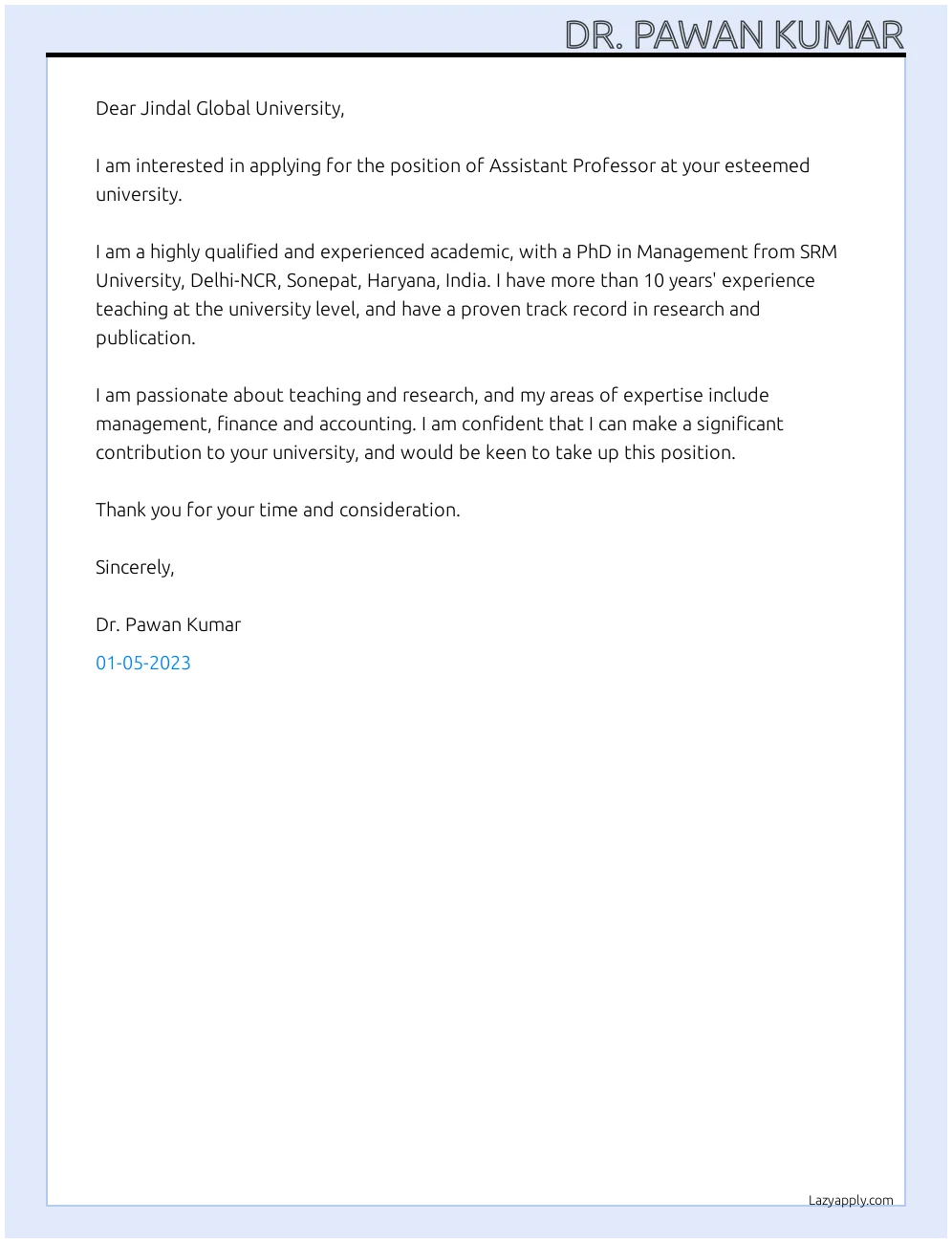
Understanding the Cover Letter’s Purpose
A cover letter is a crucial document when applying for a college professor position. It serves as your introduction to the hiring committee and provides an opportunity to showcase your qualifications, skills, and experience in a way that a resume alone cannot. The primary purpose is to persuade the committee that you are the best candidate for the job, aligning your skills and research interests with the specific needs of the department and university. It’s a chance to make a strong first impression and highlight what makes you unique, beyond the facts and figures listed in your resume. Your cover letter must reflect your understanding of the position and demonstrate why you’re a great fit for the role. A well-crafted cover letter increases your chances of getting an interview.
Why a Great Cover Letter Matters
In the highly competitive field of academia, a great cover letter is a must. It offers a personalized context to your application. It highlights the personality of the applicant. It adds depth and detail to your resume, allowing you to articulate your career goals, teaching philosophy, and research interests. A strong cover letter enables you to connect your skills and experiences directly to the job requirements, demonstrating to the search committee why you are uniquely qualified. Also, it shows your writing skills. Because the search committee likely reads many applications, a compelling cover letter immediately grabs their attention and sets you apart from other candidates. It showcases your ability to communicate effectively and persuasively. It also reveals your genuine interest in the position and the university.
Key Components of an Effective Cover Letter

Contact Information and Salutation
Start with your contact information at the top, including your name, address, phone number, and professional email address. Always address the letter to a specific person if possible; research the department website or contact the university to find the name of the search committee chair. If you cannot find a specific name, use a professional salutation, such as ‘Dear Search Committee’. Avoid generic salutations. Ensure your contact information is easy to read and up-to-date. Your email address should sound professional to reflect your image.
Crafting a Powerful Opening Paragraph
The opening paragraph is your first chance to make an impact. Start with a strong hook that grabs the reader’s attention. State the position you are applying for and how you learned about it. Briefly highlight your most relevant qualifications and express your enthusiasm for the role and the institution. Show that you understand the requirements of the position and the university’s mission. Your opening should be concise, engaging, and clearly state your purpose. A compelling opening shows that you have put time and effort in your application. Use this section to create a positive and memorable first impression. Show your appreciation for the opportunity to be considered for the position.
Highlighting Relevant Skills and Experience

The body of your cover letter is where you demonstrate how your skills and experiences align with the job requirements. Focus on the experiences and skills that are most relevant to the position. Use specific examples to illustrate your capabilities, such as research projects, teaching experience, publications, and presentations. Use keywords from the job description to show that you are a strong match. Organize your experiences logically, such as chronologically or thematically, to show a clear narrative. Customize your letter to highlight the specific skills and experiences most important to the position and the university.
Quantifying Achievements and Impact
Wherever possible, quantify your achievements with data. Use numbers to demonstrate the impact of your work, such as the number of students you’ve taught, the grant funding you’ve secured, or the impact factor of your publications. For example, instead of saying ‘I have experience teaching large classes,’ you could say ‘I have successfully taught courses with over 100 students.’ Quantifying your achievements provides concrete evidence of your abilities and demonstrates your contributions. It makes your accomplishments more compelling and memorable to the search committee.
Tailoring Your Letter to the Specific Position
Avoid using a generic cover letter; always tailor it to the specific position and institution. This demonstrates that you’ve invested time and effort in understanding the role and the university’s needs. Research the department, its faculty, and its research focus. Highlight how your skills and experiences align with the specific requirements outlined in the job description. Your letter must show that you understand the department’s mission and the university’s values. Personalize your letter to include aspects of the position that excites you. Show that you have a genuine interest in joining the department and contributing to its success.
Researching the Department and University

Before writing your cover letter, thoroughly research the department and university. Visit the department website to learn about the faculty, research interests, and curriculum. Explore the university’s mission, values, and strategic goals. Understanding the university’s culture allows you to tailor your letter to align with its values. Mention specific research areas, initiatives, or programs that align with your interests and goals. Demonstrate your knowledge of the university’s goals. This shows that you have done your homework and are a good fit for the institution.
Addressing the Selection Criteria
Carefully review the job description and identify the key selection criteria. Address these criteria explicitly in your cover letter, using specific examples to demonstrate how you meet each requirement. If the job description emphasizes teaching experience, provide examples of your teaching methods, curriculum development, and student evaluations. If research is a priority, describe your research publications, grants, and presentations. Align your skills, experience, and goals with the desired qualifications. This shows the search committee that you have what they are looking for. Ensure that your letter reflects all of the job requirements.
Structuring the Body Paragraphs Effectively
The Importance of Clear and Concise Writing

Use clear, concise language and avoid jargon or overly complex sentence structures. Your cover letter should be easy to read and understand. Get straight to the point. Each paragraph should have a clear topic sentence and support your points. Use active voice. This makes your writing more direct and engaging. Proofread carefully for grammar and spelling errors. Ensure that your writing style is professional and appropriate for an academic setting.
Showcasing Your Research and Publications
Your research and publications are critical components of your application. Briefly summarize your research interests and highlight your key publications, including their impact and significance. If you have any ongoing research projects, mention them and their potential impact. If possible, mention any awards, grants, or recognitions that you have received for your research. This makes your work more impactful. Mention where your work has been published. Tailor your research highlights to match the department’s research focus. Show how your research aligns with the university’s goals and contributes to the body of knowledge in your field.
Demonstrating Teaching Experience and Philosophy
Highlight your teaching experience and teaching philosophy. Describe your teaching methods, the courses you have taught, and the results of your teaching evaluations. Share your teaching philosophy and how it aligns with the university’s values. Mention any innovative teaching approaches or technologies that you have used. Providing concrete examples of your teaching abilities makes your teaching experience more impactful. Focus on creating a positive and inclusive learning environment. Show the committee that you are passionate about teaching and helping students. If available, showcase positive student feedback.
Writing a Strong Closing Paragraph

Expressing Enthusiasm and Interest
Reiterate your interest in the position and your enthusiasm for the opportunity. Reaffirm your qualifications and how they align with the job description. Express your excitement about joining the department and contributing to the university’s mission. Briefly summarize your key strengths and why you are an ideal candidate. End the letter with a confident and positive tone. Leave a lasting impression with the committee. Show your genuine interest in the position and the university.
Providing Contact Information and Call to Action
Provide your contact information again, and thank the committee for their time and consideration. Include a clear call to action. This makes it easy for the committee to contact you. State your willingness to answer any questions they may have. Offer to provide additional materials. Make it easy for the search committee to take the next step. Close with a professional and respectful salutation. It’s a good idea to mention that you look forward to hearing from them soon.
Proofreading and Editing for Perfection

Before submitting your cover letter, carefully proofread and edit it for any errors. Errors can reflect negatively on your qualifications. Check for grammar, spelling, and punctuation errors. Make sure your writing is clear, concise, and professional. Have someone else read your cover letter to provide feedback. Ask a mentor, colleague, or career counselor to review your letter. This helps to ensure that it is polished and professional. Make sure the formatting is clean and consistent. Ensure that your letter is free of any mistakes.
Common Cover Letter Mistakes to Avoid
There are several common mistakes that can weaken your cover letter and decrease your chances of getting an interview. Avoid using a generic template. Do not use a generic or mass-produced cover letter. Do not make spelling and grammar errors. These errors indicate a lack of attention to detail. Don’t just rehash your resume; a cover letter must provide a summary of the information contained on your resume. Avoid overly long paragraphs. Avoid using jargon or overly complicated language. The cover letter must be written clearly and concisely to engage the reader. Don’t use negative language or criticize previous employers. Finally, do not send your letter without proofreading and editing.