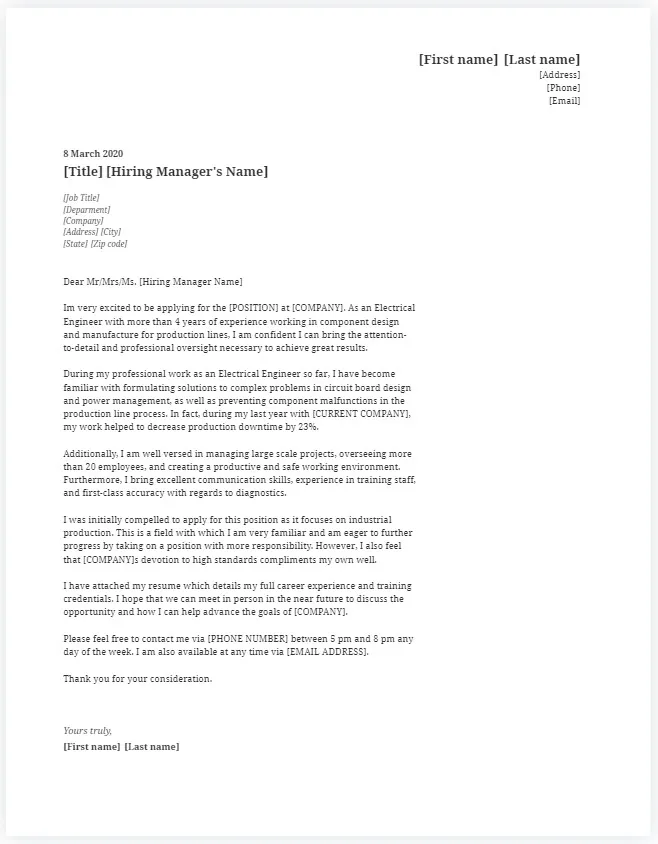
Understanding the Engineering Cover Letter
In the competitive field of engineering, a well-crafted cover letter is your first opportunity to make a strong impression. It’s more than just a formality; it’s a crucial marketing tool that showcases your unique qualifications and enthusiasm for the specific engineering role. This document allows you to tell your story, providing context to your resume and highlighting the skills and experiences that make you the ideal candidate. A standout cover letter captures the hiring manager’s attention and sets the stage for a successful application. Understanding its importance is the first step toward crafting a compelling letter that gets you noticed.
Importance of a Cover Letter for Engineering Jobs
Why is a cover letter so vital in the realm of engineering? Firstly, it demonstrates your genuine interest in the specific position and the company. Generic applications are easily dismissed. A tailored cover letter shows that you’ve done your homework, understand the company’s needs, and are excited about the opportunity to contribute. Secondly, it allows you to expand on the information presented in your resume, providing a narrative that highlights your accomplishments and explains how your skills align with the job requirements. It’s your chance to bridge the gap between your qualifications and the employer’s expectations, making your application more impactful. Finally, a well-written cover letter can differentiate you from other qualified candidates, especially in a field where technical skills are expected.
Highlighting Relevant Skills and Experience

Your cover letter should act as a spotlight, illuminating your most relevant skills and experiences. Don’t simply list your qualifications; instead, demonstrate how your past experiences have equipped you to excel in the new role. Start by carefully reviewing the job description and identifying the key skills and requirements. Then, select specific examples from your projects, internships, or previous jobs that showcase these skills. Remember to quantify your achievements whenever possible, using data and metrics to illustrate the impact of your contributions. For example, instead of saying “Managed projects,” you could say “Managed and successfully delivered 5 engineering projects, resulting in a 15% reduction in project costs and a 10% increase in efficiency.” This level of detail makes your cover letter compelling and memorable.
Showcasing Technical Skills
Technical skills are the cornerstone of any engineering role, and your cover letter should highlight your proficiency in relevant areas. Mention specific software, tools, and technologies you’re familiar with, such as CAD software (e.g., AutoCAD, SolidWorks), programming languages (e.g., Python, C++), simulation tools (e.g., ANSYS, MATLAB), and project management software (e.g., MS Project, Jira). Provide concrete examples of how you’ve used these skills in past projects. For example, if you’re applying for a mechanical engineering position, you might say, “Utilized SolidWorks to design and analyze the structural integrity of a new product, leading to a 20% improvement in its performance.”
Demonstrating Problem-Solving Abilities
Engineers are, at their core, problem solvers. Your cover letter should emphasize your ability to identify, analyze, and solve complex challenges. Describe situations where you faced engineering problems and the steps you took to overcome them. Highlight your analytical thinking, attention to detail, and ability to find innovative solutions. Use the STAR method (Situation, Task, Action, Result) to structure your examples, providing a clear narrative of the challenges you faced, the actions you took, and the positive outcomes you achieved. For instance, “During a critical project phase, we encountered a design flaw that could have delayed our project completion by weeks. I quickly analyzed the situation, proposed a new design modification, and implemented it within three days, ensuring we stayed on schedule.”
Quantifying Achievements in Engineering

Numbers speak louder than words, especially in engineering. Whenever possible, quantify your accomplishments to demonstrate the impact of your work. Use metrics and data to illustrate your successes. For example, instead of saying “Improved efficiency,” say “Improved production efficiency by 15% through process optimization.” Or, instead of “Reduced costs,” say “Reduced project costs by $20,000 by implementing value engineering principles.” These specific details not only impress the hiring manager but also provide tangible evidence of your ability to deliver results. Consider using bullet points to showcase your accomplishments clearly and concisely.
Using Action Verbs Effectively
Action verbs bring your cover letter to life, making it more dynamic and engaging. Start each bullet point or sentence describing your achievements with a strong action verb. Some examples include designed, developed, implemented, managed, analyzed, optimized, and led. Using action verbs helps you convey a sense of proactivity, responsibility, and accomplishment. It also helps hiring managers quickly understand your role and the impact of your work. Avoid passive voice and instead use verbs that highlight your direct involvement and contributions. A cover letter filled with action verbs will grab attention and leave a lasting impression. Refer to the image above for useful action verbs.
Tailoring Your Cover Letter to the Job Description
One size does not fit all when it comes to cover letters. Generic cover letters are a red flag for hiring managers, indicating a lack of genuine interest in the role. To stand out, customize your cover letter for each job you apply for. Carefully review the job description and identify the key requirements, skills, and qualifications the employer is seeking. Then, tailor your letter to specifically address these requirements. Highlight the relevant experiences and skills from your background that align with the job description. Use the same keywords and terminology used in the job posting to demonstrate that you understand the role and the company’s needs. This level of personalization will make your cover letter significantly more effective.
Researching the Company and Its Values

Before you start writing your cover letter, conduct thorough research on the company. Visit their website, read their mission statement, and explore their social media profiles. Understand their products, services, values, and recent projects. This knowledge allows you to tailor your cover letter to demonstrate your genuine interest in the company and your understanding of their goals. Identify the company’s core values and explain how your skills and experiences align with them. This shows that you’re not just looking for a job but also a long-term career and want to contribute to the company’s success. Show your interest by mentioning specific projects or initiatives that resonate with you.
Customizing for Specific Requirements
Every engineering job has specific requirements and qualifications. Pay close attention to these details in the job description. Highlight the skills, experiences, and qualifications that match these requirements. If the job requires proficiency in a specific software or technology, make sure to mention your relevant experience with it. If the job emphasizes teamwork or leadership skills, provide examples that showcase these qualities. Tailor your letter to address these requirements directly. This personalization demonstrates that you are a great fit and have the skills they are looking for. Ensure that you use clear and concise language and avoid generic statements that do not provide value.
Formatting and Structure for Impact
The format and structure of your cover letter are crucial for capturing the reader’s attention and making it easy to read. Use a professional and clean font, such as Times New Roman, Arial, or Calibri, with a font size between 10 and 12 points. Ensure that your letter is well-organized and easy to follow. Use clear headings, bullet points, and ample white space to break up the text and make it visually appealing. Keep your letter concise and focused, aiming for one page maximum. A well-formatted cover letter demonstrates attention to detail and professionalism. In addition to the above, the content should be well-organized.
Crafting a Compelling Introduction

Your introduction is your chance to make a strong first impression. Start by clearly stating the position you are applying for and how you learned about the opportunity. Then, provide a brief but compelling summary of your relevant experience and qualifications. The introduction should immediately grab the reader’s attention and make them want to learn more. Consider using a brief anecdote or a statement that demonstrates your enthusiasm for the role. For instance, you could start by saying “I am writing to express my enthusiastic interest in the Civil Engineer position at [Company Name], as advertised on [Platform].” Then, briefly mention your experience with similar projects. The introduction is key to sparking interest.
Organizing Your Body Paragraphs
The body paragraphs are the heart of your cover letter, where you elaborate on your skills, experiences, and qualifications. Organize these paragraphs logically, using clear and concise language. Each paragraph should focus on a specific point, highlighting relevant skills or experiences. Use the STAR method (Situation, Task, Action, Result) to structure your examples, providing a clear narrative of your achievements. Tailor your body paragraphs to address the key requirements outlined in the job description. Make sure each section flows into the next logically, creating a compelling and coherent story about your qualifications and your suitability for the role. Proofread each section to make sure the writing is correct.
Writing a Strong Conclusion
The conclusion is your opportunity to leave a lasting impression and encourage the hiring manager to take action. Restate your interest in the position and reiterate why you are a good fit. Express your enthusiasm for the opportunity to contribute to the company. Then, include a call to action, such as stating that you are available for an interview and looking forward to discussing your qualifications further. Thank the hiring manager for their time and consideration. A strong conclusion reinforces your enthusiasm and makes a final compelling argument for why you should be considered for the role. Avoid using the same phrases as the beginning, and avoid clichés.
Proofreading and Editing Your Cover Letter

Before submitting your cover letter, it’s essential to proofread and edit it carefully. Typos, grammatical errors, and inconsistencies can damage your credibility and undermine your application. Check for any spelling mistakes, grammatical errors, and punctuation errors. Ensure that your sentences are clear, concise, and easy to read. Review the formatting to make sure it is consistent and professional. Read your cover letter out loud to catch any awkward phrasing or sentences that don’t flow well. It’s also a good idea to ask a friend, family member, or career counselor to review your letter and provide feedback. Proofreading is critical, so take your time and do it carefully.
Ensuring Accuracy and Clarity
Accuracy and clarity are paramount in a cover letter. Ensure that all the information you provide is accurate and truthful. Double-check the dates, names, and titles mentioned in your letter. Use clear and concise language that avoids jargon and technical terms that the hiring manager may not understand. Avoid using overly complex sentences. The goal is to communicate your qualifications effectively, not to impress with your vocabulary. Every statement should be accurate and easy to understand. If you are unsure about a fact, check your sources to avoid any misrepresentations. Incorrect data is a huge detriment.
Seeking Feedback and Review
Getting a second opinion on your cover letter is a valuable step in the process. Ask a trusted friend, family member, or career counselor to review your letter and provide feedback. They can offer an objective perspective on your writing style, clarity, and overall effectiveness. Ask them to check for any errors, inconsistencies, or areas where you could improve your letter. You can also seek feedback from professionals in your field, such as experienced engineers or recruiters. Ask them to evaluate whether your letter effectively highlights your skills and experiences and if it makes a strong case for your candidacy. Taking the time to get feedback and make revisions based on the suggestions is a great way to boost your chances of success.
Key Takeaways for a Standout Cover Letter

Crafting a standout cover letter is an essential skill for any engineer seeking a new job. By focusing on the key elements discussed in this guide, you can create a compelling document that grabs the hiring manager’s attention and increases your chances of landing an interview. Remember to understand the importance of a cover letter, highlight your relevant skills and experiences, quantify your achievements, use action verbs effectively, and tailor your letter to each job description. The following points will get you noticed: research the company, format for impact, demonstrate problem-solving skills, showcase technical skills, customize for specific requirements, and ensure accuracy. Proofread and edit your letter carefully, and always seek feedback from others. A well-written cover letter is a powerful tool that can help you stand out from the competition and take the next step in your engineering career.