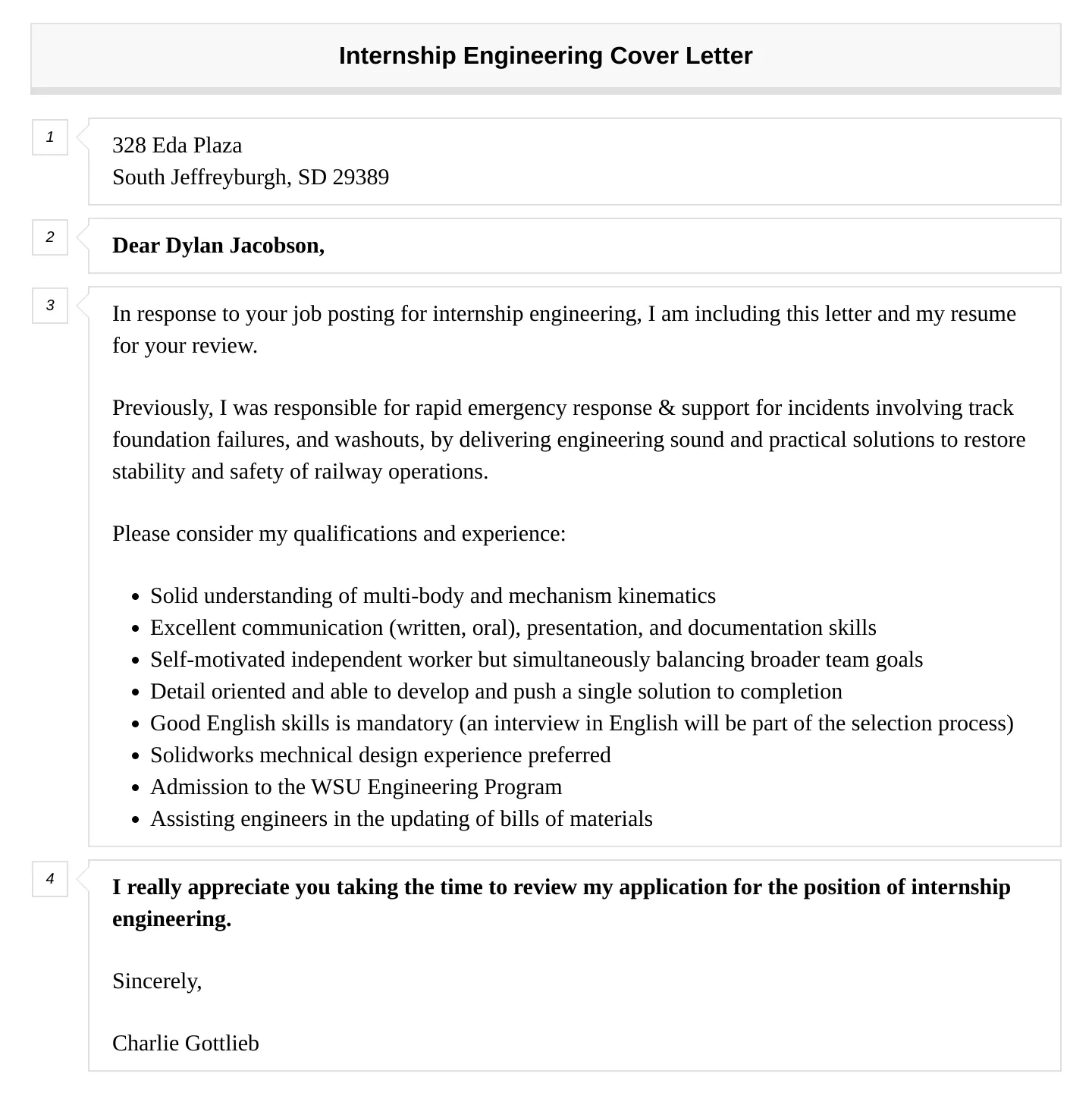
Engineer Intern Cover Letter: Essential Elements
A well-crafted engineer intern cover letter is your first opportunity to make a positive impression on a potential employer. It’s a crucial tool in your job application arsenal, complementing your resume and providing a space to showcase your personality, passion, and suitability for the role. A great cover letter goes beyond simply reiterating your resume; it tells a story about your aspirations and how your skills align with the company’s needs. This guide breaks down the essential elements, helping you craft a compelling cover letter that grabs attention and increases your chances of landing an interview. Remember, this is your chance to stand out, so take the time to make it count!
Contact Information
Your Name and Contact Details

Begin by including your full name, address, phone number, and professional email address. Ensure your email address is appropriate and professional. This section ensures the employer knows how to reach you. Accuracy is paramount here; a typo in your contact information could mean missing out on an opportunity. Make it easy for the hiring manager to quickly find this crucial information. Position this at the top left or left-aligned of your letter.
Date
The date is crucial for formal documents like cover letters. Use the current date to indicate when you are submitting your application. This helps the employer know when you applied and can be helpful for their record-keeping purposes. Place this below your contact information, usually aligned to the right side or the center.
Employer’s Information
Below the date, include the hiring manager’s name (if known), their title, the company’s name, and the company’s address. Researching the hiring manager’s name shows initiative and a genuine interest in the position. If you can’t find the hiring manager’s name, address the letter to the ‘Hiring Manager.’ This section demonstrates your attention to detail and professionalism. Ensure all information is accurate to avoid any confusion. Misspelling a name or getting the address wrong can make you look unprofessional.
The Salutation

Address the Hiring Manager by Name
Start your letter with a formal salutation, such as ‘Dear Mr./Ms./Mx. [Last Name].’ Addressing the hiring manager by name is more personal and shows you’ve taken the time to research the company and the role. If you’re unsure of the hiring manager’s name, a general greeting like ‘Dear Hiring Manager’ is acceptable, but always try to find the specific name if possible. Avoid generic greetings like ‘To Whom It May Concern,’ as these can make your letter feel impersonal. This small detail can significantly impact how the hiring manager perceives your interest and dedication to the position.
Body Paragraph 1: Expressing Interest
The opening paragraph should clearly state the position you’re applying for and how you learned about it. Mentioning where you found the job posting – a company website, LinkedIn, a university career center – helps the employer understand how you discovered the opportunity. Express your enthusiasm for the role and the company. Show that you’ve done your research and understand the company’s mission, values, and goals. This paragraph sets the tone for the rest of your letter and should immediately grab the reader’s attention. A strong opening shows you’re eager and prepared.
Identify the Position and Source

Clearly state the specific engineer intern position you are applying for and where you saw the job posting. For example, ‘I am writing to express my interest in the Engineer Intern position advertised on your company website.’ This immediately informs the reader of your intent and allows them to quickly understand the purpose of your letter. Providing context helps the hiring manager easily link your application to their open positions and avoid any confusion.
Highlight Your Enthusiasm
Show genuine excitement for the opportunity. Explain what aspects of the role or the company particularly appeal to you. For example, if the company focuses on sustainable engineering, mention your passion for environmental solutions and how the internship aligns with your career goals. This enthusiasm will make you stand out from other candidates. Demonstrating your interest in the company’s work will make your application more memorable. Expressing enthusiasm makes you appear more approachable and like a good fit.
Body Paragraph 2: Showcasing Skills and Experience
This section is where you demonstrate your qualifications. Highlight the skills and experiences relevant to the engineer intern position. Instead of simply listing your skills, provide specific examples of how you’ve used them in projects, coursework, or previous internships. Quantify your achievements whenever possible; use numbers to showcase your accomplishments. Tailor this section to match the requirements and keywords mentioned in the job description. This targeted approach will make your application more compelling and demonstrate that you have the skills necessary for the role. Focus on the aspects of your experience that align with the role’s needs.
Relevant Coursework and Projects

Describe specific coursework and projects that have prepared you for the engineer intern position. Mention the skills you developed or the problems you solved in these projects. This helps the hiring manager see your hands-on experience and how it aligns with the internship’s requirements. For instance, if the internship involves CAD software, highlight relevant CAD projects. Be specific and provide enough detail to illustrate your understanding and proficiency. Projects can be from academic or personal areas.
Quantifiable Achievements
Use numbers and metrics to quantify your achievements. Instead of saying ‘Improved project efficiency,’ state ‘Improved project efficiency by 15% by implementing X technique.’ This provides concrete evidence of your capabilities and demonstrates your ability to deliver results. Quantifiable achievements make your accomplishments more compelling and easier for the hiring manager to understand. Always try to include specific numbers to make your points. See the image for an example.
Technical Skills
List the technical skills relevant to the engineer intern position. These might include software proficiency (e.g., AutoCAD, MATLAB), programming languages (e.g., Python, C++), or specific engineering methodologies. Be honest about your skill level and tailor your list to the job description. If the job requires skills in a specific area, make sure to mention those skills prominently. Showing the employer your skills in a concrete way will make you appear to have the needed skills.
Body Paragraph 3: Explaining Your Value

In this paragraph, explain what value you bring to the company. Highlight how your skills, experience, and enthusiasm align with the company’s needs and the internship’s goals. Tailor your response to the specific company and the role, demonstrating that you have researched the company and understand what they are looking for in an intern. Show that you have a clear understanding of what the company does and how you can contribute. This customization sets you apart from generic applicants. Tailor the information to make you look like a great fit.
Tailor to the Company’s Needs
Tailor your cover letter to the specific company and position. Research the company’s values, mission, and recent projects. Highlight the aspects of your skills and experience that align with the company’s specific needs and goals. This shows that you have taken the time to understand the company and are genuinely interested in contributing to their success. Generic letters are easily dismissed, so show how your skills relate to the company’s work.
Explain Why You’re a Good Fit
Clearly explain why you are a good fit for the role and the company. Describe how your skills, experience, and enthusiasm align with the internship’s requirements and the company’s culture. Provide specific examples of how you can contribute to the team or the company’s projects. This demonstrates your understanding of the role and how you can contribute to the organization. Emphasize the benefits the company will receive by having you in the role.
The Closing Paragraph

The closing paragraph is your final opportunity to leave a positive impression. Express your gratitude for the hiring manager’s time and consideration. Reiterate your interest in the position and your enthusiasm for the company. Include a call to action, such as requesting an interview or expressing your availability for further discussion. A strong closing paragraph summarizes your key points and leaves the reader with a clear understanding of why you are the right candidate. This paragraph will increase your chances of getting an interview. See the image for an example.
Express Gratitude
Thank the hiring manager for considering your application and for their time. This shows professionalism and respect. Expressing gratitude is a standard and expected part of a cover letter, showing your respect for the opportunity and the hiring manager. Always finish with a positive and appreciative note, like “Thank you for considering my application and for your time.” This is professional.
Call to Action
Include a call to action, such as requesting an interview or stating your availability for a follow-up call. This makes it easy for the hiring manager to take the next step. Be proactive and let them know you are eager to learn more about the opportunity. Examples include, ‘I am eager to discuss my qualifications further in an interview’ or ‘I am available for a call at your earliest convenience.’ This encourages the hiring manager to take action and is crucial.
Closing and Signature
Conclude your cover letter with a professional closing and your signature. Use a standard closing and sign your name to formally end your letter. The closure is just as important as the opening as it gives a clear and formal finish.
Sincerely or Regards
Use a professional closing such as ‘Sincerely,’ ‘Regards,’ or ‘Best regards.’ Choose a closing that aligns with the tone of your letter. Keep it simple and professional. These are formal and indicate the letter is finished and your name will follow. A simple closing is best.
Typed Name
Type your full name below the closing. This provides a clear and legible signature. If you are submitting a physical copy, sign your name above your typed name. Make it easy for the hiring manager to see your name.
Crafting a compelling engineer intern cover letter is essential for making a positive impression and securing an interview. By following these guidelines and tailoring your letter to each specific job application, you can significantly increase your chances of standing out from the competition. Remember to showcase your enthusiasm, highlight your relevant skills and experiences, quantify your achievements whenever possible, and always proofread your letter for any errors. Good luck with your job search!