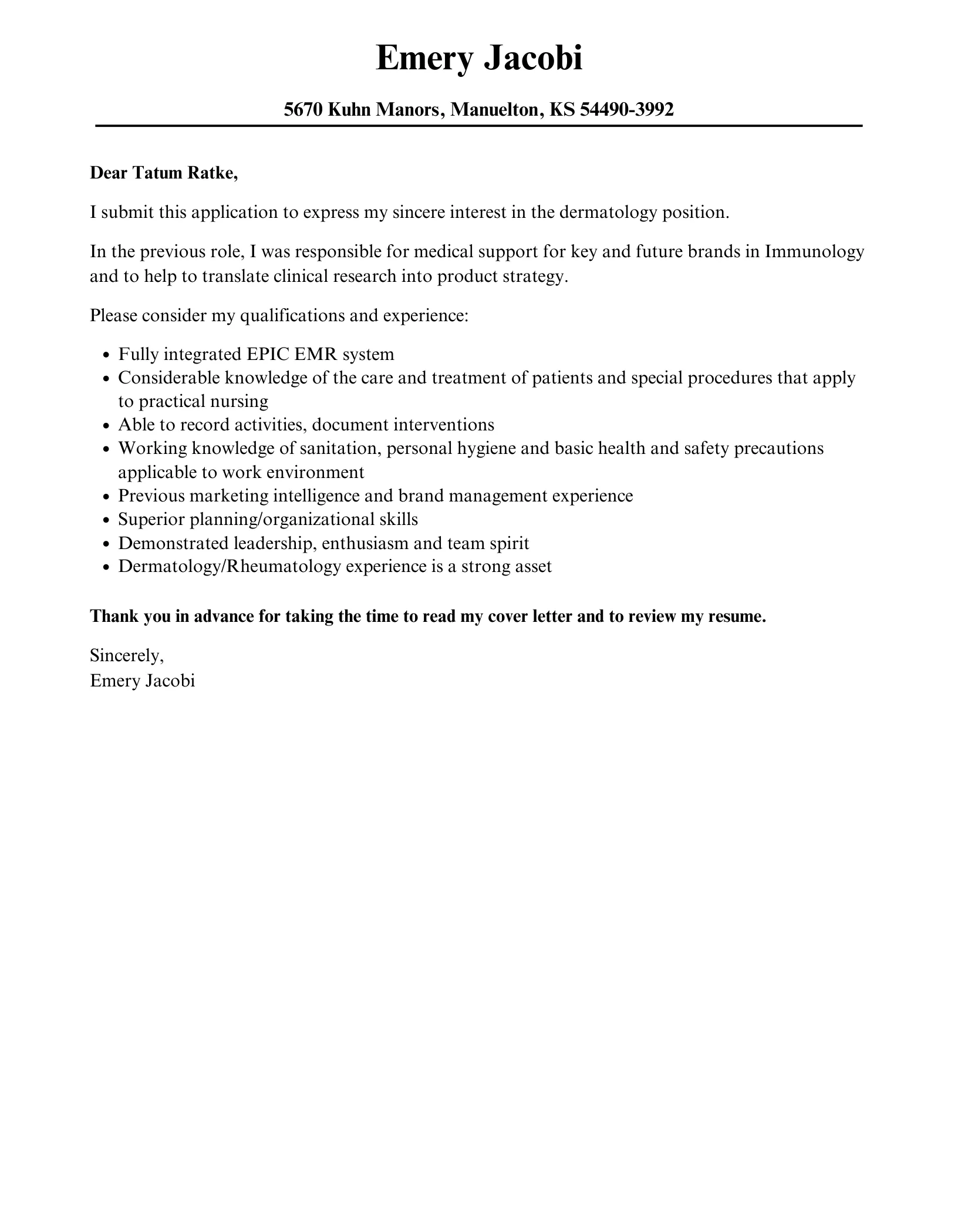
Understanding the Dermatology Nurse Cover Letter
A dermatology nurse cover letter is a crucial document when applying for a nursing position in the field of dermatology. It serves as your introduction to a potential employer and offers an opportunity to highlight your skills, experience, and passion for the specialty. It’s not just a formality; it’s your chance to make a strong first impression and demonstrate why you’re the ideal candidate for the role. A well-crafted cover letter complements your resume, providing context and elaborating on your qualifications in a way that a resume alone cannot.
Why a Cover Letter Matters
In the competitive field of nursing, a cover letter can significantly increase your chances of getting an interview. It allows you to personalize your application and show the hiring manager that you’ve taken the time to understand the specific requirements of the job. A cover letter also gives you the space to explain any gaps in your employment history or career transitions, providing a narrative that helps the employer understand your journey.
Importance of a Tailored Cover Letter

Generic cover letters are easily spotted and often discarded. Tailoring your cover letter to each specific job application is essential. This means researching the employer, understanding the job description, and highlighting the skills and experiences that directly align with their needs. A tailored cover letter demonstrates your genuine interest in the position and your commitment to the organization, setting you apart from candidates who submit generic applications. Consider the specific skills they are looking for, and adapt your cover letter accordingly.
Key Components of a Dermatology Nurse Cover Letter
Your Contact Information
At the top of your cover letter, include your full name, address, phone number, and professional email address. Ensure your email address is professional and easy to read. This information should be clearly presented so the hiring manager can easily contact you. Accuracy is paramount, as even a small mistake can prevent them from reaching you. Make sure your voicemail message is professional and ready for potential employers.
Applicant’s Name, Address, Phone, Email

This section should be straightforward and easy to find. Use a clear and legible font, and ensure the information is correctly formatted. Double-check all details before sending your cover letter to avoid any potential communication issues. A professional email address is a must have, preferably your name and surname and not a silly name or nickname.
The Hiring Manager’s Contact Details
If possible, find out the name of the hiring manager and address the letter to them directly. This personal touch shows that you’ve done your research and are genuinely interested in the position. If you can’t find the name, use a professional greeting like ‘Dear Hiring Manager’ or ‘Dear [Department Name] Team’.
Addressing the Hiring Manager
Always address the hiring manager by name if you know it. This shows that you have taken the time to do some research. This personalized approach demonstrates a higher level of engagement and interest in the role, making your application more memorable. If a name is unavailable, a professional greeting is the next best choice. Avoid generic greetings like ‘To Whom It May Concern’ as they can make your application seem impersonal.
Crafting a Compelling Opening

Expressing Enthusiasm
Start your cover letter with a strong opening that immediately grabs the reader’s attention. Express your enthusiasm for the position and the organization. Clearly state the specific job you are applying for and where you found the advertisement. This sets a positive tone and shows your excitement about the opportunity, making the hiring manager more interested in reading the rest of your letter.
Mentioning the Job Position
Be specific about the position you are applying for. State the job title clearly and mention where you saw the job posting (e.g., online job board, company website). This ensures clarity and helps the hiring manager quickly understand your application’s purpose. This also demonstrates that you’ve carefully reviewed the job description and are aware of the specific requirements.
Highlighting Relevant Experience

Showcasing Skills and Qualifications
In the body of your cover letter, highlight the skills and qualifications that align with the job requirements. Refer back to the job description and identify the key skills the employer is seeking. Provide specific examples of how you’ve demonstrated those skills in previous roles. This should include technical skills, such as experience with dermatological procedures and equipment, as well as soft skills such as communication and patient care.
Detailing Dermatology Experience
If you have experience working in a dermatology setting, emphasize it. Describe your specific responsibilities, such as assisting with procedures, patient education, and wound care. Highlight any specialized training or certifications you have related to dermatology. Be specific about the types of treatments you’ve assisted with and the patient populations you’ve served. This is your opportunity to show that you have the right background for this specific role.
Focusing on Patient Care Skills

Dermatology nursing involves significant patient interaction. Therefore, emphasize your patient care skills. Mention your ability to build rapport with patients, provide compassionate care, and educate them about their conditions and treatments. Highlight your experience in managing patient concerns and providing emotional support. Detail your experience with pre and post-operative care, and with follow-up patient education. Patient satisfaction is a key metric, so show that you understand how to ensure the best possible patient experience.
Emphasizing Relevant Certifications
List any relevant certifications, such as those related to dermatology nursing or specific medical procedures. These certifications demonstrate your commitment to professional development and can set you apart from other candidates. Include details about the certification body, the date of certification, and any renewal requirements. Having up-to-date certifications shows you are competent and committed to your career. Examples may include certifications in wound care or advanced cardiac life support.
Quantifying Achievements
Providing Measurable Results

Whenever possible, quantify your achievements with numbers and data. This adds credibility to your claims and demonstrates your impact in previous roles. Instead of saying ‘Improved patient satisfaction,’ say ‘Increased patient satisfaction scores by 15% within six months.’ Use metrics to show how you’ve contributed to positive outcomes in previous positions. This could include metrics such as reduced patient wait times, improved treatment adherence, or decreased infection rates. Using data makes your accomplishments more impactful.
Giving Specific Examples
Provide specific examples that illustrate your skills and experience. Use the STAR method (Situation, Task, Action, Result) to structure your responses. For example, describe a specific situation you encountered, the task you were assigned, the actions you took, and the results you achieved. This helps the hiring manager visualize your capabilities and understand how you handle real-world scenarios. Specific examples provide concrete evidence of your skills and abilities, making your cover letter more persuasive.
Closing Your Cover Letter
Expressing Gratitude
Thank the hiring manager for considering your application. Express your appreciation for their time and attention. A simple ‘Thank you for your consideration’ is a professional and courteous way to end your letter. This shows respect for the hiring process and leaves a positive final impression.
Making a Call to Action
End your cover letter with a call to action. Indicate your availability for an interview and express your eagerness to discuss your qualifications further. You can state something like, ‘I am available for an interview at your earliest convenience and look forward to the opportunity to discuss my qualifications in more detail.’ This encourages the hiring manager to take the next step and contact you, increasing your chances of getting an interview. Make sure your contact details are clear and easy to find.
Reviewing and Editing Your Cover Letter
Before submitting your cover letter, carefully review and edit it. Check for any grammatical errors, typos, and inconsistencies. Ensure that the formatting is clean and professional. Have a friend or colleague review your cover letter as a second set of eyes can catch errors you might have missed. A well-edited cover letter shows attention to detail and professionalism. Proofreading is an important step to ensure the quality of your application.