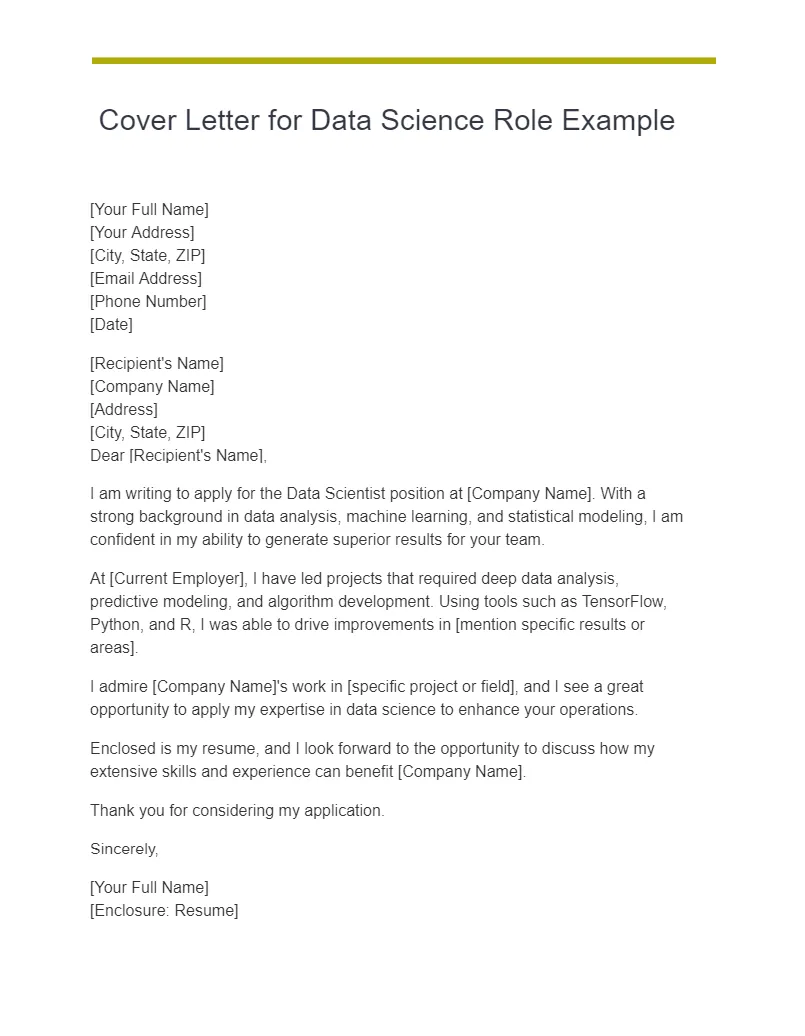
Data Cover Letter Importance
A data cover letter is your key to grabbing a recruiter’s attention in a competitive data science market. It’s your first opportunity to showcase how your unique skills align with the job requirements. A well-crafted cover letter can significantly boost your chances of getting noticed and securing an interview. In the field of data science, you need to demonstrate your technical expertise, analytical abilities, and communication skills. This letter gives you the platform to expand on your resume. It also provides a way to explain your motivations and the value you bring to the company. It shows genuine interest and initiative, setting you apart from others. Make your data cover letter count, and start on the path to your dream job.
Highlighting Your Data Skills
Showcasing relevant skills is crucial. Start by pinpointing the key skills listed in the job description and align your letter accordingly. Don’t just list your skills; show how you used them in past projects or jobs. Quantify your achievements, whenever possible, by including numbers to demonstrate the impact of your work. Focus on the tools and technologies you have mastered like Python, R, SQL, or specific data visualization platforms. It’s a bridge connecting your skills to the needs of the job. It highlights how your skills are applicable. The more specific, the better. This is a great way to showcase your expertise and give the reader a solid understanding of your abilities. Make your skills pop to leave a lasting impression.
Technical Skills

Your technical skills create the foundation of your expertise. Your data cover letter should emphasize the tools you use like Python, R, SQL, or others. State the specific versions and your frequency of use. Focus on skills that are relevant to the job description. Your projects are a great way to show how you used your skills. If the role requires expertise in Python for data analysis, highlight projects that show that. Specific examples showcase your commitment. It’s important to include courses, certifications, and any other way that you have attained your technical skills. Adding that level of detail is a great way to show your commitment.
Data Analysis
Data analysis is the core of all data-related roles. It’s important to focus on how you can analyze and extract insights. It’s a great way to show how you make data-driven decisions. Detail your methodologies such as statistical analysis, machine learning, or predictive modeling. Provide examples that include the data sources you used, the analytical techniques you implemented, and the results you achieved. Explain how your analysis led to results like improved efficiency, cost savings, or new revenue streams. Show your skills at handling data from various sources, and then explain how you handled data quality issues. Remember, it’s about demonstrating not only your know-how but also your practical applications. Highlighting all your skills will strengthen your letter.
Data Visualization
Data visualization is key to good communication. Show your skills in creating compelling visualizations in your data cover letter. Mention the tools you’re proficient in, such as Tableau, Power BI, or Matplotlib. Explain how you’ve used these tools to transform raw data into understandable visuals. Mention all the types of charts, graphs, and dashboards you’ve created and how they helped convey key findings. Describe how you adapted your visualizations for different audiences and purposes. These skills are crucial for data science positions. Showing them off will make your letter pop. Show how visualizations helped you present insights for the right audiences.
Communication Skills

Good communication skills are vital to your success in a data-related role. Emphasize your ability to communicate complex findings clearly. Include examples of how you’ve presented to both technical and non-technical audiences. Mention how you have experience writing reports and explaining technical concepts in an easy-to-understand manner. Show your adaptability and how you modify your communication style to diverse stakeholders. Demonstrate your ability to translate data into actionable recommendations. By emphasizing your communication skills, you show your ability to be an asset to a team.
Tailoring Your Data Cover Letter
Customization is the key to a great data cover letter. Avoid a generic letter that won’t grab the recruiter’s attention. Tailor each letter to each job. This will greatly increase your chances of landing an interview. Research the role and the company thoroughly. Understand the mission and values of the company, as well as the specific requirements of the position. Use the job description as your guide to understand the skills and qualifications the employer is seeking. Modify your letter to highlight your relevant experience and qualifications. By taking the time to understand the company, your cover letter will stand out.
Research the Company
Prior to writing your data cover letter, research the company. This will allow you to create a targeted letter that will resonate with the potential employer. Visit the company website, read the ‘About Us’ section, and explore their blog. Search for news and industry reports that will provide insight. Look for information about company culture, values, and goals. Find the hiring managers and the team leads to understand their needs. Tailor your cover letter to show how your experience aligns with the company’s needs. Your cover letter will be more impactful when you understand the company.
Customize Your Content

After your research, it’s time to customize your letter. Use the job description as your guide to identify skills the employer needs. Then emphasize your experience in your letter. Use keywords from the job description, but don’t overdo it. Include your achievements and quantify your impact. Reference the company name and specific projects. Show your interest in the role and your understanding of the company’s needs. Customization makes your cover letter stand out.
Cover Letter Structure
Proper structuring helps to convey your message clearly. It guides the reader and helps them understand your value. A standard data cover letter includes the introduction, body paragraphs, and a conclusion. The introduction should capture the reader’s attention. Body paragraphs should showcase your skills, experience, and accomplishments. Provide specific examples to support your claims. The conclusion summarizes your qualifications and reiterates your interest in the role. Ensure a logical flow, with each section building upon the previous one. A well-structured cover letter makes the best impression.
Opening: Grab Their Attention
The opening is your first chance to grab the reader’s attention. Start with a statement that shows your enthusiasm for the role. State the position and where you found the posting. Briefly mention why you are interested in the company and the role. Show enthusiasm by highlighting what appeals to you. Avoid generic openings like “I am writing to express my interest.” Your opening should be concise and show you are a good fit for the position.
Body Paragraphs: Showcase Your Value

The body paragraphs are where you showcase your value. Dedicate each paragraph to a specific skill, experience, or accomplishment that aligns with the job description. Provide specific examples, using the STAR method to illustrate how you’ve applied your skills in previous projects. Quantify your achievements whenever possible. Highlight your technical skills, analytical skills, and communication abilities. Show your skills and experience. Connect your skills to the company’s needs. This is where you tell your professional story and show how you can contribute to the company. Make sure it’s easy to read.
Closing: Call to Action
Summarize your qualifications in the closing. Restate your interest in the role, and include a call to action. Briefly restate why you are a good fit for the company. Express your enthusiasm for the opportunity to learn more. Thank the reader for their time. Request an interview. Ensure your closing is professional and leaves a positive impression, encouraging the employer to take the next step.
Formatting Tips for Your Cover Letter
Proper formatting makes your data cover letter professional. Choose a professional font such as Arial or Times New Roman. Use a font size between 10 and 12 points. Use consistent spacing, margins, and alignment. Use clear headings and subheadings to organize your content. Use bullet points to highlight skills. Keep your letter concise. Avoid jargon and proofread carefully. Use a professional letterhead. Proper formatting ensures a good impression.
Font and Layout

Choose a professional font and layout for your data cover letter to ensure it is visually appealing and easy to read. Select a clear and legible font like Arial, Calibri, or Times New Roman, and use a font size between 10 and 12 points. Use a consistent font throughout the entire letter, and avoid using overly decorative fonts that can be distracting. Set your margins to one inch on all sides, and use single-line spacing. Use clear headings and subheadings to organize your content. Ensure that you include sufficient white space between paragraphs. Avoid excessive use of bolding or italics, as these can make your letter look cluttered. Use bullet points or numbered lists to highlight your skills or achievements. Ensure the layout is balanced and visually appealing, drawing the reader’s eye to the most important information. A well-formatted cover letter makes a positive first impression.
Proofreading and Editing
Proofreading is a must. Proofreading makes sure your letter is free of errors. Before submitting, review your letter for any mistakes. Read it aloud to catch any awkward phrasing. Ask a friend or advisor to proofread. Make sure your letter is clear and conveys your qualifications. By eliminating errors, you show attention to detail and professionalism. Double-check your contact information. Proofreading ensures your cover letter makes a positive impression.