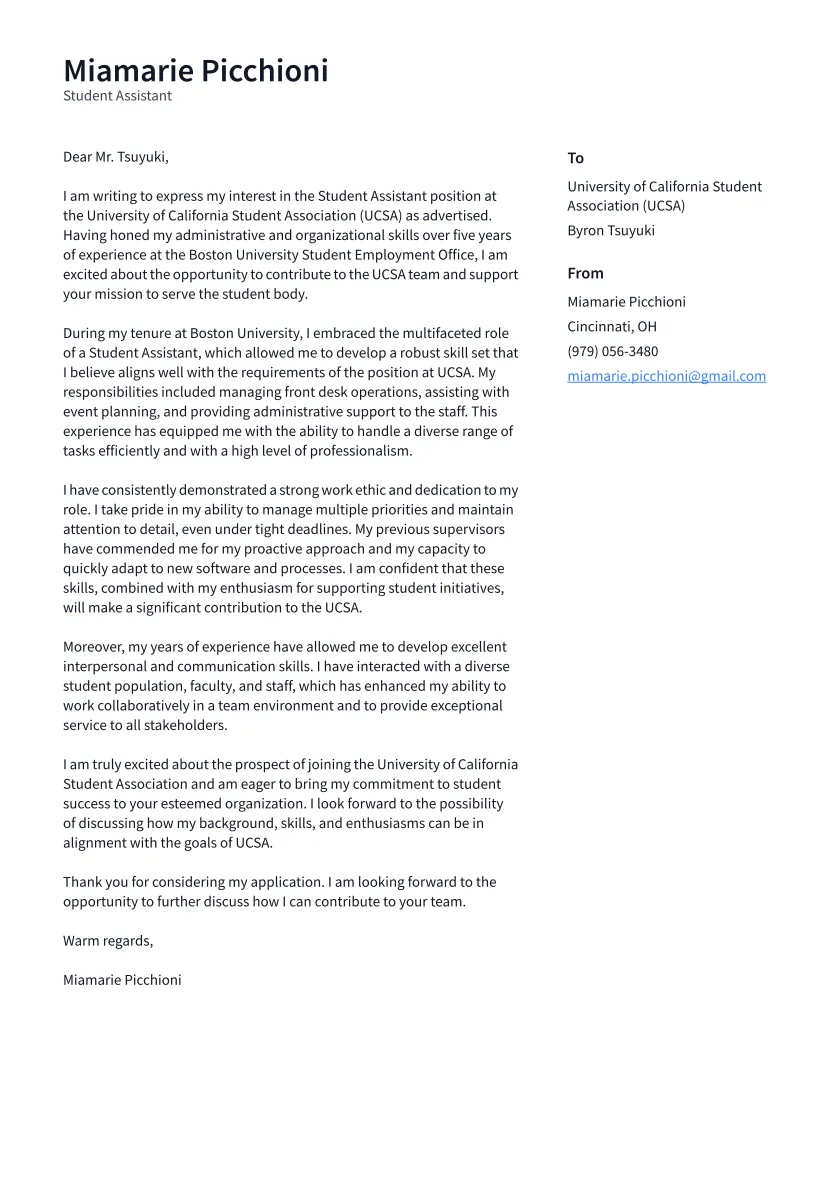
Why a Cover Letter Matters for Student Assistants
As a student assistant, you’re likely juggling academics with your job search. Amidst the competition, a well-crafted cover letter can be your secret weapon. It’s your first chance to make a strong impression, going beyond your resume to showcase your personality, passion, and qualifications. Unlike a resume, which is a factual overview, a cover letter allows you to tell a story, connecting your experiences and skills to the specific requirements of the student assistant role. It provides context, demonstrating your understanding of the position and your genuine interest in the opportunity. This initial document is critical, often serving as the deciding factor in whether your application moves to the next stage. A compelling cover letter can distinguish you from other applicants, making you stand out in the crowded field of candidates.
The Purpose of a Cover Letter
The purpose of a cover letter is multifaceted; it serves as an introduction, a sales pitch, and a personalized message all in one. Primarily, it introduces you to the hiring manager, providing a brief snapshot of your background and career objectives. A cover letter provides the context to understand why you’re interested in the role. More significantly, a well-written cover letter allows you to go beyond the basic details of your resume, highlighting the skills and experiences most relevant to the student assistant position. It is a tool to demonstrate your understanding of the role and the organization. It allows you to articulate your fit and passion for the opportunity. This document is where you can explain gaps in your experience, address potential weaknesses, and demonstrate the value you’ll bring to the team. It is a personal narrative that humanizes your application, making it more memorable.
Highlighting Skills and Experience

When crafting your cover letter as a student assistant, the most critical aspect is highlighting the skills and experiences directly relevant to the role. Begin by carefully reviewing the job description, identifying the key skills and requirements the employer seeks. Then, select the experiences from your resume that directly align with those requirements. It’s not enough to list your skills; you must demonstrate them with specific examples. This could include detailing how you’ve used communication, organizational, or time management skills in previous roles. If you’re lacking direct work experience, draw on transferable skills from your academic projects, extracurricular activities, or volunteer work. For example, if the role requires strong data entry skills, mention any experience you have using relevant software or managing databases. If the job demands strong teamwork, provide an example of a collaborative project where you successfully contributed to a positive outcome. The objective is to show the hiring manager that you are a good match for the position.
Cover Letter Formatting
Proper formatting is vital for readability and professionalism. Start with a clear, concise layout that is easy on the eyes. Use a standard font like Times New Roman, Arial, or Calibri, with a font size between 10 and 12 points. Ensure that your cover letter has consistent margins (typically one inch on all sides) and that the text is left-aligned. Use single spacing within paragraphs and double spacing between paragraphs to improve readability. The structure should include the date, the hiring manager’s name (if known), the recipient’s title, and the company’s address. Divide your content into clear sections with headings, making it easy for the reader to follow your key points. Keep paragraphs relatively short, ideally between three and five sentences, and use bullet points for lists or to highlight key skills or accomplishments. The goal is to present your information in an organized and professional way, demonstrating your attention to detail and respect for the reader’s time. A well-formatted cover letter makes a positive first impression and shows that you take the application process seriously.
Top 5 Cover Letter Secrets
Tailor Your Letter to the Role

One of the most critical secrets to a successful cover letter is tailoring it to each specific job application. Avoid using a generic template. Take the time to customize your letter for each position, referencing the specific requirements and responsibilities outlined in the job description. Start by thoroughly researching the company and the role. This allows you to understand their needs and expectations. Then, highlight the skills and experiences most relevant to the particular position. Show that you understand the organization’s mission and values, and explain how your goals align with theirs. By personalizing your cover letter, you demonstrate to the hiring manager that you have taken the time to understand the opportunity and that you are genuinely interested in the specific role and company. This shows your attention to detail and proactive approach. This approach will help you stand out from candidates who submit generic applications.
Emphasize Relevant Skills
When emphasizing relevant skills, focus on those that directly align with the requirements of the student assistant position. Review the job description carefully to identify the key skills the employer is seeking, such as communication, organization, time management, attention to detail, and technical proficiency. Make sure to provide specific examples of how you have demonstrated these skills in previous roles, academic projects, or extracurricular activities. Instead of simply listing your skills, use action verbs to describe how you utilized those skills. For instance, instead of saying ‘I have strong organizational skills’, you could say ‘I organized and maintained a database of over 500 contacts, ensuring efficient communication and information retrieval’. Providing specific examples of your skills in action demonstrates your competency and adds credibility to your claims. This allows the hiring manager to clearly see the value you would bring to their team, highlighting your ability to contribute effectively to their organization.
Showcase Your Enthusiasm
Demonstrating genuine enthusiasm is crucial. Convey your excitement for the opportunity and the company. Avoid generic statements, and instead, express your sincere interest in the specific role and the organization’s mission. Do your research to understand the company’s values, recent projects, or industry contributions. Then, incorporate these details into your cover letter to show that you’ve done your homework and that you’re genuinely interested in their work. In your closing paragraph, reiterate your excitement and express your eagerness to learn more about the role. Be sure to proofread for grammar and spelling errors, as any mistakes can detract from your overall message. A cover letter filled with enthusiasm and tailored to the specific role will make a positive impression, increasing your chances of moving to the next stage.
Proofread Meticulously

Proofreading is an essential, often overlooked, step. Before submitting your cover letter, thoroughly review it for any errors in grammar, spelling, and punctuation. Mistakes can undermine your credibility and make you appear unprofessional. Read your letter aloud, which can help you catch awkward phrasing or typos that you might miss while reading silently. Use a spell-checker, but don’t rely on it entirely; proofread carefully for context and meaning. Ask a friend, family member, or career advisor to review your cover letter for a fresh perspective. They can help you identify any mistakes you may have missed. A clean, error-free cover letter demonstrates your attention to detail and your respect for the hiring manager’s time, increasing your chances of making a positive first impression. It is a sign of professionalism that can set you apart from other applicants.
Keep It Concise
Keep your cover letter concise, typically within one page. Hiring managers often have to review many applications, so they appreciate a brief, well-written document. Focus on conveying the most relevant information and avoid unnecessary details. Use clear, direct language and avoid jargon or overly complex sentences. Each sentence should serve a purpose and contribute to your overall message. Prioritize the key skills and experiences that align with the job requirements. By being concise, you demonstrate respect for the hiring manager’s time and ensure that the most important aspects of your application are easily accessible. A succinct cover letter is more likely to hold the reader’s attention and leave a lasting impression. Be sure to edit out any unnecessary information, keeping only what directly supports your application and showcases your best qualities.
Cover Letter Structure
Contact Information

At the top of your cover letter, begin with your contact information. Include your full name, address, phone number, and email address. Make sure that your email address is professional, such as using your first and last name or a variation thereof. This helps the hiring manager to easily contact you if they are interested in moving forward with your application. If you have a LinkedIn profile, you may choose to include the URL as well. Ensure that your contact information is accurate and up-to-date. This is the first thing the hiring manager will see, so it should be clear and easy to find. Double-check all the details to avoid any errors. Accurate contact information ensures that you don’t miss out on opportunities.
Opening Paragraph
The opening paragraph is critical, as it sets the tone for your cover letter and grabs the reader’s attention. Start by stating the position you are applying for and where you found the job posting. If you know the hiring manager’s name, address them by name. It is always best to address your letter to a specific individual. Then, briefly state why you’re a good fit for the role. Show enthusiasm for the opportunity and the company. Your opening should be clear, concise, and engaging. Avoid generic phrases like ‘I am writing to express my interest’ and instead, immediately highlight your most relevant skills or experience. The goal is to make a strong first impression and encourage the reader to continue reading the rest of your letter.
Body Paragraphs
The body paragraphs are the core of your cover letter. They should provide detailed information about your qualifications and experiences. Typically, this section consists of two or three paragraphs. Each paragraph should focus on a specific aspect of your skills or experience, providing concrete examples and demonstrating how you meet the requirements of the job. Use the job description to guide your content, ensuring that you address the key skills and qualifications the employer is seeking. Quantify your achievements whenever possible, using numbers and data to illustrate your impact. For instance, if you improved efficiency in a previous role, state the percentage or specific result. Maintain a professional tone and use clear, concise language. Connect your experiences with the role, making it easy for the reader to see why you are a great match. The body paragraphs should paint a compelling picture of your value and suitability for the student assistant position.
Closing Paragraph

The closing paragraph provides a final opportunity to summarize your interest and leave a lasting impression. Reiterate your enthusiasm for the opportunity and the company. Briefly mention your most relevant skills or experiences one more time, reinforcing your suitability for the role. Thank the hiring manager for their time and consideration. Include a call to action, such as expressing your availability for an interview or encouraging them to contact you for further information. Be polite and professional, avoiding any overly casual language. Proofread your closing paragraph to ensure it’s free of errors and concludes your letter on a positive note. A strong closing paragraph leaves the reader with a clear understanding of your interest and value, making you stand out from other applicants.
Common Mistakes to Avoid
Generic Letters
One of the most common mistakes is using a generic cover letter that isn’t tailored to the specific job. Generic letters fail to showcase your understanding of the role and the company, making your application less effective. Always customize your cover letter to highlight the skills and experiences most relevant to the position. Avoid using a template without making significant changes, as this can make your application look impersonal and unprofessional. Show that you have researched the company and understand its needs. By personalizing your cover letter, you demonstrate to the hiring manager that you are genuinely interested in the specific role and company, which increases your chances of making a positive impression.
Typos and Grammatical Errors

Typos and grammatical errors can severely damage your credibility. Such errors make you appear careless and unprofessional. Always proofread your cover letter thoroughly before submitting it. Use a spell-checker, but don’t rely on it entirely. Read your letter aloud to catch awkward phrasing or mistakes you might miss while reading silently. Ask a friend, family member, or career advisor to review your cover letter. Proofreading helps ensure that your letter is polished and error-free, showcasing your attention to detail and professionalism. A polished cover letter will help you make a positive first impression and stand out from the other applicants.
Ignoring Instructions
Another common mistake is ignoring the application instructions provided in the job posting. Be very careful and make sure you understand the instructions fully. Following the instructions is essential. If the job posting asks for specific information, a particular format, or a specific way of submitting your application, failing to follow these instructions shows that you do not pay attention to detail. It may even lead to your application being rejected. Read the job description carefully and make sure you understand everything before you start writing your cover letter and resume. Demonstrating your ability to follow instructions is a basic requirement, so make sure that you understand and adhere to them precisely. Failing to do so reflects negatively on your attention to detail and your ability to follow directions.
The Importance of a Strong Closing
The closing of your cover letter offers a final opportunity to leave a lasting impression. Summarize your key qualifications and reiterate your enthusiasm for the position. Express your interest in an interview and thank the hiring manager for considering your application. End with a professional closing, such as ‘Sincerely’ or ‘Best regards’, followed by your full name. A strong closing should be concise, professional, and memorable. Make it clear that you are eager to hear back from the hiring manager, reiterating your eagerness and emphasizing your contact information. This can be the deciding factor in whether or not you are selected for an interview.