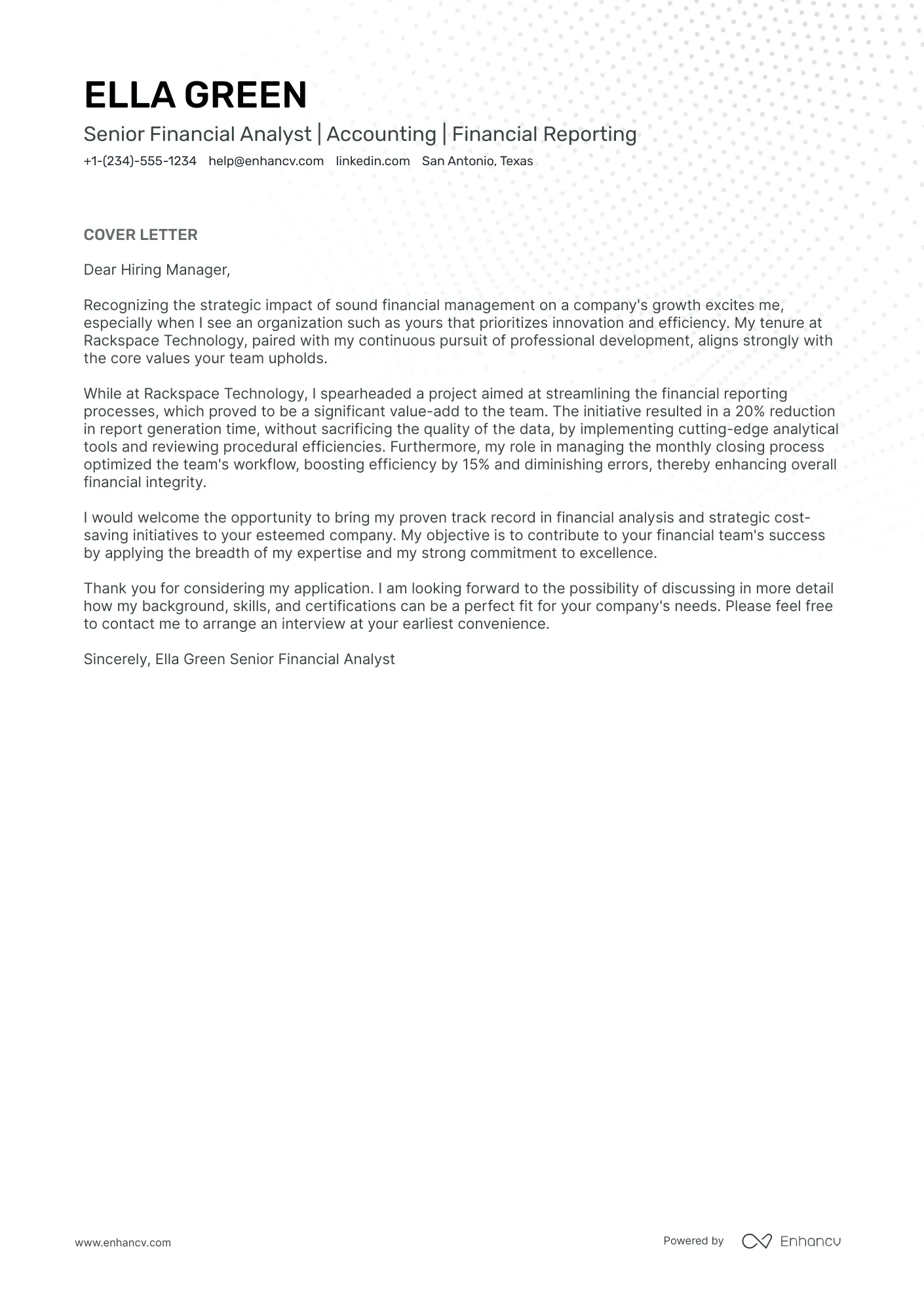
Cover Letter Example for Financial Analysts
A well-crafted cover letter is your first chance to impress a potential employer and secure an interview for a Financial Analyst position. It should be a concise and compelling document that highlights your relevant skills, experience, and enthusiasm for the role. Unlike a resume, which provides a factual overview of your career, a cover letter allows you to inject personality and demonstrate why you are the ideal candidate for the specific job. This guide will provide you with a framework and example to create a cover letter that stands out. Your cover letter should not simply reiterate your resume; it should expand on your accomplishments and illustrate how you can contribute to the company’s success. Remember to keep the tone professional and the language clear and concise. Tailoring your cover letter to each job application is crucial, as it demonstrates your genuine interest and attention to detail.
Highlight Your Financial Skills
Your cover letter should prominently feature your core financial skills. Financial analysts are expected to possess strong analytical and problem-solving abilities, as well as a solid understanding of financial modeling, forecasting, and valuation. Be sure to highlight your proficiency in these areas. This can include your experience with financial statements analysis, budgeting, and variance analysis. If you’re proficient in financial software like Excel, SAP, or specific industry-related tools, mention them. Employers value candidates who can quickly and accurately interpret financial data and make informed recommendations. Moreover, emphasizing skills such as risk assessment, investment analysis, and financial reporting can significantly enhance your cover letter and make you a more attractive candidate. Always tailor the skills you highlight to align with the requirements listed in the job description.
Quantifiable Achievements

Rather than simply listing your responsibilities, focus on your achievements and quantify them whenever possible. Instead of saying, “Managed the budget,” say, “Managed a $5 million budget, resulting in a 10% reduction in operational costs.” This approach immediately demonstrates the impact you had in previous roles. Providing specific numbers and percentages gives potential employers tangible evidence of your abilities and the value you can bring to their organization. Consider using the STAR method (Situation, Task, Action, Result) to structure your achievements. This method allows you to provide context, describe the actions you took, and highlight the positive outcomes. When describing accomplishments, use action verbs to create a dynamic and engaging narrative. For example, “Improved,” “Increased,” “Reduced,” or “Implemented” are powerful words that show what you’ve accomplished.
Showcase Your Technical Proficiency
In today’s financial world, proficiency in relevant software and tools is essential. Your cover letter should clearly demonstrate your technical skills, including your expertise in financial modeling software like Excel (including advanced functions), and other specialized financial tools. Mention your experience with financial reporting software, data analysis tools, or any other relevant technologies. This could include proficiency in accounting software, such as SAP or Oracle. Employers are looking for candidates who can efficiently manage large datasets, create complex financial models, and generate accurate reports. Highlighting your technical skills in your cover letter shows that you’re ready to hit the ground running. If the job description specifies certain software or tools, make sure to include them in your cover letter, demonstrating that you meet the requirements of the role and have the specific skills they require.
Mention Specific Company Research
Demonstrate your genuine interest in the company by mentioning specific research you’ve done. Before applying, research the company’s mission, values, recent projects, and industry position. Showing this knowledge tells the hiring manager that you care and that you’ve taken the time to understand their business. Referencing the company’s recent achievements or challenges shows that you are informed and engaged. For instance, you can mention a specific product, service, or market the company operates in. Tailoring your cover letter to reflect the company’s needs and values increases your chances of standing out from the competition. Your cover letter is an opportunity to show why you’re interested in this specific role at this specific company, not just any Financial Analyst position.
Tailor to the Job Description

Never use a generic cover letter. Always customize your letter to match the specific job description. Carefully review the job requirements and responsibilities and align your skills and experience accordingly. Highlight the qualifications and accomplishments that are most relevant to the position. Use keywords from the job description throughout your cover letter to increase the chances of your application being noticed. This will make it clear to the hiring manager that you understand the role and the company’s needs. Tailoring your letter shows you’ve put in the effort, and you’re genuinely interested in the position. When you tailor your cover letter, you increase the probability of demonstrating to the employer that you are a good fit for the role, and you have a higher chance of moving to the next stage in the hiring process.
Demonstrate Strong Communication Skills
Financial analysts must possess excellent written and verbal communication skills. Your cover letter is a direct reflection of these skills. Write in a clear, concise, and professional manner, avoiding jargon and overly complex language. Ensure your writing is free of grammatical errors, spelling mistakes, and typos. The structure of your cover letter should be logical and easy to follow. Use active voice, and vary your sentence structure to maintain interest. Consider using bullet points to list your skills or achievements for easier readability. The tone of your cover letter should be enthusiastic and professional. Proofread your cover letter multiple times to ensure accuracy. A well-written cover letter demonstrates your attention to detail and your ability to communicate effectively, both essential qualities for a financial analyst.
Include a Compelling Opening
The opening paragraph is critical to capturing the reader’s attention. Begin with a strong statement that highlights your interest in the company or the specific role. Avoid generic phrases and instead, convey your enthusiasm and suitability for the position. You might start by mentioning a specific achievement or skill that aligns with the job requirements. Briefly explain why you’re interested in the company and the role. Make a strong first impression. The opening should make the reader want to continue reading. Consider including a brief summary of your most relevant qualifications. A good opening will set the tone for the rest of your letter and encourage the hiring manager to read further. It should quickly establish your professional persona and signal your value to the company.
Showcase Your Relevant Experience

Focus on the most relevant experience from your background. Even if you’re early in your career, highlight any internships, projects, or coursework that demonstrate your financial acumen. For experienced professionals, emphasize your most recent roles and the skills most relevant to the job description. Use action verbs to describe your responsibilities and accomplishments. Be specific about the results you achieved in previous roles. If you’ve worked on financial modeling, budgeting, or forecasting projects, provide details about the scope and outcomes of those projects. If you have certifications or relevant professional qualifications, be sure to list them. Show how your experience aligns with the requirements of the financial analyst role and how you’ve successfully navigated similar challenges or projects.
Emphasize Your Problem-Solving Abilities
Financial analysts are, at their core, problem-solvers. Your cover letter should highlight your ability to analyze complex situations, identify issues, and develop effective solutions. Provide examples of situations where you used your analytical skills to solve problems. You can discuss how you identified and resolved discrepancies in financial data, improved efficiency in a process, or made recommendations that resulted in cost savings. Demonstrate your capacity to think critically and make informed decisions based on data. When detailing your problem-solving abilities, emphasize the steps you took to address the problem and the positive outcomes of your actions. Showing your problem-solving skills makes you a more desirable candidate by demonstrating your analytical and critical thinking abilities.
Proofread and Edit Carefully
The final step, but perhaps the most crucial, is to proofread and edit your cover letter meticulously. A single typo or grammatical error can undermine your credibility and make a negative impression on a potential employer. Review your cover letter multiple times, checking for spelling mistakes, grammatical errors, and formatting inconsistencies. If possible, have a friend or colleague review your cover letter for you. Fresh eyes can often catch errors that you might miss. Ensure the tone is professional and the language is clear and concise. Make sure the cover letter flows well and is easy to read. Ensure that all the content aligns with the job description and reflects the specific skills required for the role. A well-edited cover letter indicates that you pay attention to detail, which is a crucial skill for a financial analyst, and increases the likelihood of the employer taking you seriously.