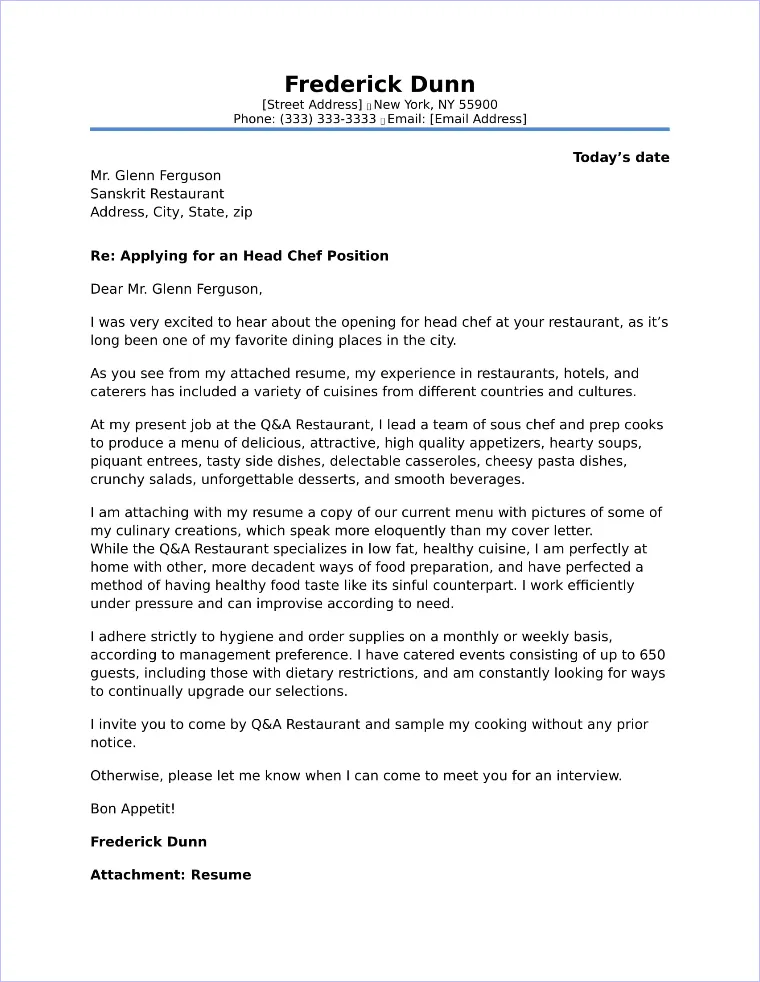
Crafting a Chef Cover Letter
A well-crafted cover letter is your first impression on a potential employer, and for a chef, it’s your opportunity to showcase your culinary skills and passion for food. It goes beyond your resume, allowing you to tell a story, highlight your unique abilities, and explain why you’re the perfect fit for the role. It’s not just about listing your past jobs; it’s about presenting yourself as a chef, an artist, and a leader who is ready to create exceptional dining experiences. This guide will walk you through the essential elements to creating a cover letter that will make a lasting impression and increase your chances of landing your dream job. From understanding its purpose to avoiding common pitfalls, we’ll cover everything you need to know to make your application stand out.
Understanding the Purpose of Cover Letter
The primary goal of a cover letter is to secure an interview. It serves as a personal introduction, a marketing tool, and a way to make a connection with the hiring manager. Unlike your resume, which provides a factual overview of your experience, your cover letter allows you to explain your motivations, express your enthusiasm, and elaborate on specific skills and accomplishments relevant to the position. It also helps you to address any gaps in your employment history or explain why you’re seeking a new opportunity. By taking the time to write a thoughtful and personalized cover letter, you demonstrate your genuine interest in the position and the company, setting you apart from other applicants who may rely solely on their resumes.
Highlighting Your Culinary Skills

Your cover letter is the perfect place to highlight your culinary skills. Don’t just list them; demonstrate them. Instead of saying ‘Proficient in French cuisine,’ provide a specific example, like, ‘Successfully managed a team of cooks in preparing and executing a complex French menu for over 100 guests daily.’ Mention specific techniques you excel in, like knife skills, sauce-making, or pastry expertise. If you have experience with particular cuisines, highlight those. Remember to tailor your skills to match the job description; if the restaurant specializes in Italian food, emphasize your Italian cooking experience. Including the specific techniques and cuisine experience can impress the potential employers. This approach showcases your practical expertise and ability to deliver outstanding results in the kitchen.
Listing Relevant Experience
When listing your experience, focus on the roles that are most relevant to the position you are applying for. Start with your most recent or most relevant experience and briefly describe your responsibilities and achievements in each role. For each position, mention the restaurant name, location, and the dates of your employment. Provide details about the types of food you prepared, the size of the kitchen you worked in, the number of staff you managed, and any special projects you were involved in. Quantify your achievements whenever possible (more on this later). If you have gaps in your employment history, briefly address them without making excuses. Focus on the positive aspects of your experience, and highlight what you learned and how you grew as a chef.
Showcasing Your Achievements
Instead of simply listing your responsibilities, showcase your achievements in previous roles. What did you accomplish? How did you contribute to the restaurant’s success? Did you receive any awards or accolades? Did you improve kitchen efficiency, reduce food costs, or increase customer satisfaction? Provide specific examples of your accomplishments and quantify them whenever possible. For instance, instead of saying ‘Improved food quality,’ you could write ‘Implemented new cooking techniques that increased customer satisfaction by 15%.’ Highlighting your achievements demonstrates your ability to deliver results and adds significant value to your application, making you a more appealing candidate.
Quantifying Accomplishments

One of the most effective ways to showcase your achievements is by quantifying them. Use numbers, percentages, and specific data to demonstrate the impact of your work. For example, instead of saying ‘Managed food costs effectively,’ you could write ‘Reduced food costs by 8% through inventory management and waste reduction strategies.’ Or, instead of ‘Improved kitchen efficiency,’ try ‘Increased table turnover by 10% through optimized food preparation workflows.’ Quantifying your accomplishments makes your claims more credible and provides concrete evidence of your abilities. It also allows the hiring manager to quickly assess your value and the positive impact you could have on their restaurant or establishment.
Tailoring Your Cover Letter
A generic cover letter will likely end up in the rejection pile. To stand out, you must tailor your cover letter to each specific job application. Review the job description carefully and identify the key requirements and desired skills. Then, customize your cover letter to emphasize how your skills and experience align with those requirements. Mention the specific restaurant or establishment you are applying to and show that you understand their style, cuisine, and values. This demonstrates that you’ve done your research and are genuinely interested in the opportunity. Tailoring your cover letter shows that you are invested in the position, and that you can be a valuable asset to the company.
Researching the Restaurant or Establishment
Before you start writing, research the restaurant or establishment you are applying to. Visit their website, check out their menu, read reviews, and follow them on social media. Understand their cuisine, their atmosphere, and their target audience. This research will help you tailor your cover letter to demonstrate your interest in their specific brand. It will also help you identify the keywords and phrases they use to describe themselves and their ideal candidates, which you can then incorporate into your cover letter. Showing that you know the company’s values and what makes it unique will make your application more compelling and improve your chances of getting noticed.
Addressing the Hiring Manager

Whenever possible, address your cover letter to a specific person, such as the hiring manager or the executive chef. This personal touch makes your cover letter more engaging and shows that you have taken the time to learn about the company. If you can’t find the hiring manager’s name, try to find it on LinkedIn or the company website. If you are unable to find a specific name, you can use a professional greeting such as ‘Dear Hiring Manager’ or ‘Dear Chef.’ Avoid generic greetings like ‘To Whom It May Concern,’ which can make your cover letter feel impersonal and less appealing.
Formatting Your Cover Letter
Your cover letter should be well-formatted and easy to read. Use a professional font, such as Times New Roman, Arial, or Calibri, and use a font size between 10 and 12 points. Use clear headings and subheadings to organize your content and make it easy for the reader to scan. Keep your paragraphs concise and use bullet points to highlight key skills and achievements. Avoid using excessive formatting or distracting elements. The goal is to present your information in a clear, organized, and professional manner. A clean and easy-to-read format is crucial to ensuring your message is communicated effectively, and making a positive impression.
Using a Professional Tone
Maintain a professional and confident tone throughout your cover letter. Use a formal writing style, avoiding slang, jargon, and casual language. Be enthusiastic and passionate about your culinary skills and your interest in the position, but avoid being overly familiar or boastful. Proofread your cover letter carefully to ensure that it is free of grammatical errors and typos. A professional tone and polished writing are essential to demonstrating your attention to detail and your commitment to excellence, qualities highly valued in the culinary industry.
Structuring Your Cover Letter

A well-structured cover letter typically consists of these key sections: the heading, the greeting, the opening paragraph, the body paragraphs, and the closing paragraph. The heading should include your contact information, the date, and the employer’s contact information. The greeting should be addressed to the hiring manager. The opening paragraph should state your interest in the position and briefly explain why you are a good fit. The body paragraphs should highlight your skills, experience, and achievements, as well as show how they align with the job requirements. The closing paragraph should reiterate your interest and include a call to action, such as requesting an interview. Following this structure will help ensure that your cover letter is organized and easy to read.
Writing an Engaging Opening
The opening paragraph is your chance to grab the hiring manager’s attention. Start with a strong statement that immediately captures their interest. You could mention how you learned about the opportunity, express your admiration for the restaurant, or highlight a key skill or achievement that makes you an ideal candidate. The opening paragraph should also clearly state the position you are applying for. Avoid generic openings, such as ‘I am writing to express my interest.’ Instead, try a more engaging approach, like, ‘I am writing to express my interest, as a chef with a passion for Italian cuisine, I was thrilled to see the opening for a Chef de Cuisine at [Restaurant Name].’ A captivating opening will entice the hiring manager to continue reading your cover letter.
Expressing Your Passion for Cooking
Show your passion for cooking throughout your cover letter. Let your enthusiasm shine through your writing, and describe what you enjoy about your craft. Mention your favorite cuisines, ingredients, or techniques. Discuss how you approach food and the value you see in the process of cooking. Expressing your passion for cooking will demonstrate your dedication, creativity, and genuine interest in the culinary arts, which is very attractive to potential employers. This will help you stand out as a chef who is not just skilled but also passionate about their work, and will make you more appealing to the employers.
Detailing Your Culinary Expertise

In your cover letter, provide specific details about your culinary expertise. Mention the types of cuisines you are proficient in, the techniques you master, and the equipment you are skilled in using. Describe your experience with menu planning, food costing, and inventory management. Highlight any special skills, such as pastry making, butchery, or sous vide techniques. Include any awards or certifications you’ve received. Providing detailed information about your culinary expertise showcases your capabilities and allows the hiring manager to quickly assess your fit for the position and the establishment. Mention the types of cuisine, the scale and the level of the kitchen.
Showcasing Your Professionalism
In addition to your culinary skills, it’s important to showcase your professionalism. This includes your ability to work as part of a team, communicate effectively, and manage a kitchen efficiently. Mention your experience in training and supervising staff, maintaining a clean and organized work environment, and adhering to food safety regulations. Showcase your ability to handle pressure, solve problems, and make decisions under pressure. Highlighting these attributes will make you a well-rounded candidate and prove you can handle the responsibilities of a chef. This will make you more appealing to the employers, as they seek someone who is not only skilled but also responsible and able to handle the pressure.
Emphasizing Relevant Experience
Focus on the experience that is most relevant to the position you are applying for. Review the job description carefully and identify the key requirements. Then, highlight the experiences that best demonstrate your ability to meet those requirements. If the job requires experience with a specific type of cuisine, emphasize your experience with that cuisine. If it requires experience managing a large kitchen team, highlight your experience in a similar role. By emphasizing your relevant experience, you show the hiring manager that you possess the skills and qualifications they are seeking. This will significantly increase your chances of getting the job.
Creating a Strong Closing

Your closing paragraph should reiterate your interest in the position and your enthusiasm for the opportunity. Thank the hiring manager for their time and consideration. Include a call to action, such as requesting an interview or expressing your availability for a phone call. Keep your closing concise and professional, and avoid clichés. For example, you could write, ‘Thank you for your time and consideration. I am eager to learn more about this opportunity and discuss how my skills and experience can contribute to [Restaurant Name]’s success. I am available for an interview at your earliest convenience.’ A strong closing leaves the hiring manager with a positive impression and encourages them to take the next step.
Proofreading and Editing Your Cover Letter
Before submitting your cover letter, proofread it carefully for any errors in grammar, spelling, and punctuation. Errors can undermine your credibility and make you appear careless. Use a spell checker and grammar checker, but also read your cover letter aloud to catch any mistakes that automated tools might miss. Ask a friend or colleague to review your cover letter and provide feedback. Proofreading ensures that your cover letter is polished, professional, and free of any distracting errors. This will help you create a strong first impression and increase your chances of getting the job.
Ensuring Accuracy and Clarity
In addition to proofreading, ensure that your cover letter is accurate and clear. Verify the facts and figures you have presented, and make sure your statements are supported by your resume. Use clear and concise language, and avoid jargon or overly complex sentences. Make sure your cover letter is easy to understand and follow. The goal is to communicate your message clearly and effectively, demonstrating your skills, experience, and qualifications in a way that is easy for the hiring manager to comprehend. Accuracy and clarity are essential for making a positive impression and securing an interview.
Highlighting Keywords
To increase the chances of your cover letter being noticed by applicant tracking systems (ATS), incorporate keywords from the job description. Identify the key skills, qualifications, and responsibilities mentioned in the job posting, and strategically include those keywords in your cover letter. Be careful not to stuff your cover letter with keywords; instead, use them naturally within the context of your writing. Highlighting keywords helps your cover letter get past the initial screening process and ensures that it is seen by the hiring manager. This simple tip will make it more likely that your cover letter makes it through the initial screening processes.
Reviewing Cover Letter Examples
Reviewing cover letter examples can provide valuable insight into how to structure and write an effective cover letter for a chef position. Look for examples online or in career resources. Pay attention to the opening and closing paragraphs, the body paragraphs, and the overall tone of the letter. Analyze how the examples highlight skills, experience, and achievements. Adapt the structure and language to fit your situation, ensuring that the examples serve as a guide. Reviewing the examples will allow you to understand what a good cover letter is, and improve your chances of getting the job.
Avoiding Common Mistakes
Avoid common mistakes that can hurt your chances of getting a job. These include: using a generic cover letter, not tailoring your cover letter to the specific job, making grammatical errors or typos, being overly casual or informal, and not providing enough detail about your skills and experience. Also, avoid being negative or complaining about previous employers. Ensure that your cover letter is tailored to the job, well-written, and free of errors. By avoiding these mistakes, you can significantly improve your chances of getting the job.
Submitting Your Cover Letter
When submitting your cover letter, carefully follow the application instructions. If the job posting specifies how to submit your cover letter, make sure you adhere to those instructions. Include your cover letter as an attachment and use a professional file name. Ensure that your contact information is up-to-date. Double-check the formatting and make sure everything is easy to read. Submitting a well-prepared cover letter, with attention to detail, shows the hiring manager that you are serious about the opportunity and are capable of following instructions.
Following Application Instructions
Always follow the application instructions. This may seem obvious, but many applicants fail to do so, which can lead to their applications being rejected. Carefully review the job posting for specific instructions on how to submit your cover letter and resume. If the posting asks for specific file formats, font sizes, or other requirements, make sure to comply with them. Not following application instructions demonstrates a lack of attention to detail and a lack of respect for the employer’s time and preferences. Following the instructions shows that you are a detail-oriented and considerate candidate. This can increase your chances of getting noticed.