Understand the Purpose of a Career Change Cover Letter
A career change cover letter is a crucial document when transitioning into a new field. Unlike a standard cover letter, it serves a unique purpose to bridge the gap between your past experience and your desired future. It’s an opportunity to explain the ‘why’ behind your career shift and demonstrate how your skills and experiences are relevant to the new role, even if they don’t directly align with the job description. The primary aim is to persuade the hiring manager that you’re a viable candidate, despite your non-traditional background. By articulating your motivations, highlighting transferable skills, and showing your enthusiasm, you can effectively address any concerns about your lack of direct experience and increase your chances of getting an interview. Think of it as your chance to tell a compelling story about your career journey and how it leads to the specific job you are applying for.
Highlight Transferable Skills
One of the most critical aspects of a career change cover letter is highlighting your transferable skills. These are the skills you’ve acquired in previous roles, volunteer work, or even personal projects that can be applied to the new job. Examples include communication, problem-solving, leadership, project management, and customer service skills. To identify these, carefully analyze the job description and pinpoint the skills the employer values most. Then, reflect on your past experiences and how you’ve demonstrated those skills. Provide specific examples, quantifying your achievements whenever possible. For instance, instead of saying ‘Managed projects,’ say ‘Managed three cross-functional projects, delivering them on time and under budget.’ This approach demonstrates how your skills translate across different industries and roles. It’s about proving that you possess the core competencies required to succeed, even if your past role wasn’t identical to the one you’re applying for. Think of it as selling the skills you have, rather than the specific job titles or responsibilities.
Identify Your Relevant Experience

Even if your experience doesn’t directly match the job description, there are likely aspects of your background that are relevant. This could include projects you’ve worked on, software you’ve used, industries you’re familiar with, or even the type of teams you’ve worked in. The key is to identify these aspects and position them as assets. For example, if you’re changing from marketing to project management, highlight your experience with campaign planning, budgeting, or team leadership, which are transferable skills. When describing your past experience, focus on your accomplishments and how they’ve prepared you for the new role. Use action verbs to showcase what you did and the impact you made. By carefully selecting and presenting your relevant experience, you can build a compelling case for why you are a good fit.
Emphasize Your Enthusiasm
Your enthusiasm is vital, particularly when changing careers. It demonstrates your commitment to the new field and your willingness to learn and adapt. Show your genuine interest in the company and the specific role by researching the company’s mission, values, and recent projects. Explain why you’re excited about this particular opportunity and how it aligns with your career goals. Mentioning specific aspects of the company or the role that appeal to you shows that you’ve done your homework and are genuinely interested. Expressing your enthusiasm goes beyond simply saying ‘I am enthusiastic’; it means providing concrete reasons for your excitement and demonstrating your understanding of the role. It’s also a great way to offset any concerns the hiring manager might have about your lack of direct experience. Remember, passion can often compensate for a lack of experience.
Address the Career Change
Directly addressing the career change is essential. Be upfront about your transition and briefly explain your reasons for the shift. Avoid generic statements; instead, provide a concise and compelling narrative that explains your motivations. Highlight what drew you to the new field and what you hope to achieve in this role. Your explanation should be positive and focused on the future, rather than dwelling on your past experiences. Frame your career change as a strategic move aligned with your long-term goals. Briefly mention what inspired this change, whether it was a passion, a new skill learned, or a desire for a different work environment. Your goal is to show a clear and well-thought-out plan, reassuring the hiring manager that you are not making a hasty decision.
Structure Your Career Change Cover Letter

A well-structured cover letter is vital for conveying your message effectively. A clear layout and logical flow make it easier for the hiring manager to understand your qualifications and career goals. Divide your letter into distinct sections, each with a specific purpose, and use headings to guide the reader. The key is to create a professional, easy-to-read document that highlights your key qualifications and enthusiasm for the role. Keep each section concise, focusing on what’s most relevant to the job. The structure helps you organize your thoughts and ensures you address all the necessary points.
Header and Salutation
Start your cover letter with a professional header, including your contact information (name, phone number, email, and optionally, your LinkedIn profile link). Then, address the hiring manager by name if possible; if you can’t find their name, a generic greeting like ‘Dear Hiring Manager’ is acceptable. This demonstrates that you are detail-oriented and have taken the time to research the company and the position. Addressing the hiring manager by name makes your letter feel more personalized. Ensure all your contact information is correct and up-to-date, so that the employer can contact you easily. Use a professional email address and maintain a professional tone throughout your communication.
Opening Paragraph
The opening paragraph is your first chance to grab the hiring manager’s attention. State the position you are applying for and briefly mention where you saw the job posting. Then, immediately highlight your enthusiasm for the role and the company. If possible, mention a specific aspect of the role or company that interests you, demonstrating that you’ve researched the opportunity. Also, mention your career change and state why you are applying for this role; it is important to be direct and honest, but avoid being vague or overly descriptive. Focus on how your skills align with the job requirements and what you can bring to the role. Keep the opening concise and to the point, setting the tone for the rest of your letter.
Body Paragraphs

The body paragraphs are where you make your case. Focus on showcasing your transferable skills and relevant experiences. Use specific examples to demonstrate how you’ve used these skills in the past and how they apply to the new role. This is the section where you can tell your story and convince the employer of your ability to perform the job effectively. Structure your paragraphs around key skills or requirements mentioned in the job description. Use action verbs to describe your accomplishments and quantify your achievements whenever possible. For each skill or experience, provide a brief context, followed by the specific action you took, and the results you achieved. It’s better to use three or four concise paragraphs, rather than one long, rambling one.
Closing Paragraph
In your closing paragraph, reiterate your interest in the position and the company. Thank the hiring manager for their time and consideration. Reiterate your excitement about the opportunity. Then, include a call to action, such as ‘I look forward to discussing my qualifications further in an interview.’ This shows initiative and encourages the hiring manager to take the next step. Proofread your letter carefully before submitting it, ensuring that it is free of any errors. A well-crafted closing paragraph leaves a lasting positive impression.
Formatting and Style Tips
Formatting and style play a significant role in how your cover letter is received. A clean, professional layout is essential for readability. Use a standard font like Times New Roman, Arial, or Calibri, and keep the font size between 10 and 12 points. Use single spacing within paragraphs and double spacing between paragraphs to create visual separation. The letter should be concise, ideally one page in length. Use bullet points, bolding, or italics sparingly to highlight key information. Proofread carefully to eliminate any typos or grammatical errors. A well-formatted letter demonstrates attention to detail and professionalism, increasing your chances of success.
Tailor Your Cover Letter to Each Job

Never send a generic cover letter. Always tailor your letter to the specific job and company. Review the job description carefully and identify the key requirements and skills. Highlight the skills and experiences that align with those requirements, and use the same keywords as the job description whenever possible. Research the company and learn about its mission, values, and recent projects. Use this information to personalize your letter and show that you understand the company’s culture and needs. Mention specific aspects of the company or role that interest you, and tailor your letter to demonstrate your genuine enthusiasm. This personalized approach shows initiative and demonstrates that you’re serious about the opportunity.
Proofread Carefully
Proofreading is critical. Typos and grammatical errors can undermine your credibility. Carefully review your cover letter for any spelling, punctuation, and grammatical mistakes. Read it aloud to catch errors you might miss when reading silently. Ask a friend, family member, or career counselor to proofread it as well, as a fresh pair of eyes can often spot errors you might miss. Pay close attention to details, such as the correct spelling of the hiring manager’s name and the company name. Make sure all contact information is correct. Take the time to proofread your cover letter thoroughly before submitting it. This shows professionalism and attention to detail.
Use Keywords Effectively
In today’s job market, using the right keywords is essential to get your cover letter noticed. Many companies use applicant tracking systems (ATS) to screen applications, and these systems often scan for specific keywords. Carefully review the job description and identify the keywords and phrases that the employer is looking for. Then, incorporate those keywords naturally throughout your cover letter, especially in the skills and experience sections. Avoid keyword stuffing, which can make your letter sound unnatural and unprofessional. Instead, weave the keywords into the context of your sentences to ensure that your skills and experiences are clearly and effectively communicated.
Examples of Effective Career Change Cover Letters

Reviewing examples can provide valuable insight into how to structure and write an effective career change cover letter. Look for examples that demonstrate clear explanations of the career change, focus on transferable skills, and showcase enthusiasm for the new role. Pay attention to the formatting, style, and tone of the examples. Adapt successful elements from these samples to fit your own experiences and goals. Remember that each cover letter should be personalized to the specific job. Use examples as a guide, but don’t simply copy them.
Cover Letter Example
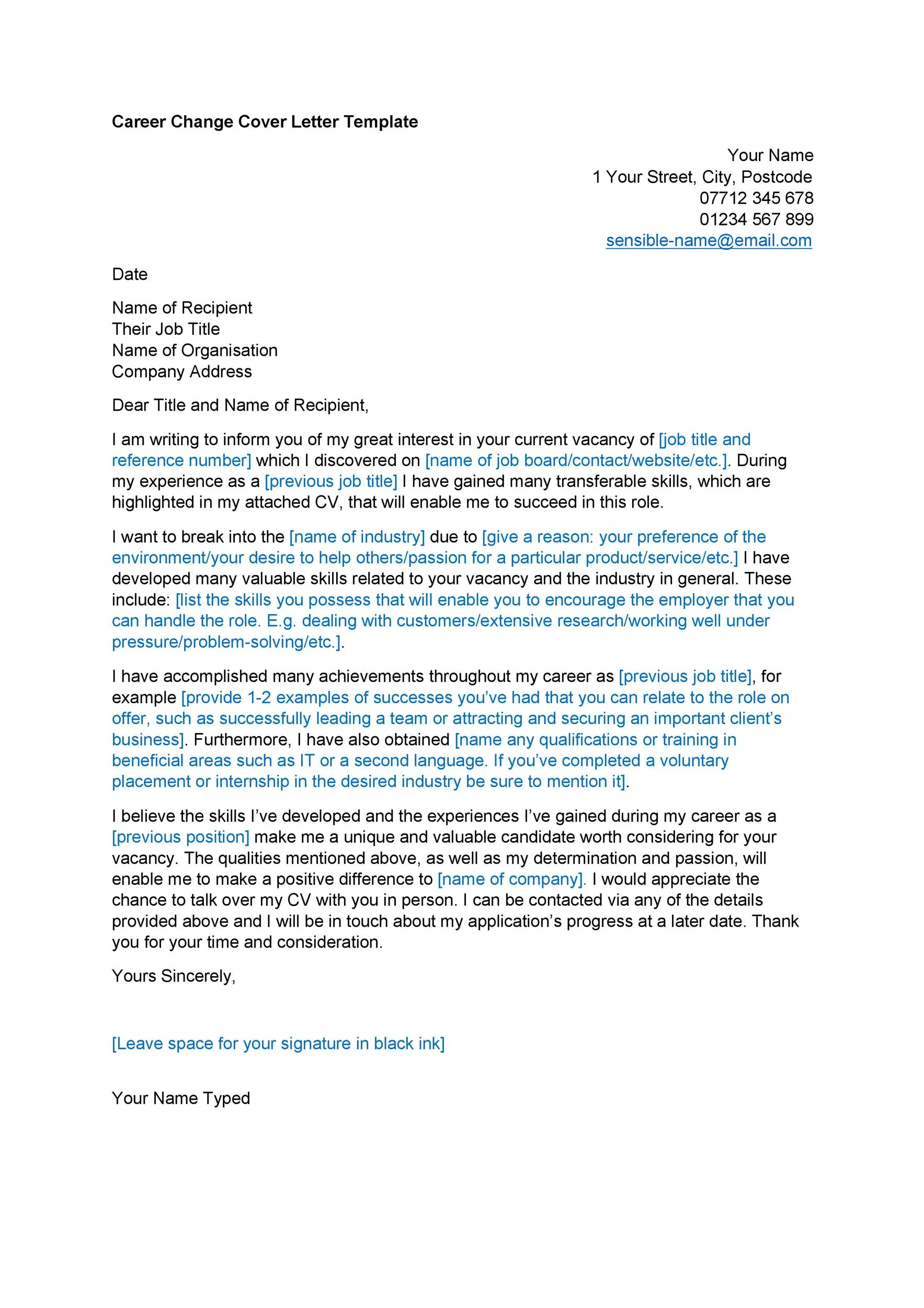
Here is an example of a career change cover letter to guide you:
[Your Name] [Your Address] [Your Phone Number] [Your Email]
[Date]
[Hiring Manager Name] [Hiring Manager Title] [Company Name] [Company Address]
Dear [Mr./Ms./Mx. Last Name],
I am writing to express my enthusiastic interest in the [Job Title] position at [Company Name], as advertised on [Platform where you saw the job]. With a proven track record in [Previous Field] and a strong desire to transition into [New Field], I am confident that my transferable skills and genuine passion align perfectly with the requirements of this role.
In my previous role as a [Your Previous Role] at [Your Previous Company], I honed my skills in [Skill 1], [Skill 2], and [Skill 3]. For example, I successfully [quantifiable achievement]. I am particularly drawn to [Company Name] because of [Specific reason, e.g., their innovative work in X].
I am eager to apply my skills in [Skill 1], [Skill 2], and [Skill 3] to contribute to your team. I am particularly excited about [Specific aspect of the job or company].
Thank you for your time and consideration. I look forward to the opportunity to discuss my qualifications further.
Sincerely, [Your Signature] [Your Typed Name]
Remember to replace the bracketed information with your specific details and tailor it to the job you are applying for.
Key Takeaways
Writing a compelling cover letter for a career change requires a strategic approach. By understanding the purpose of the letter, highlighting your transferable skills, addressing the career change directly, and structuring your letter effectively, you can significantly increase your chances of landing an interview. Remember to tailor your letter to each job, proofread carefully, and use keywords effectively. Use examples to guide your writing process, but always personalize your letter. By following these guidelines, you can create a cover letter that showcases your qualifications and enthusiasm, opening doors to exciting new opportunities in your desired field.