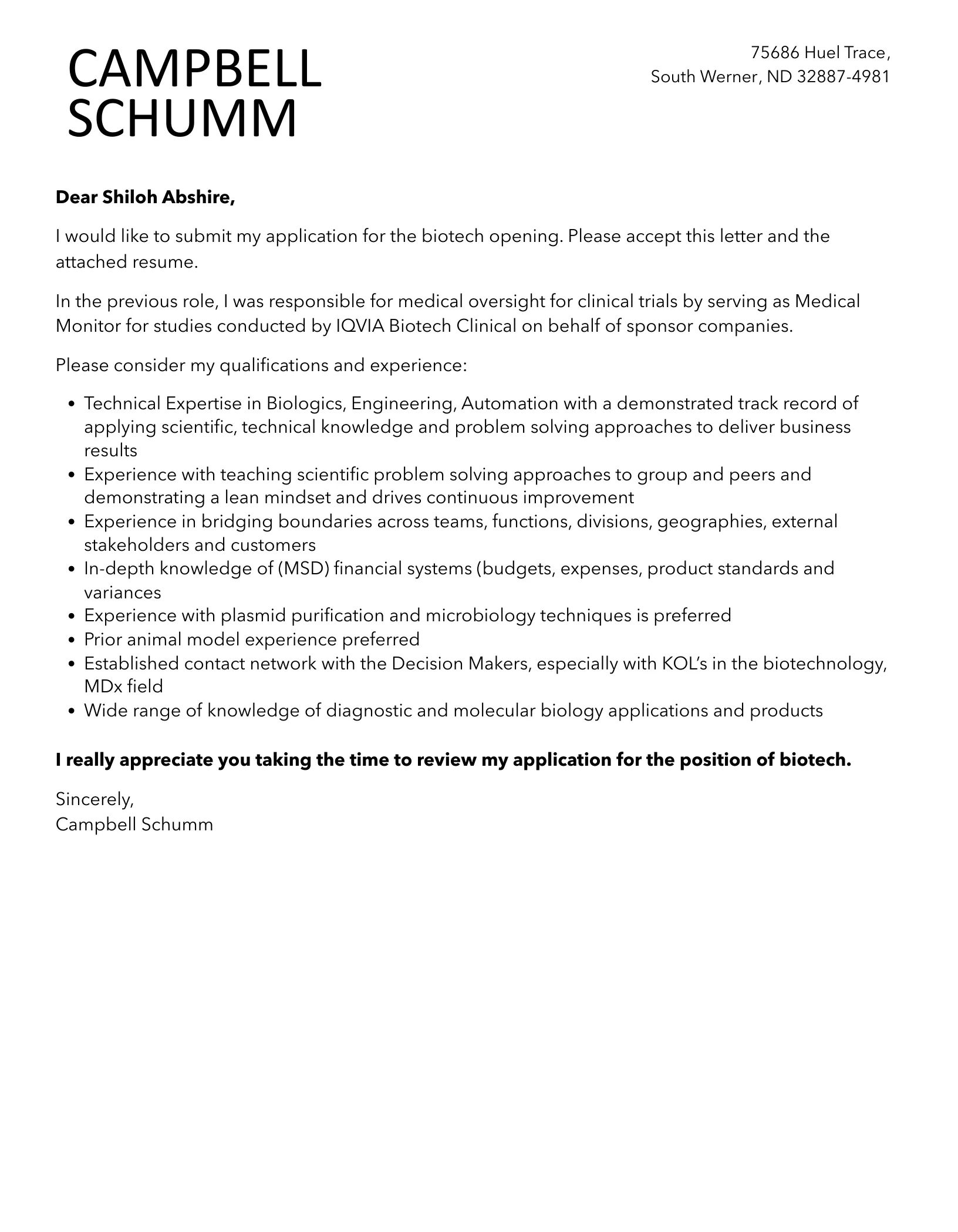
Understanding the Importance of a Biotech Cover Letter
In the competitive field of biotechnology, a well-crafted cover letter is not just a formality it’s a critical tool for making a strong first impression and securing an interview. A cover letter provides you with the opportunity to go beyond your resume, showcasing your personality, passion, and relevant skills in a way that a list of qualifications simply cannot. It’s your chance to tell a story, highlighting how your unique background aligns with the specific requirements of the job and the values of the company. A compelling cover letter can significantly increase your chances of standing out from other applicants, particularly in a field where specialized skills and experience are highly valued. Therefore, taking the time to create a personalized and impactful cover letter is an investment in your career success.
Why a Cover Letter Matters in Biotech
In the biotech industry, a cover letter serves multiple crucial purposes. Firstly, it allows you to demonstrate your understanding of the company and the specific role you are applying for. Researching the company’s mission, values, and recent projects enables you to tailor your cover letter to highlight how your skills and experiences align with their goals. Secondly, it provides an opportunity to address any potential gaps in your resume or explain career transitions. For instance, if you’re changing fields or industries, your cover letter can explain why your skills are transferable and relevant. Thirdly, a well-written cover letter showcases your communication skills, which are essential in biotech where you’ll need to convey complex scientific information clearly and concisely. A well-written cover letter demonstrates professionalism and attention to detail, both highly valued qualities in biotech.
Highlighting Your Skills and Experience

Your biotech cover letter should effectively highlight your relevant skills and experiences, emphasizing those that align with the job requirements. Instead of simply listing your qualifications, provide specific examples of how you’ve utilized your skills in previous roles or projects. For instance, if the job description requires experience with PCR, describe a specific project where you successfully employed this technique, detailing the challenges you overcame and the positive outcomes you achieved. Similarly, if the role requires data analysis skills, mention the software you’re proficient in and provide examples of how you’ve used these skills to interpret data and contribute to scientific findings. Use action verbs to describe your accomplishments and quantify your results whenever possible. This helps potential employers quickly understand the value you can bring to their team.
Key Components of a Strong Biotech Cover Letter
Formatting Your Cover Letter for Biotech Applications
The format of your biotech cover letter is important because it sets the tone and makes a first impression. Use a professional font like Times New Roman, Arial, or Calibri, and maintain a consistent font size throughout the document. The ideal length for a cover letter is typically one page, keeping it concise and to the point. Ensure that your cover letter is well-organized with clear headings and paragraphs. Use bullet points to highlight key skills and accomplishments, making it easy for the hiring manager to scan the document. Ensure that the cover letter aligns with the formatting of your resume, creating a consistent and professional brand. Proofread the letter multiple times for any errors in grammar, spelling, or punctuation.
Header and Contact Information

Your cover letter header should include your full name, professional title (if applicable), contact information (phone number, email address, and LinkedIn profile URL), and the date. This information should be placed at the top of the document, usually left-aligned. Following your information, include the hiring manager’s name (if known), their title, the company name, and the company’s address. If you’re sending your cover letter electronically, ensure that your email address is professional-sounding. Your contact information must be up to date, as this is how potential employers will contact you for interviews or further communications.
Professional Salutation
Start your cover letter with a professional salutation. If you know the hiring manager’s name, use “Dear Mr./Ms./Mx. [Last Name]” to personalize your letter. If the hiring manager’s name is not available, use a more general greeting like “Dear Hiring Manager” or “Dear [Company Name] Hiring Team.” Avoid using outdated or overly formal salutations. Ensure that the salutation aligns with the tone of the job description and the company culture. This sets the tone for the rest of your letter, demonstrating your attention to detail and respect for the hiring process. Remember to properly address the recipient, showing that you’ve taken the time to research who will be reviewing your application.
Writing a Compelling Opening
The opening of your cover letter should immediately capture the reader’s attention and make them want to continue reading. Clearly state the position you are applying for and where you saw the job posting. Briefly highlight why you are interested in the role and what makes you a strong candidate. Start with a strong opening sentence that showcases your enthusiasm and understanding of the company. Avoid generic openings such as “I am writing to express my interest…” Instead, use an opening that directly relates to the job description or the company’s mission. Consider mentioning a recent achievement or a skill that directly aligns with the job’s requirements. The goal is to pique the hiring manager’s interest and encourage them to read further.
Showcasing Your Achievements and Skills

Quantifying Your Accomplishments
Quantifying your accomplishments is a critical step in making your biotech cover letter more impactful. Instead of simply stating that you have experience, provide specific examples with measurable results. For instance, instead of saying, “I managed lab experiments,” say “Managed over 50 lab experiments, leading to a 20% increase in research efficiency.” Use numbers, percentages, and specific data to demonstrate your impact. This gives the hiring manager a clear understanding of what you have achieved and the value you can bring to their organization. This shows that you are not only skilled but also results-oriented, a trait highly sought after in the biotech industry. Using numbers can also help you stand out, providing concrete evidence of your abilities.
Tailoring Your Cover Letter
Customizing your cover letter for each specific job application is essential. Avoid using a generic template and make sure to tailor your letter to the specific requirements and responsibilities outlined in the job description. Research the company and the role thoroughly. Highlight the skills and experiences that are most relevant to the position. Mention specific projects or achievements that align with the company’s goals. This shows the hiring manager that you have taken the time to understand their needs and that you are genuinely interested in the opportunity. A tailored cover letter demonstrates your commitment and ability to be a valuable asset to the team, increasing your chances of getting an interview.
Matching Skills to Job Requirements

When tailoring your cover letter, carefully match your skills and experiences to the job requirements. Identify the key skills and qualifications listed in the job description and ensure that you highlight these in your letter. Use the same keywords and phrases that are used in the job description. Provide specific examples of how you have used these skills in previous roles or projects. Do not simply list skills; instead, explain how you have applied those skills to achieve results. This helps the hiring manager quickly see how your background aligns with their needs. By directly addressing the requirements, you demonstrate your understanding of the role and your ability to contribute from day one.
Demonstrating Your Passion for Biotech
Expressing Your Enthusiasm
In a field as innovative and challenging as biotech, expressing your enthusiasm is vital. Show your passion for the industry and the specific role. Communicate your genuine interest in the company’s mission, research, or products. Use your cover letter to explain why you are excited about the opportunity and what motivates you to work in biotech. Show that you’re not just looking for a job, but that you’re driven by the science and its potential to make a difference. This can be achieved by mentioning specific projects, publications, or advances in the field that have inspired you. Employers look for individuals who are enthusiastic and dedicated to the advancement of biotechnology.
Using Keywords

Using relevant keywords from the job description is a crucial aspect of crafting a successful biotech cover letter. Hiring managers often use Applicant Tracking Systems (ATS) to scan resumes and cover letters for specific keywords. Review the job description carefully and identify the key skills, technologies, and experiences required for the role. Integrate these keywords naturally into your cover letter. Avoid keyword stuffing, which can make your letter sound unnatural and less effective. Instead, incorporate these keywords throughout the document, particularly in the summary, skills section, and descriptions of your experience. This ensures that your cover letter is easily found and demonstrates your alignment with the job requirements.
Crafting a Strong Closing
Call to Action
The closing of your cover letter should reiterate your interest in the position and leave a lasting impression. Include a clear call to action. State that you are eager to discuss your qualifications further and that you look forward to the opportunity to interview. Thank the hiring manager for their time and consideration. Reiterate your contact information, making it easy for them to get in touch with you. Keep the tone of the closing professional and enthusiastic. A well-crafted closing reinforces your interest in the role and leaves the hiring manager with a positive impression of your candidacy. It demonstrates your professionalism and helps move your application forward.
Proofreading and Editing

Proofreading and editing your biotech cover letter is an absolutely essential step to ensure its professionalism and impact. Errors in grammar, spelling, or punctuation can undermine your credibility and make you appear careless. Before submitting your cover letter, carefully review it multiple times. Use spell-check and grammar-check tools, but also read the letter aloud to catch any awkward phrasing or sentences that don’t flow smoothly. Ask a friend, mentor, or career counselor to review your cover letter. A fresh pair of eyes can often spot mistakes that you might miss. Correct any errors and revise the letter until you are confident that it accurately represents your skills and qualifications. A polished, error-free cover letter shows your attention to detail and dedication to your application.
Common Biotech Cover Letter Mistakes to Avoid
Using Generic Language
Avoid using generic language that could be applied to any job. Instead of using vague phrases, provide specific examples and demonstrate how your skills and experiences are relevant to the particular role and the company. Generic language makes your cover letter less memorable and less likely to impress the hiring manager. Generic statements such as, “I am a hard worker and a team player,” are not specific enough. Instead, use concrete examples to illustrate your skills. For instance, describe a specific project where you collaborated effectively with a team to achieve a scientific goal. Tailor your letter to each job, making sure that your skills and experiences match those required in the job description, demonstrating you’re a strong fit.
Failing to Tailor to the Specific Role
One of the biggest mistakes you can make when writing a biotech cover letter is failing to tailor it to the specific role you are applying for. Sending a generic cover letter that is not tailored to the job demonstrates a lack of interest and attention to detail. Customize each cover letter to highlight the skills and experiences most relevant to the position and the company. Show that you’ve researched the company, understand their mission, and are enthusiastic about the opportunity. Avoid the temptation to reuse the same letter for multiple applications, invest the time in crafting a personalized letter that reflects your genuine interest and qualifications. By tailoring your cover letter, you significantly increase your chances of getting noticed and securing an interview in the competitive biotech field.