Why a Cover Letter is Crucial for Admin Assistants
In the competitive job market, especially for administrative assistant roles, a cover letter is more than just an optional extra – it’s a critical tool for making a strong first impression. Think of your cover letter as your personal introduction, a chance to showcase your personality, enthusiasm, and suitability for the position beyond what your resume can convey. For an administrative assistant, attention to detail, strong communication skills, and the ability to present yourself professionally are essential. A well-crafted cover letter allows you to demonstrate these qualities immediately, setting you apart from candidates who may only submit a resume. Furthermore, a cover letter provides the perfect platform to highlight your understanding of the role and your genuine interest in the company, significantly increasing your chances of landing an interview and ultimately securing the job. By using a cover letter, you are showing the hiring manager that you are willing to go the extra mile.
Key Elements of a Strong Admin Assistant Cover Letter
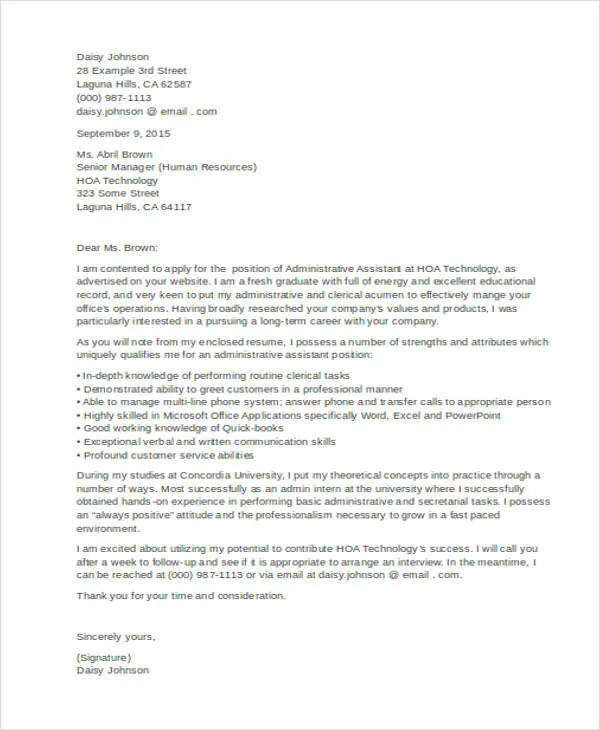
To write a cover letter that effectively captures the hiring manager’s attention, it’s important to focus on including key elements that are pertinent to an administrative assistant role. Start with a professional header, including your contact information and the date, followed by the hiring manager’s name (if you know it) and the company’s address. The opening paragraph should immediately grab the reader’s attention, expressing your enthusiasm for the position and referencing where you saw the job posting. In the body paragraphs, highlight your relevant skills and experience, using specific examples to demonstrate your abilities. This section should also address how your skills align with the company’s needs and the specific requirements of the administrative assistant role. The closing paragraph should reiterate your interest and include a call to action, such as requesting an interview. Remember to keep the tone professional and concise throughout the letter, demonstrating excellent writing and communication skills.
Highlighting Skills and Experience

Administrative assistants need a diverse set of skills and relevant experience, so it’s crucial to clearly and concisely highlight these in your cover letter. Focus on skills directly related to the job description, such as proficiency in Microsoft Office Suite (Word, Excel, PowerPoint, Outlook), experience with scheduling and calendar management, strong organizational abilities, and excellent communication skills (both written and verbal). Describe your relevant experience, providing specific examples of how you have successfully managed administrative tasks in the past. For instance, if you have experience managing calendars, mention the size of the team or the number of appointments you managed. If you handled travel arrangements, give details about the complexity of the trips you organized. Remember to tailor your descriptions to the specific requirements mentioned in the job posting, ensuring that your skills and experience align with the employer’s needs. This ensures that you don’t simply list skills, but demonstrate how you’ve applied them in a professional setting.
Showcasing Soft Skills
Soft skills are essential to administrative assistant roles, and your cover letter is the perfect place to showcase them. These skills, such as communication, organization, problem-solving, and interpersonal abilities, often separate successful candidates from the rest. Highlight your ability to communicate effectively, both in writing and verbally, by describing how you’ve handled correspondence, interacted with clients, or presented information. Demonstrate your organizational skills by mentioning projects you’ve managed, deadlines you’ve met, or systems you’ve implemented to improve efficiency. Give examples of your problem-solving abilities by describing challenging situations you’ve resolved, such as dealing with customer complaints or managing unexpected issues. Finally, showcase your interpersonal skills by mentioning teamwork, collaboration, and how you build relationships with colleagues. By providing specific examples of how you’ve demonstrated these soft skills in previous roles, you’ll make a strong case that you possess the necessary qualities to excel as an administrative assistant.
Quantifying Achievements
To make your cover letter truly impactful, quantify your achievements whenever possible. Numbers and data provide concrete evidence of your capabilities and make your accomplishments more impressive. Rather than simply stating that you improved office efficiency, specify how you did it. Did you streamline a process that saved the company time or money? Mention the percentage of improvement or the amount of resources saved. Did you improve customer satisfaction? Provide the increase in positive feedback or the reduction in complaints. Did you manage a large volume of tasks or projects? Give the exact number of projects, clients, or deadlines you handled. Use numbers to illustrate your proficiency in software or other technical skills, too, if you improved speed or accuracy through these skills. For example, mention the number of emails you managed per day, the number of reports you generated, or the speed at which you were able to perform tasks. By quantifying your achievements, you provide verifiable proof of your value as an administrative assistant.
Tailoring Your Cover Letter

To make the most significant impact, tailor your cover letter to each specific job application. This involves more than just changing the company name; it means carefully reviewing the job description and aligning your skills, experience, and achievements with the specific requirements and preferences mentioned. Identify the keywords and phrases used in the job posting and integrate them into your cover letter where appropriate. Research the company to understand its values, culture, and objectives, and reflect this understanding in your letter. For example, if the company emphasizes teamwork, highlight your collaborative experiences. If the company is focused on innovation, showcase your experience with implementing new processes or technologies. This level of personalization demonstrates your genuine interest in the specific role and the company, greatly increasing the likelihood that your application will stand out. Furthermore, a tailored cover letter will show the hiring manager that you are attentive, detail-oriented, and a good fit for their particular needs.
Researching the Company
Before you start writing your cover letter, take the time to research the company. This research is essential for tailoring your letter and showing your genuine interest in the role. Visit the company’s website to learn about its mission, values, and culture. Read news articles and press releases to stay updated on the company’s recent activities and achievements. Explore the company’s social media presence to get a sense of its brand and how it interacts with employees and clients. Research the company’s products or services to understand its business model and target audience. The more you know about the company, the better you can align your cover letter with its needs and values. Try to identify any specific challenges or goals the company is facing, and consider how your skills and experience could contribute to solving those challenges or achieving those goals. By demonstrating your knowledge of the company, you show the hiring manager that you have taken the time to consider the role and are truly invested in the opportunity.
Customizing Your Letter for Each Application
While it may seem tedious, customizing your cover letter for each application is crucial to making a strong impression. Generic cover letters that are sent to multiple companies do not reflect genuine interest and often miss the mark. Start by reviewing the job description and identifying the key requirements and keywords. Incorporate these keywords into your letter while describing your relevant skills, experiences, and accomplishments. Highlight any specific experiences, skills, or projects that are most relevant to the job. Explain why you are interested in this particular company and this specific role. Tailor your language and tone to match the company’s culture and values. Demonstrate how your professional goals align with the company’s objectives. Even small adjustments, such as mentioning specific company initiatives or projects, can demonstrate your commitment to the opportunity. The effort to customize your letter shows the hiring manager that you are not simply sending out mass applications, but that you have carefully considered this opportunity and are genuinely excited about it.
Formatting and Structure Best Practices

The formatting and structure of your cover letter are just as important as the content itself. A well-formatted cover letter demonstrates professionalism, attention to detail, and respect for the reader’s time. Choose a clean, easy-to-read font, such as Times New Roman, Arial, or Calibri, and maintain a consistent font size (typically 11 or 12 points) throughout the document. Use single spacing within paragraphs and double spacing between paragraphs to improve readability. Use clear headings and subheadings to break up the text and guide the reader through your letter. Keep your letter concise, ideally no more than one page, to respect the hiring manager’s time. Use proper margins and alignment to ensure a neat and professional appearance. A well-structured cover letter includes a header with your contact information, a formal salutation, a compelling introduction, body paragraphs that highlight relevant skills and experience, a concise closing, and a professional sign-off. Follow these formatting and structure best practices to create a cover letter that is both visually appealing and easy to read.
Formatting Your Cover Letter
The formatting of your cover letter is a reflection of your professionalism and attention to detail. Start by including your full name, address, phone number, and email address in the header, aligned to the left or right. Add the date below your contact information, and then add the hiring manager’s name (if known), title, and company address below the date. Ensure that your font choice is clean and readable, such as Times New Roman, Arial, or Calibri. Use a consistent font size (11 or 12 points) throughout the document. Maintain consistent margins of 1 inch on all sides. Use single spacing within paragraphs and double spacing between paragraphs. Left-align your text and avoid justified text. Use bolding or italics sparingly to emphasize key points. Consider using bullet points to list skills or accomplishments, which helps the hiring manager quickly scan your information. When you are done, review your cover letter to check for any formatting inconsistencies or errors. A well-formatted cover letter makes a positive impression and shows that you are capable of producing professional documents.
Structuring Your Cover Letter
A well-structured cover letter is essential for capturing and maintaining the hiring manager’s attention. Begin with a professional salutation, addressing the hiring manager by name if possible. In the opening paragraph, state the position you are applying for and how you learned about the opportunity. Briefly express your enthusiasm for the role and the company. The body of your letter should be divided into several paragraphs, each addressing a specific aspect of your qualifications. Focus on demonstrating how your skills and experiences align with the requirements of the job description. Use specific examples to illustrate your achievements and quantify them whenever possible. In the closing paragraph, reiterate your interest in the position and include a call to action, such as requesting an interview. Express your thanks to the hiring manager for their time and consideration. End with a professional sign-off, such as “Sincerely” or “Best regards”, followed by your typed name. A well-structured cover letter is easy to read and efficiently conveys your key strengths, making a compelling case for your candidacy.
Proofreading and Editing for Perfection

Proofreading and editing your cover letter is absolutely critical to avoid making a negative impression. A cover letter riddled with errors can undermine your credibility and suggest a lack of attention to detail – essential qualities for an administrative assistant. Begin by reviewing your cover letter multiple times, checking for grammatical errors, spelling mistakes, punctuation errors, and incorrect word usage. Use a grammar checker to catch any mistakes you might have missed. Then, read your cover letter aloud to identify any awkward phrasing or sentences that don’t flow smoothly. Check that your contact information is correct and that the hiring manager’s name and company details are accurate. Ask a friend, family member, or career counselor to read your cover letter and provide feedback. Fresh eyes can often spot errors that you may have overlooked. Taking the time to proofread and edit thoroughly demonstrates professionalism and attention to detail, increasing your chances of making a positive impression.
Common Mistakes to Avoid
Several common mistakes can undermine the effectiveness of your cover letter. Avoiding these mistakes can significantly improve your chances of making a strong impression. One of the most significant errors is a lack of personalization – using a generic cover letter that is not tailored to the specific job and company. Another is generic language, such as clichéd phrases and vague descriptions of your skills and experience. Ensure that you don’t simply repeat information that is already in your resume; your cover letter should expand on and highlight your unique qualifications. Typos and grammatical errors are a major red flag, demonstrating a lack of attention to detail. Don’t include information that is irrelevant to the job, and avoid being overly formal or casual in your tone. Finally, a weak call to action, or no call to action at all, can diminish your chances of being contacted. Review your cover letter carefully to ensure that it is free of these common mistakes and presents you in the best possible light.
Lack of Personalization
One of the most common and damaging mistakes in cover letters is a lack of personalization. Sending a generic cover letter to multiple companies indicates a lack of genuine interest in the specific role and company. A generic cover letter often fails to address the particular needs and preferences of the employer and does not reflect the candidate’s enthusiasm for the position. To avoid this, always tailor your cover letter to each specific job application. Start by reviewing the job description carefully and highlighting the key requirements and keywords. Then, in your cover letter, demonstrate how your skills, experience, and accomplishments align with those requirements. Research the company to learn about its values, culture, and objectives, and mention these in your letter. Show that you have taken the time to understand the company and the role. Personalize your letter by mentioning specific company initiatives, projects, or goals. This personalization demonstrates that you are genuinely interested in this opportunity and are not simply sending out mass applications. Make sure you are not using a general template; instead, rewrite your letter each time to reflect this level of attention to detail.
Generic Language

Using generic language in your cover letter is another significant pitfall. Vague, cliché-ridden phrases and uninspired descriptions of your skills and experience can make your cover letter bland and unmemorable. Phrases like “team player,” “hard worker,” or “results-oriented” are common and can fail to set you apart from other candidates. Instead of using generic language, provide specific examples and quantify your achievements whenever possible. Rather than saying “I have strong communication skills,” describe specific instances where you successfully communicated, such as “Managed correspondence for a team of 20+ professionals, ensuring timely responses and clear communication, which improved team efficiency by 15%.” Replace generic statements with concrete details that showcase your unique skills and experiences. Use active verbs to describe your accomplishments and responsibilities. Highlight your key skills by providing specific examples of how you have used them in the past, demonstrating their effectiveness. Avoid using jargon or overly complex language. Strive for clarity and conciseness, ensuring that your cover letter is easy to read and quickly conveys your value to the hiring manager.
Typos and Grammatical Errors
Typos and grammatical errors can instantly undermine your credibility and jeopardize your chances of landing an interview. For an administrative assistant, impeccable attention to detail is crucial, so a cover letter with mistakes sends the wrong message. Always proofread your cover letter carefully. Double-check for spelling errors, grammatical mistakes, and punctuation errors. Read your cover letter aloud to catch any awkward phrasing or sentences that don’t flow smoothly. Utilize a grammar checker to identify any errors that you might have missed. Ask a friend, family member, or career counselor to review your cover letter and provide feedback. Ensure that all contact information is correct and that the hiring manager’s name and company details are accurate. A well-written, error-free cover letter shows that you are attentive to detail, have strong communication skills, and are committed to presenting yourself professionally.
Call to Action and Closing
The call to action and the closing of your cover letter are your last opportunities to make a strong impression and encourage the hiring manager to take the next step. A weak or missing call to action can leave the reader unsure of what you want them to do next. In your closing paragraph, reiterate your interest in the position and mention that you are looking forward to the opportunity to discuss your qualifications in an interview. Include a clear and specific call to action, such as “I am eager to discuss my qualifications further in an interview.” Provide your contact information again, ensuring that the hiring manager has an easy way to reach you. Use a professional and appropriate sign-off, such as “Sincerely,” “Best regards,” or “Thank you for your consideration.” Ensure that your closing is concise and impactful, reinforcing your enthusiasm and professionalism. A strong closing leaves the hiring manager with a positive impression and increases the likelihood that they will contact you for an interview.
Writing a Compelling Closing

A compelling closing is essential for leaving a lasting impression on the hiring manager. Your closing paragraph should reiterate your enthusiasm for the role, the company, and the opportunity to discuss your qualifications further. Begin by briefly summarizing why you are a strong candidate for the position. Highlight your key skills and experience, and how they align with the job requirements. Express your gratitude for the hiring manager’s time and consideration. Then, include a clear and specific call to action. Make it easy for the hiring manager to know the next step you’d like them to take. For example, you can state, “I am eager to discuss how my skills can contribute to your team. I am available for an interview at your earliest convenience.” End with a professional sign-off, such as “Sincerely,” “Best regards,” or “Thank you for your consideration.” Ensure that your closing is concise, enthusiastic, and professional, as it’s the final message the hiring manager will read before deciding on your application.
Including Contact Information
It’s important to make it easy for the hiring manager to contact you by including your contact information. Ensure that your contact information is readily accessible throughout your cover letter. In the header, include your full name, address, phone number, and a professional-looking email address. In the closing paragraph, you may briefly restate your contact information. Make sure that your contact details are accurate and up-to-date. Double-check your phone number and email address to ensure they are correct. When you’re submitting your cover letter online, ensure that the contact information in your application matches what you have listed in your cover letter. By providing your contact information, you show the hiring manager that you are available, interested, and ready to take the next step in the hiring process. This makes it easy for them to schedule an interview and ultimately extend a job offer.