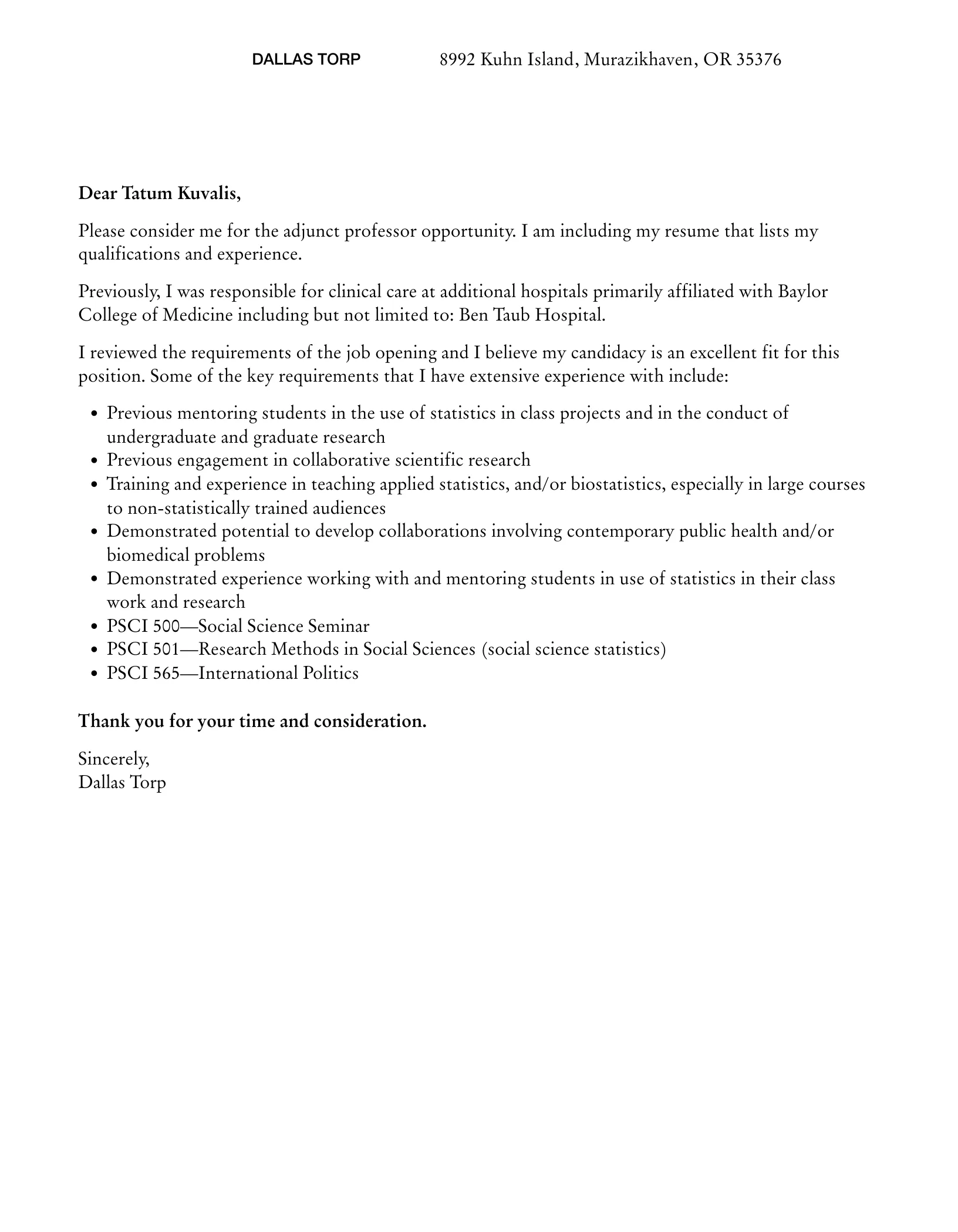
Crafting a Cover Letter for Adjunct Professor Positions
Securing an adjunct professor position requires more than just a strong resume it demands a compelling cover letter. This guide provides a comprehensive approach to crafting a cover letter that not only showcases your qualifications but also captures the attention of the hiring committee. This guide provides a step-by-step breakdown, ensuring your application stands out in a competitive academic landscape. A well-written cover letter is your opportunity to present yourself, articulate your passion for teaching, and demonstrate how your unique skills and experiences align with the specific needs of the institution.
Understanding the Role of an Adjunct Professor
Before delving into the specifics of your cover letter, it is essential to understand the role of an adjunct professor. This understanding will help you tailor your letter to resonate with the hiring committee. Adjunct professors typically work on a part-time basis, teaching specific courses or providing specialized expertise. Their roles can vary, but they often involve delivering lectures, grading assignments, mentoring students, and contributing to departmental meetings. Knowing these responsibilities will enable you to highlight the relevant skills and experiences that align with the position’s requirements. A clear understanding of the expectations allows you to articulate your suitability effectively.
Responsibilities and Expectations

Responsibilities often include preparing and delivering lectures, creating and grading assignments, holding office hours, and participating in departmental meetings. Expectations typically encompass maintaining a high level of teaching quality, engaging with students, and adhering to the university’s policies and procedures. Highlight any previous experience that demonstrates your ability to fulfill these responsibilities. This could include experience teaching, developing curricula, or mentoring students. Showing that you are prepared to meet these expectations will make your application very appealing to the hiring managers.
Key Skills and Qualifications
Essential qualifications include a relevant master’s or doctoral degree, teaching experience, and expertise in the subject matter. Key skills comprise excellent communication, presentation, and interpersonal skills. Highlight your ability to engage students, manage a classroom, and assess student performance. Include any specific skills mentioned in the job description, such as experience with online teaching platforms or specific software. Tailoring your cover letter to match the specific requirements increases your chances of selection. Emphasizing these qualifications helps the committee see how you would fit in their department.
Essential Components of a Compelling Cover Letter
A well-structured cover letter consists of several key components that work together to make a strong impression. By including all of these elements you can write a compelling cover letter that conveys your professional expertise in a concise manner. A solid structure will make your application easy to read, and present yourself in a professional and confident manner. Remember, each element serves a purpose, contributing to the overall effectiveness of your application and increasing your chances of success. Be sure to showcase yourself using these crucial components.
Contact Information and Salutation

Begin your cover letter with your contact information, including your name, address, phone number, and email address. Following this, address the hiring manager or the specific person mentioned in the job posting. If you are unsure of the hiring manager’s name, research the department or use a general salutation like “Dear Hiring Committee.” Personalize your letter, addressing the recipient by name whenever possible, and be sure to verify the spelling of the hiring manager’s name. Using their name instead of the generic will help you get more noticed by the hiring team.
Opening Paragraph: Captivating the Reader
The opening paragraph is crucial for grabbing the reader’s attention. Start with a strong statement that clearly states your interest in the position and the specific department. Mention where you found the job posting and briefly highlight your most relevant qualifications or experience. Make a connection between your qualifications and the needs of the institution. For example, if the university emphasizes student engagement, you could mention your experience with interactive teaching methods. This will set the tone for the rest of your letter and encourage the reader to continue.
Highlighting Your Relevant Experience
The body of your cover letter should showcase your relevant experience. Focus on your teaching experience, mentioning specific courses taught, your teaching style, and any positive student outcomes. Quantify your achievements whenever possible. For example, you could state that you increased student engagement by a certain percentage or received positive feedback on your teaching evaluations. If you have experience in other related fields such as research or professional practice, integrate it into your letter and explain how these skills contribute to your ability to excel as an adjunct professor.
Showcasing Your Teaching Philosophy

A well-articulated teaching philosophy is essential. Briefly describe your approach to teaching, highlighting how you engage students, foster critical thinking, and create an inclusive learning environment. Explain your methods for assessing student learning and how you adapt your teaching to meet diverse student needs. Provide specific examples to support your philosophy. For example, you could describe a project or activity you used that encouraged collaboration and active participation. The teaching philosophy shows your passion for teaching and your commitment to student success.
Emphasizing Your Qualifications and Skills
Clearly outline your qualifications and skills, matching them to the specific requirements listed in the job posting. If the job description emphasizes a particular skill, make sure to highlight your proficiency in that area. For example, if the position requires experience with online teaching platforms, detail your familiarity with those platforms. Showcase any specific expertise or knowledge that aligns with the department’s needs. Tailoring this section to directly address the job requirements demonstrates your understanding of the role and your ability to meet the institution’s needs, making you a strong candidate. This increases your overall chances of success.
Addressing the Specific Requirements
Carefully review the job posting and address each of the listed requirements. If the posting asks for experience with specific software, curriculum development, or particular pedagogical approaches, be sure to mention it and provide specific examples. If there are any gaps in your experience, address them proactively. For instance, if you lack experience in a particular area, explain your willingness to learn and adapt. Demonstrating that you have read and understood the job description and that you meet the qualifications shows that you are very interested in this opportunity.
Closing the Letter and Expressing Gratitude

Conclude your cover letter by reiterating your interest in the position and thanking the hiring committee for their time and consideration. Include a strong call to action, such as stating that you are available for an interview and eager to discuss your qualifications further. Provide your contact information again. This final impression underscores your professionalism and enthusiasm and ensures that the hiring committee has everything they need to reach out to you. Expressing gratitude leaves a positive impression.
Formatting and Style Guidelines
Following proper formatting and style guidelines is essential for making your cover letter easy to read and visually appealing. Well-formatted letters present you in the best possible light, and will help you to stand out from the crowd. Ensure that your cover letter is polished and error-free by paying close attention to these guidelines. A well-formatted letter demonstrates professionalism and attention to detail. If you follow these tips you can write a cover letter that will make a strong impression.
Font Selection and Readability
Choose a professional and readable font such as Times New Roman, Arial, or Calibri. Use a font size between 11 and 12 points. Avoid using overly decorative or unconventional fonts, as they can be difficult to read. Ensure that your letter is well-spaced, with standard margins (1 inch on all sides) and line spacing (1.15 or 1.5). Proper formatting enhances readability and makes a positive impression on the reader. Choose a font that is easy to read and that is generally used by professional applicants. This will increase the likelihood that your cover letter gets read by the hiring team.
Length and Structure of the Letter

Keep your cover letter concise and focused. Aim for a length of one page, unless specifically instructed otherwise. Use a clear and logical structure, with distinct paragraphs for each section. Use headings and bullet points to break up large blocks of text and make your letter easier to scan. Organize your content in a way that highlights your key qualifications and experiences, and that showcases your teaching philosophy. This will make the reader want to keep reading and increase your chances of getting the job.
Proofreading and Editing for Errors
Proofread your cover letter carefully for any grammatical errors, spelling mistakes, or typos. These errors can detract from your credibility and professionalism. Use a grammar checker and ask a friend or colleague to review your letter for you. Ensure that your sentences are well-structured and that your language is clear and concise. A polished cover letter will make a positive impression, demonstrating your attention to detail and your commitment to excellence. Be sure to have someone else proofread your work, as they may catch errors that you miss.
Common Mistakes to Avoid
Avoiding common mistakes can significantly improve the impact of your cover letter. Some mistakes can reduce your chances of getting the job. By recognizing these potential pitfalls, you can ensure that your application is professional and effective. Make sure you are avoiding these issues when creating your cover letter. The goal is to create a cover letter that will help you to land the job you are looking for.
Generic Letters

Avoid using a generic cover letter that is not tailored to the specific position. Each cover letter should be customized to match the requirements and the mission of the institution. Research the department and the specific role to understand their needs. This requires time, but a personalized letter shows that you are genuinely interested in the opportunity and that you have taken the time to understand the institution’s needs. Generic letters are easily recognizable and can lead to your application being immediately discarded. Take the time to modify the letter for each position that you apply for.
Failing to Tailor to the Position
Always tailor your cover letter to the specific requirements of each adjunct professor position. Use the job description as a guide and highlight how your skills and experiences align with the required qualifications. This includes mentioning the specific courses you can teach, your familiarity with relevant software or platforms, and your teaching philosophy. If you do not customize your letter, the reader may assume that you are not truly interested in the position. Demonstrating that you have taken the time to understand the position will improve your chances of success.
Ignoring the Specific Requirements
Make sure you address all the specific requirements and expectations outlined in the job posting. If the posting mentions a particular skill, experience, or qualification, make sure to highlight it in your cover letter and provide relevant examples. Failing to address these requirements signals to the hiring committee that you may not be a good fit for the position. This could result in your application being rejected. By directly addressing the requirements, you show that you have carefully reviewed the job posting and that you meet the necessary qualifications.
Lack of Enthusiasm and Passion
Showcase your enthusiasm and passion for teaching and the subject matter. The tone of your cover letter should be positive and enthusiastic, demonstrating your genuine interest in the opportunity and in contributing to the institution. Avoid writing a dry or impersonal letter, as this may not create a positive impression. Convey your passion in your teaching philosophy and your career aspirations. The hiring team will be more likely to remember your application if you showcase your enthusiasm.
Examples of Successful Cover Letter Phrases
Using effective and impactful phrases can significantly improve the overall quality of your cover letter. Phrases should be succinct and communicate your abilities in a compelling way. Including powerful and impactful phrases can highlight your abilities and make your letter more persuasive. Including these phrases in your cover letter demonstrates your skills, your enthusiasm, and your preparedness for the position. Use these phrases as inspiration to make your letter stand out from the crowd.
Highlighting Teaching Experience
Use phrases such as “developed and implemented engaging lesson plans,” “successfully increased student engagement by X%,” or “received consistently positive teaching evaluations.” These phrases demonstrate your teaching abilities and your commitment to student success. You can also mention how you adapt your lessons to meet different students needs. Tailor the phrases to highlight your specific accomplishments and the impact you made in your previous teaching roles. The hiring team is sure to be impressed with your accomplishments.
Demonstrating Research Contributions
If you have made significant research contributions, use phrases such as “published peer-reviewed articles,” “presented research at national conferences,” or “secured grant funding for research projects.” These phrases highlight your expertise and your ability to contribute to the institution’s research mission. Focus on the impact of your research, such as its contributions to the field or its potential for innovation. This is helpful if the position requires research as part of the role.
Showcasing Publications and Presentations
Use phrases that showcase your achievements in publishing and presenting your work. Try phrases like “authored or co-authored publications in peer-reviewed journals”, “presented research findings at esteemed conferences.” Make sure that you list any publications or presentations that you have done. This helps demonstrate your expertise. This information should be relevant to the position that you are applying for and clearly show the impact of your work.
Including References and Contact Information
Include a section for references, providing the names, titles, and contact information of your references, or stating “References available upon request.” Make sure to inform your references that you have listed them. Also, include your own contact information, ensuring that the hiring committee can easily reach you. Providing detailed contact information and references makes it easy for the hiring team to check your credentials. This simple step can dramatically improve your chances of getting a job.